

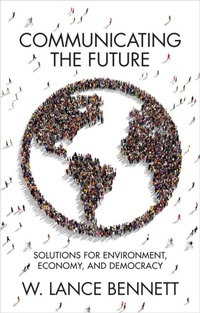
Communicating the Future
Solutions for Environment, Economy and Democracy
1st Edition
Published on 17. December 2020
Book
Hardback
192 pages
978-1-5095-4044-0 (ISBN)
Description
We are facing an unprecedented environmental crisis. How can we communicate and act more effectively to make the political and economic changes required to survive within the life support capacities of our planet?
This is the question at the heart of scholar W. Lance Bennett's much-anticipated book. In lively prose, Bennett challenges readers to consider how best to approach the environmental crisis by changing how we think about the relationships between environment, economy and democracy. He introduces a framework that citizens, practitioners and scholars can use to evaluate common but unproductive communication that blocks thinking about change; develop more effective ways to define and approach problems; and design communication processes to engage diverse publics and organizations in developing understandings, goals, and political strategies. Until advocates develop economic programs with built-in environmental solutions, they will continue to lose policy fights. Putting "intersectional" communication into action requires acknowledging that communication is not only an exchange of messages, but an organizational process.
Communicating the Future is important reading for students and scholars of media and communication, as well as general readers concerned about the environmental crisis.
This is the question at the heart of scholar W. Lance Bennett's much-anticipated book. In lively prose, Bennett challenges readers to consider how best to approach the environmental crisis by changing how we think about the relationships between environment, economy and democracy. He introduces a framework that citizens, practitioners and scholars can use to evaluate common but unproductive communication that blocks thinking about change; develop more effective ways to define and approach problems; and design communication processes to engage diverse publics and organizations in developing understandings, goals, and political strategies. Until advocates develop economic programs with built-in environmental solutions, they will continue to lose policy fights. Putting "intersectional" communication into action requires acknowledging that communication is not only an exchange of messages, but an organizational process.
Communicating the Future is important reading for students and scholars of media and communication, as well as general readers concerned about the environmental crisis.
Reviews / Votes
In these turbulent times, when we are all struggling to imagine a new normal, Lance Bennett provides a compelling, provocative, and highly readable vision for constructing a new social reality. His approach is grounded in communication. To act more effectively on our many environmental crises, Bennet argues we need to start thinking and communicating differently, focusing on the intersections among global and local environmental, economic, and political dynamics. Through a well-documented and engaging analysis of the spread of ideas that challenge leading societal paradigms, such as the rise of neoliberalism, Bennett develops the "idea flow model" of political communication. He masterfully demonstrates how "communication is most powerful when ideas are produced and packaged so that they can travel over different social networks and flow into popular narratives about who we are and how we want to live." This is an important and timely book. Communicating for the Future makes a significant contribution to our theoretical understanding of communication, networks, organization, and social change and simultaneously provides a thought-provoking, hopeful, and practical strategic guide for creating a more viable future.Cynthia Stohl, University of California, Santa Barbara
"In these turbulent times, when we are all struggling to imagine a new normal, Lance Bennett provides a compelling, provocative, and highly readable vision for constructing a new social reality. His approach is grounded in communication. To act more effectively on our many environmental crises, Bennet argues we need to start thinking and communicating differently, focusing on the intersections among global and local environmental, economic, and political dynamics. Through a well-documented and engaging analysis of the spread of ideas that challenge leading societal paradigms, such as the rise of neoliberalism, Bennett develops the 'idea flow model' of political communication. He masterfully demonstrates how 'communication is most powerful when ideas are produced and packaged so that they can travel over different social networks and flow into popular narratives about who we are and how we want to live.' This is an important and timely book. Communicating for the Future makes a significant contribution to our theoretical understanding of communication, networks, organization, and social change and simultaneously provides a thought-provoking, hopeful, and practical strategic guide for creating a more viable future."
Cynthia Stohl, University of California, Santa Barbara
More details
Other editions
Additional editions
Book
12/2020
1st Edition
Polity Press
€19.00
Shipment within 15-20 days
E-Book
12/2020
1st Edition
Wiley
€15.99
Available for download
E-Book
12/2020
1st Edition
Polity Press
€15.99
Available for download