

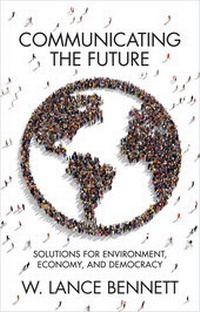
Communicating the Future
Solutions for Environment, Economy and Democracy
1st Edition
Published on 3. December 2020
192 pages
978-1-5095-4584-1 (ISBN)
Description

We are facing an unprecedented environmental crisis. How can we communicate and act more effectively to make the political and economic changes required to survive and even thrive within the life-support capacities of our planet?
This is the question at the heart of W. Lance Bennett's much-anticipated book. Bennett challenges readers to consider how best to approach the environmental crisis by changing how we think about the relationships between environment, economy, and democracy. He introduces a framework that citizens, practitioners, and scholars can use to evaluate common but unproductive communication that blocks thinking about change; develop more effective ways to define and approach problems; and design communication processes to engage diverse publics and organizations in developing understandings, goals, and political strategies. Until advocates develop economic programs with built-in environmental solutions, they will continue to lose policy fights. Putting "intersectional" communication into action requires acknowledging that communication is not only an exchange of messages, but an organizational process.
Communicating the Future is important reading for students and scholars of media and communication, as well as general readers concerned about the environmental crisis.
This is the question at the heart of W. Lance Bennett's much-anticipated book. Bennett challenges readers to consider how best to approach the environmental crisis by changing how we think about the relationships between environment, economy, and democracy. He introduces a framework that citizens, practitioners, and scholars can use to evaluate common but unproductive communication that blocks thinking about change; develop more effective ways to define and approach problems; and design communication processes to engage diverse publics and organizations in developing understandings, goals, and political strategies. Until advocates develop economic programs with built-in environmental solutions, they will continue to lose policy fights. Putting "intersectional" communication into action requires acknowledging that communication is not only an exchange of messages, but an organizational process.
Communicating the Future is important reading for students and scholars of media and communication, as well as general readers concerned about the environmental crisis.
More details
Other editions
Additional editions
Book
12/2020
1st Edition
Polity Press
€19.00
Shipment within 15-20 days
Book
12/2020
1st Edition
Polity Press
€56.00
Shipment within 15-20 days
Person
W. Lance Bennett is Emeritus Professor of Political Science and Communication, and Senior Research Fellow at the Center for Journalism, Media and Democracy at the University of Washington.
Content
- Cover
- Title page
- Copyright page
- Contents
- Acknowledgments
- Introduction: The Future is Now
- Overview of the Book
- 1 Communicating Complex Problems
- Language vs. Reality: Avoiding Solutions that Perpetuate Problems
- Life in an Age of Magical Thinking
- How Everyday Communication Logic Affects Thinking About Change
- Recognize That the Future Starts Now
- Be Careful with Categories
- Learn to Think at the Intersection of Categories
- Avoid Backwards Thinking that Gets Us Working the Wrong Ends of Problems
- Notice How Facts and Values Are Used Selectively to Support Each Other
- Think Critically about "Being Realistic"
- Using Communication Logics to Decode Everyday Communication
- Why So Much Everyday Communication Is Unhelpful
- Imagining a Different World
- The Politics Problem
- The Idea-Flow Framework
- Idea Production
- Packaging Ideas
- Networking Ideas
- Political Uptake
- 2 What's Missing in Environmental Communication?
- Why Ideas Matter
- The Fragmentation of Ideas in the Modern Environmental Movement
- Competing Sources of Idea Production
- Better Packaging for Alarms than Solutions
- The Weak Networking of Environmental Ideas
- The Limited Political Uptake of Real Solutions
- The Pitfalls of Sustainable Development
- 3 Economy vs. Environment: Selling Predatory Economics
- The Idea of Endless Growth
- The Rise of Neoliberal Free-Market Mania
- The Production of Neoliberal Ideas
- Packaging Neoliberalism
- Networking Neoliberalism
- Political Uptake
- The Problem of Post-Democracy
- 4 Democracy with a Future: Mobilizing Ideas and Opportunities for Change
- The Political Future at a Crossroads
- Some Political Lessons from the Rise of Neoliberalism
- Lesson 1: The Coordinated Production of Alternative Ideas
- Lesson 2: Packaging Ideas for Change
- Lesson 3: Networking the Spread of Ideas
- Lesson 4: Political Uptake and Institutional Embedding of Ideas and Values
- Lesson 5: Taking Advantage of Political Opportunities
- Seizing Opportunities for Change
- 5 Communicating Change: Attention, Amplification, and Organization
- Making Sure the Contents Suit the Packaging
- Shifting Attention to (Simpler) Ideas about Economic Change
- Setting the Stage for Change: A Mindset for Developing Better Ideas
- How Change Happens: Power, People, and Government
- A Place to Start: What's the Economy For?
- Making the Idea-Flow Model Work
- Improving Idea Production
- Idea Packaging
- Networking Ideas for Change
- Political Uptake
- Conclusion
- Notes
- Introduction: The Future is Now
- 1 Communicating Complex Problems
- 2 What's Missing in Environmental Communication?
- 3 Economy vs. Environment: Selling Predatory Economics
- 4 Democracy with a Future: Mobilizing Ideas and Opportunities for Change
- 5 Communicating Change: Attention, Amplification, and Organization
- Index
- EULA
