

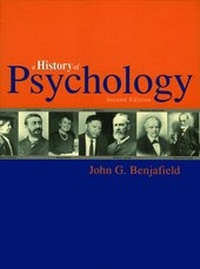
A History of Psychology
2nd Edition
Published in November 2004
Book
Hardback
392 pages
978-0-19-541930-6 (ISBN)
Description
"A History of Psychology" teaches the history of psychology by presenting the ideas of significant individuals while gradually making clear to the student the role of cultural context in shaping the ideas that become dominant at a particular time.
More details
Edition
2nd Revised edition
Language
English
Place of publication
Canada
Target group
College/higher education
Edition type
Revised edition
Illustrations
num. fig.
numerous line figures
Dimensions
Height: 226 mm
Width: 178 mm
ISBN-13
978-0-19-541930-6 (9780195419306)
Copyright in bibliographic data and cover images is held by Nielsen Book Services Limited or by the publishers or by their respective licensors: all rights reserved.
Schweitzer Classification
Other editions
New editions
John G. Benjafield
A History of Psychology
Book
11/2009
3rd Edition
Oxford University Press, Canada
€92.99
Article is exhausted; no reprint
Previous edition
Book
04/2003
Oxford University Press Inc
€58.27
Shipment within 15-20 days
Content
Preface to Second Edition; 1. Touchstones: The Origins of Psychological Thought; Introduction; Pythagoras (570-495 BC); Pythagorean Cosmology; The Pythagorean Opposites; Pythagorean Mathematics; Plato (427-347 BC); Pythagoras, Plato, and the Problem of the Irrational; The Forms; Lao-tzu (sixth century BC); The Tension between Confucianism and Taoism; What Is Tao?; The Book of Changes; Aristotle (384-323 BC); ARistotle's Differences with Plato; The Nature of Human Action; Memory; The Scala Naturae; St Thomas Aquinas (1225-74) and the Medieval View of the Universe; Important Names, Works, and Concepts; Recommended Readings; 2. Touchstones: From Descartes to Darwin; Introduction; Rene Descartes (1596-1650); The Body as a Machine; Isaac Newton (1642-1727); The Laws of Motion; Can Newton's Laws be Generalized to Psychology?; The Nature of Colour; The British Empiricists: John Locke (1632-1704), George Berkeley (1685-1753), and David Hume (1711-1776); John Locke; George Berkeley; David Hume; James Mill (1773-1836) and John Stuart Mill (1806-1873); Mary Wollstonecraft (1759-1797); Universal Education; The Importance of Emotion; The Utopian Tradition in Psychology; Immanuel Kant (1724-1804); Kan'ts 'Second Copernican Revolution'; Can Psychology Be a Science Like Other Sciences?; Charles Darwin (1809-1882); The Voyage of the Beagle; The Development of the Theory of Evolution; Darwin and Psychology; Studying the History of Psychology; Ixion's Wheel or Jacob's Ladder?; Person or Zeitgeist?; Rediscovering the Past; Important Names, Works, and Concepts; Recommended Readings; 3 The Nineteenth-Century Transformation of Psychology; Introduction; J.F. Herbart (1776-1841); Herbart's Influence on Educational Psychology; G.T. Fechner (1801-1887); Psychophysics; Experimental Aesthetics; Hermann von Helmholtz (1821-1884); Helmholtz and the Nature of Perception; Ewald Hering (1834-1918); Christine Ladd-Franklin (1834-1930); Francis Galton(1822-1911); Hereditary Genius; Eugenics; Statistics; Memory; Herbert Spencer (1820-1903); Social Darwinism; Important Names, Works, and Concepts; Recommended Readings; 4. Wundt and His Contemporaries; Introduction; Wilhelm Wundt (1832-1920); Investigations in the Laboratory; Psychophysical Parallelism; Cultural Psychology; Wundt's Influence; Hermann Ebbinghaus (1850-1909); The Experimental Study of Learning and Remembering; Mary Whiton Calkins (1863-1930) and the Invention of 'Paired Associates'; Franz Brentano (1838-1917); The Wurzburg School; Important Names, Works, and Concepts; Recommended Readings; 5. William James; Introduction; The Principles of Psychology; Habit; The Methods and Snares of Psychology; The Stream of Thought; The Consciousness of Self; Attention; The Emotions; Will; Other Topics; Important Names, Works, and Concepts; Recommended Readings; 6 Freud and Jung; Introduction; The Unconscious; Sigmund Freud (1856-1939); Hysteria; The Project for a Scientific Psychology; The Interpretation of Dreams; The Development of the Personality; The Structure of the Personality; Religion and Culture; Freud's Death; Freud and America; Freud's Critics within Psychoanalysis; Anna Freud (1895-1982); Karen Horney (1885-1952) and the Psychology of Women; C.G. Jung (1875-1961); Jung's Relationship with Freud; Analytical Psychology; Extraversion and Introversion; Archetypes; Balancing Opposites; The Four Functions; The Collective Unconscious and the External World; Synchronicity; Important Names, Works, and Concepts; Recommended Readings; 7. Structure or Function?; Introduction; Edward B. Titchener (1867-1927); Structuralism; Titchener's Experimental Psychology; Titchener and the Imageless Thought Controversy; Titchener and the Dimensions of Consciousness; Titchener's Influence; Functionalism; John Dewey (1859-1952); Critique of the Reflex Arc Concept; Dewey's Influence on Educational Practice; James R. Angell (1869-1949); Robert S. Woodworth (1869-1962); The S-O-R Framework; Intelligence Testing; James McKeen Cattell (1860-1944); Alfred Binet (1857-1911); Intelligence Testing in the United States Army; What Is 'Intelligence', Anyway?; Psychology in Business; Frederick W. Taylor (1856-1915); Elton Mayo (1880-1949); Comparative Psychology; Edward L. Thorndike (1874-1949); Learning as the Formation of Connections; Important Names, Works, and Concepts; Recommended Readings; 8. Behaviourism; Introduction; Ivan P. Pavlov (1849-1936); Conditioned Reflexes; Speech; Temperaments and Psychopathology; Vivisectionand Anti-vivisectionism; Vladimir M. Bekterev (1857-1827); John B. Watson (1878-1958); Psychology as the Behaviourist Views It; Watson's Psychology; Emotional, Manual, and Verbal Habits; Watson and Rosalie Rayner; Watson's Second Career in Advertising; Karl S. Lashley (1890-1958); Cortical Localization of Function; The Problem of Serial Order in Behaviour; B.F. Skinner (1904-1990); The Nature of Behaviorism; Skinner's Radical Behaviorism; The Behavior of Organisms; A Case History of Scientific Method; The 'Baby Tender'; Teaching Machines; Skinner's Utopian and Dystopian Views; Important Names, Works, and Concepts; Recommended Readings; 9. Gestait Psychology; Introduction; Max Wertheimer (1880-1943); Phi Phenomenon; The Miniumum Principle; Precursors of Gestalt Pscyhology; The Laws of Perceptual Organization; Productive Thinking; Gestalt Psychology as a Philosophy; Wolfgang Kohler (1887-1967); The Mentality of Apes; The Nature of Learning; The Concept of Isomorphism; Kurt Koffka (1886-1941); Principles of Gestalt Psychology; The Growth of the Mind; Kurt Lewin (1890-1947); The Zeigarnik Effect; Group Dynamics; Fritz Heider (1896-1988); Solomon Asch (1907-1996); Kurt Goldstein (1878-1965); Organismic Theory; The Abstract Attitude; Important Names, Works, and Concepts; Recommended Readings; 10. Research Methods; Introduction; Philosophy of Science; Logical Positivism; Operationism; Where Did Psychologist Stand?; Criticisms of Operationism; Experimental Methods; Statistical Inference; R.A. Fisher (1890-1962); Fisher's Approach to Designing Experiments; The Null Hypothesis; Correlational Methods; Charles Spearman (1863-1945); Cyril Burt (1883-1971); The Burt Scandal; Louis Leon Thurstone (1887-1955); Lee J. Cronbach (1916-2001) and 'The Two Disciplines of Scientific Psychology'; Important Names, Works, and Concepts; Recommended Readings; 11. Theories of Learning; Introduction; Ernest R. Hilgard (1904-2001); E.R. Guthrie (1886-1959); Contiguity; Repetition; Reward; One-Trial Learning; Clark L. Hull (1884-1952); The Formal Structure of Hullian Theory; The Hypothetico-Deductive Method; Postulates; Kenneth W. Spence (1907-1967); Charles E. Osgood (1916-1991); The Semantic Differential; E.C. Tolman (1886-1959); Purposive Behavior; Cognitive Maps; The Place versus Response Controversy; The Verbal Learning Tradition; Functionalism and Verbal Learning; Acquisition; Serial Learning; The Fate of Verbal Learning; D.O. Hebb (1904-1985); The Emergence of Neuroscience; The Organization of Behavior; Motivation; Experiments in Sensory Deprivation; Albert Bandura (1925--); Social Learning Theory; Behavior Modification; Reciprocal Determinism; Important Names, Works, and Concepts; Recommended Readings; 12. The Developmental Point of View; Introduction; G. Stanley Hall (1884-1924); The Theory of Recapitulation; Hall's Life and Career; Hall's Recapitualtionism; Questionnaires; Adolescence; James Mark Baldwin (1861-1934); Psychology of Mental Development; Heinz Werner (1890-1964); The Comparative Psychology of Mental Development; Uniformity versus Multiformity; Continuity versus Discontinuity; Unilinearity versus Multilinearity; Fixity versus Mobility; Microgenesis; Jean Piaget (1896-1980) and Barbel Inhelder (1913-1997); Genetic Epistemology; The Development of Intelligence; Piaget's Clinical Method; Stages in the Development of Intelligence; Piaget as a Structuralist; Wholeness; Systems of Transformations; Self-regulation; Can Development Ever End?; L.S. Vygotsky (1896-1934); Thought and Language; The Zone of Proximal Development; Erik H. Erikson (1902-1994); Lifespan Developmental Psychology; Epigenesis; The Eight Stages; Eleanor J. Gibson (1910-2002); Perceptual Learning; The Visual Cliff; Eleanor Gibson on the Future of Psychology; Important Names, Works, and Concepts; Recommended Readings; 13. Humanistic Psychology; Introduction; Existentialism; Soren Kierkegaard (1813-1855); Friedrich Nietzsche (1844-1900); Jean-Paul Sartre (1905-1980); Ludwig Binswanger (1881-1966); The Emergence of Humanistic Psychology; Rollo May (1909-1994); Abraham H. Maslow (1908-1970); The Hierarchy of Needs; The Self-actualizing Person; Peak Experiences; The Psychology of Science; Carl R. Rogers (1902-1987); Client-Centred Therapy; Eugene T. Gendlin; Encounter Groups; What Happened to Humanistic Psychology?; George A. Kelly (1905-1967); The Psychology of Personal Constructs; The Repertory Test; Research in Personal Construct Theory; Qualitative Research Methods; Important Names, Works, and Concepts; Recommended Readings; 14; Introduction; The Concept of 'Information'; Noam Chomsky (1928--); Syntactic Structures; Cartesian Linguistics; George A. Miller (1920--); The Magical Number Seven; Plans and the Structure of Behavior; Subjective Behaviorism; Giving Psychology Away; Jerome S. Bruner (1915--); The New Look in Perception; A Study of Thinking; Sir Frederick Bartlett (1886-1969); Ulric Neisser (1928--); Cognitive Psychology; James J. Gibson (1904-1979); Cognition and Reality; Herbert A. Simon (1916-2001); Spurious Correlation and the Nature of Causality; Computer Simulation; Criticisms of Computer Simulation; Important Names, Works, and Concepts; Recommended Readings; 15. The Future of Psychology; Introduction; The New History of Science; Does Psychology Have Paradigms?; Feminism and the Psychology of Women; Psychology as a Social Construction; Ludwig Wittgenstein (1889-1951); Psychological Research as a Social Construction; Psychology, Modernism, and Postmodernism; Modernism; Postmodernism; The Differentiation of Psychology; The Future of the History of Psychology; Important Names, Works, and Concepts; Recommended Readings; Bibliography; Index