

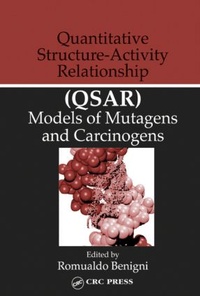
Quantitative Structure-Activity Relationship (QSAR) Models of Mutagens and Carcinogens
1st Edition
Published on 26. February 2003
Book
Hardback
304 pages
978-0-8493-1507-7 (ISBN)
Description
Applied with success in a number of areas, QSAR studies have become particularly popular in the rational design of drugs and pesticides. Much has been published on the principles of QSAR in this area, but not on their application s to toxic chemicals.
This book provides the first comprehensive, interdisciplinary presentation of QSAR studies on chemical mutagens and carcinogens. It synthesizes the body of knowledge and recent advances in this rapidly emerging field through the contributions of leading experts from around the world.
Quantitative Structure-Activity Relationship (QSAR) Models of Mutagens and Carcinogens focuses on the use of QSAR modeling in predicting and designing compounds for synthesis and testing of cancer drugs. The authors clearly show how QSAR can contribute to the elucidation of mechanisms, to identifying toxic chemicals solely by their chemical structure, and to the design of safer chemicals. The contents include a general introduction to QSAR theory and extensive reviews of virtually all existing QSAR models.
This book provides the first comprehensive, interdisciplinary presentation of QSAR studies on chemical mutagens and carcinogens. It synthesizes the body of knowledge and recent advances in this rapidly emerging field through the contributions of leading experts from around the world.
Quantitative Structure-Activity Relationship (QSAR) Models of Mutagens and Carcinogens focuses on the use of QSAR modeling in predicting and designing compounds for synthesis and testing of cancer drugs. The authors clearly show how QSAR can contribute to the elucidation of mechanisms, to identifying toxic chemicals solely by their chemical structure, and to the design of safer chemicals. The contents include a general introduction to QSAR theory and extensive reviews of virtually all existing QSAR models.
Reviews / Votes
"[T]he editor has assembled a first-rate team of contributors who are themselves active in the field ... . ... I can certainly recommend this volume on the basis of the information it contains ... . "- Journal of Medicinal Chemistry, 2004, Vol. 47, No. 21
More details
Language
English
Place of publication
Bosa Roca
United States
Publishing group
Taylor & Francis Inc
Target group
Professional and scholarly
Professional
Illustrations
43 s/w Abbildungen, 30 s/w Tabellen
30 Tables, black and white; 43 Illustrations, black and white
Dimensions
Height: 234 mm
Width: 156 mm
Weight
590 gr
ISBN-13
978-0-8493-1507-7 (9780849315077)
Copyright in bibliographic data and cover images is held by Nielsen Book Services Limited or by the publishers or by their respective licensors: all rights reserved.
Schweitzer Classification
Other editions
Additional editions
Romualdo Benigni
Quantitative Structure-Activity Relationship (QSAR) Models of Mutagens and Carcinogens
E-Book
02/2003
CRC Press
€304.99
Available for download
Romualdo Benigni
Quantitative Structure-Activity Relationship (QSAR) Models of Mutagens and Carcinogens
E-Book
02/2003
CRC Press
€304.99
Available for download
Persons
Romualdo Benigni
Editor
Instituto Superiore Di Sanita, Roma, Italy
Contributions
Consulting in Drug Design GbR, Basdorf, Germany Consulting in Drug Design GbR, Basdorf, Germany
U.S. EPA, Washington D.C., USA
Instituto Superiore di Sanita, Rome, Italy Instituto Superiore di Sanita, Rome, Italy
U.S. EPA, Research Triangle Park, North Carolina, USA
Florida Atlantic University, Boca Raton, Florida, USA
University of Minnesota, Duluth, Minnesota, USA
Liverpool John Moores University, UK
Consulting in Drug Design GbR, Basdorf, Germany Consulting in Drug Design GbR, Basdorf, Germany
U.S. EPA, Washington D.C., USA
Content
General Introduction to QSAR. Mechanisms of Action of Chemical Carcinogens and their Role in Structure-Activity Relationships (SAR) Analysis and Risk Assessment. QSARs for Individual Classes of Chemical Mutagens and Carcinogens. QSARs for the Mutagenicity and Carcinogenicity of the Aromatic Amines. SAR in the Assessment of Carcinogenesis: the Multicase Approach. Predicting Mutagenicity of Congeneric and Diverse Sets of Chemicals Using Computed Molecular Descriptors: A Hierarchical Approach. Quantitative Structure-Activity Relationships for Acute Aquatic Toxicity: The Role of Mechanisms of Toxic Action in Successful Modelling. SARs and QSARs of Mutagens and Carcinogens: Understanding Action Mechanisms and Improving Risk Assessment.