

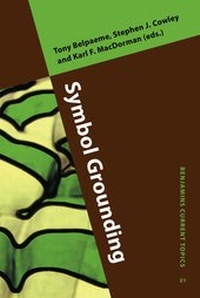
Symbol Grounding
Published on 30. November 2009
Book
Hardback
167 pages
978-90-272-2251-0 (ISBN)
Description
When explaining cognition one must explain how representations in the mind, or symbols, become meaningful by connecting to the external world. This process of connecting symbols with sensorimotor experiences is known as symbol grounding. The classical view of symbol grounding is that it is an individual process: a person or machine interacts with the environment and associates symbols with external experiences.
This volume contains views from different disciplines - ranging from psychology to robotics - on how this view can be extended by first extending symbol grounding to encompass semiotics and by showing how the classical view exaggerates the importance of written language: grounding does not necessarily involve written notations, but rather language is an external cognitive resource that allows us to acquire categories and concepts. Secondly, as symbol grounding relies on language to acquire and coordinate the process and language is a dynamical process rooted in both culture and biology, symbol grounding by extension is also sensitive to culture, emotion and embodiment.
The contributions to this volume were previously published in Interaction Studies 8:1 (2007).
This volume contains views from different disciplines - ranging from psychology to robotics - on how this view can be extended by first extending symbol grounding to encompass semiotics and by showing how the classical view exaggerates the importance of written language: grounding does not necessarily involve written notations, but rather language is an external cognitive resource that allows us to acquire categories and concepts. Secondly, as symbol grounding relies on language to acquire and coordinate the process and language is a dynamical process rooted in both culture and biology, symbol grounding by extension is also sensitive to culture, emotion and embodiment.
The contributions to this volume were previously published in Interaction Studies 8:1 (2007).
Reviews / Votes
The symbol grounding problem continues to stir lively debate among philosophers and cognitive scientists, particularly because AI researchers and roboticists have recently made very concrete proposals on how symbols can become grounded through situated language games played by embodied autonomous agents. This book is full of valuable contributions to the debate. It contains not only conceptual contributions but also new experiments as well as comparisons to child language acquisition and implications for neuroscience. -- Luc Steels, Vrije Universiteit Brussel and Sony Computer Science Lab, ParisMore details
Series
Language
English
Place of publication
Amsterdam
Netherlands
Target group
Professional and scholarly
Dimensions
Height: 245 mm
Width: 164 mm
Weight
480 gr
ISBN-13
978-90-272-2251-0 (9789027222510)
Copyright in bibliographic data and cover images is held by Nielsen Book Services Limited or by the publishers or by their respective licensors: all rights reserved.
Schweitzer Classification
Other editions
Additional editions
Tony Belpaeme | Stephen J. Cowley | Karl F. MacDorman
Symbol Grounding
E-Book
11/2009
1st Edition
John Benjamins Publishing Company
€105.99
Available for download
Persons
Content
1. Foreword (by Belpaeme, Tony); 2. Grounding symbols in the physics of speech communication (by Worgan, Simon F.); 3. Social symbol grounding and language evolution (by Vogt, Paul); 4. How many words can my robot learn? An approach and experiments with one-class learning (by Lopes, Luis Seabra); 5. How human infants deal with symbol grounding (by Cowley, Stephen J.); 6. Semiotic symbols and the missing theory of thinking (by Clowes, Robert); 7. The acquired language of thought hypothesis: A theory of symbol grounding (by Viger, Christopher); 8. Afterword: Life after the symbol system metaphor (by MacDorman, Karl F.); 9. Index