

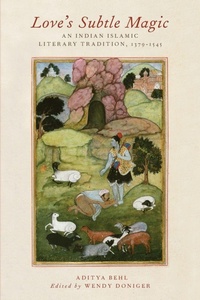
Love's Subtle Magic
An Indian Islamic Literary Tradition, 1379-1545
Published on 8. September 2016
Book
Paperback/Softback
418 pages
978-0-19-062880-2 (ISBN)
Description
The encounter between Muslim and Hindu remains one of the defining issues of South Asian society today. It began as early as the 8th century, and the first Muslim kingdom in India, the Sultanate of Delhi, was established at the end of the 12th century. This power eventually reduced to vassalage almost every independent kingdom on the subcontinent. In Love's Subtle Magic, a remarkable and highly original book, Aditya Behl uses a little-understood genre of Sufi literature to paint an entirely new picture of the evolution of Indian culture during the earliest period of Muslim domination.
These curious romantic tales transmit a profound religious message through the medium of adventurous stories of love. Although composed in the Muslim courts, they are written in a vernacular Indian language and involve Hindu yogis, Hindu princes and princesses, and Hindu gods. Until now, they have defied analysis. Behl shows that the Sufi authors of these charming tales sought to convey an Islamic vision via an Indian idiom. They thus constitute the earliest attempt at the indigenization of Islamic literature in an Indian setting. More important, however, Behl's analysis brilliantly illuminates the cosmopolitan and composite culture of the Sultanate India in which they were composed. This in turn compels us completely to rethink the standard of the opposition between Indian Hindu and foreign Muslim and recognize that the Indo-Islamic culture of this era was already significantly Indian in many important ways.
These curious romantic tales transmit a profound religious message through the medium of adventurous stories of love. Although composed in the Muslim courts, they are written in a vernacular Indian language and involve Hindu yogis, Hindu princes and princesses, and Hindu gods. Until now, they have defied analysis. Behl shows that the Sufi authors of these charming tales sought to convey an Islamic vision via an Indian idiom. They thus constitute the earliest attempt at the indigenization of Islamic literature in an Indian setting. More important, however, Behl's analysis brilliantly illuminates the cosmopolitan and composite culture of the Sultanate India in which they were composed. This in turn compels us completely to rethink the standard of the opposition between Indian Hindu and foreign Muslim and recognize that the Indo-Islamic culture of this era was already significantly Indian in many important ways.
Reviews / Votes
Doniger has edited an excellent volume constructed from lectures and drafts written by the late Behl...This volume is an indispensable guide to a long-ignored literary genre that provides glimpses into a society in which Hindus and Muslims, kings and commoners, composed a social order now divided into two hostile communities...Highly recommended. * CHOICE * Aditya Behl's magnum opus is the consummation of his long quest for the multiple meanings of four fourteenth- to sixteenth-century epic romances, Indic and Hindu in language and imagery, yet written by Muslim poets attached to Sufi orders. His magisterial and lucid analysis, graced by lovely translations and suffused by his passion for storytelling, transcends the communalized assumptions of much modern scholarship on these enigmatic poems, to persuasively reconstruct their contemporary contexts of religious, political, and gender ideologies and of courtly and esoteric performance. * Philip Lutgendorf, author of Hanuman's Tale: The Messages of a Divine Monkey * In this multi-faceted work Aditya Behl shows persuasively that the Avadhi Sufi romances not only belong to a 'regional or Hindustani literary tradition with its own poets and politics,' but also move within a 'larger Islamicate world in which stories, people, and merchandise travelled freely.' Thus the 'yogic garb of the Sufi seeker and his sensuous meeting with the divinely beautiful beloved' must be read within a Sufistically inflected 'generic logic.' Behl does an elegant job of elucidating the allegorical complexities of this logic; it is sad to realize that we will have no more such work from him. * Frances W. Pritchett, Professor of Modern Indic Languages, Columbia University * If India is an ocean of stories, its deepest currents are mysticism, its highest waves poetry. Only the most masterful of fishermen could test these waters with hope of success. Aditya Behl has done the nearly miraculous: he has given us all the catch from his wondrous, too brief, time as the supreme troller and the compleat angler of pre-modern Indian Sufi romances. Wendy Doniger has paid a tribute to his genius, putting it on display as if by an act of legerdemain in editing this long but never disappointing treasure trove of Hindustan. * Bruce Lawrence, Nancy and Jeffrey Marcus Humanities Professor of Religion, Duke University *More details
Language
English
Place of publication
New York
United States
Target group
College/higher education
Professional and scholarly
Dimensions
Height: 234 mm
Width: 156 mm
Thickness: 24 mm
Weight
705 gr
ISBN-13
978-0-19-062880-2 (9780190628802)
Copyright in bibliographic data and cover images is held by Nielsen Book Services Limited or by the publishers or by their respective licensors: all rights reserved.
Schweitzer Classification
Other editions
Additional editions
E-Book
07/2016
1st Edition
OUP eBook
€27.49
Available for download
E-Book
07/2016
1st Edition
OUP eBook
€27.49
Available for download
Book
11/2012
Oxford University Press Inc
€171.20
Shipment within 15-20 days
Persons
Aditya Behl (1966-2009) was Associate Professor of South Asian Studies at the University of Pennsylvania.
Wendy Doniger is Mircea Eliade Distinguished Service Professor of the History of Religions at the University of Chicago.
Wendy Doniger is Mircea Eliade Distinguished Service Professor of the History of Religions at the University of Chicago.
Author
formerly Associate Professor of South Asian Studies (deceased)formerly Associate Professor of South Asian Studies (deceased), University of Pennsylvania
Editor
Mircea Eliade Distinguished Service Professor of the History of ReligionsMircea Eliade Distinguished Service Professor of the History of Religions, University of Chicago
Content
Chapter 1: Studying the Sultanate Period
Chapter 2: Inaugurating Hindavi
Chapter 3: Creating a New Genre: The Candayan
Chapter 4: Oceans and Stories: The Mirigivati
Chapter 5: The Landscape of Paradise and the Embodied City: The Padmavat, Part 1
Chapter 6: The Conquest of Chittaur: The Padmavat, Part 2
Chapter 7: Bodies That Signify: The Madhumalati, Part 1
Chapter 8: The Seasons of Madhumalati's Separation: The Madhumalati, Part 2
Chapter 9: Hierarchies of Response
Epilogue: The Story of Stories
Notes
Index
Chapter 2: Inaugurating Hindavi
Chapter 3: Creating a New Genre: The Candayan
Chapter 4: Oceans and Stories: The Mirigivati
Chapter 5: The Landscape of Paradise and the Embodied City: The Padmavat, Part 1
Chapter 6: The Conquest of Chittaur: The Padmavat, Part 2
Chapter 7: Bodies That Signify: The Madhumalati, Part 1
Chapter 8: The Seasons of Madhumalati's Separation: The Madhumalati, Part 2
Chapter 9: Hierarchies of Response
Epilogue: The Story of Stories
Notes
Index