

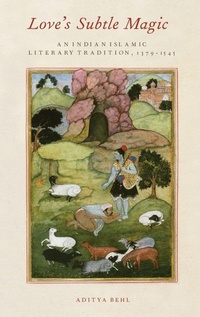
Love's Subtle Magic
An Indian Islamic Literary Tradition, 1379-1545
Published on 29. November 2012
Book
Hardback
416 pages
978-0-19-514670-7 (ISBN)
Description
The encounter between Muslim and Hindu remains one of the defining issues of South Asian society today. This encounter began as early as the 8th century, and the first Muslim kingdom in India would be established at the end of the 12th century. This powerful kingdom, the Sultanate of Delhi, eventually reduced to vassalage almost every independent kingdom on the subcontinent. In Love's Subtle Magic, a remarkable and deeply original book, Aditya Behl uses a little-understood genre of Sufi literature to paint an entirely new picture of the evolution of Indian culture during the earliest period of Muslim domination. These curious romantic tales transmit a deeply serious religious message through the medium of lighthearted stories of love. Although composed in the Muslim courts, they are written in a vernacular Indian language. Until now, they have defied analysis, and been mostly ignored by scholars east and west. Behl shows that the Sufi authors of these charming tales purposely sought to convey an Islamic vision via an Indian idiom. They thus constitute the earliest attempt at the indigenization of Islamic literature in an Indian setting. More important, however, Behl's analysis brilliantly illuminates the cosmopolitan and composite culture of the Sultanate India in which they were composed. This in turn compels us completely to rethink the standard of the opposition between Indian Hindu and foreign Muslim and recognize that the Indo-Islamic culture of this era was already significantly Indian in many important ways.
Reviews / Votes
With its subtle readings, its steadfast rigor in contextualization, and its thorough dismissal of the sectarian binaries within which such texts have been traditionally read, the book is an illuminating, cosmopolitan, and continually insightful read and a wonderful testament to Behl's lasting place in South Asian scholarship. * Samira Sheikh, Journal of the American Oriental Society * Marvellous book. * Stephen Frederic Dale, Journal of Islamic Studies * Behls analysis of Hindavi premakhyans and the era in which they were written is breathtaking. * Janet M. Powers, Religion *More details
Language
English
Place of publication
New York
United States
Target group
College/higher education
Professional and scholarly
Students and scholars of Hinduism and Indian Literature.
Dimensions
Height: 240 mm
Width: 161 mm
Thickness: 29 mm
Weight
863 gr
ISBN-13
978-0-19-514670-7 (9780195146707)
Copyright in bibliographic data and cover images is held by Nielsen Book Services Limited or by the publishers or by their respective licensors: all rights reserved.
Schweitzer Classification
Other editions
Additional editions
Book
09/2016
Oxford University Press Inc
€78.20
Shipment within 15-20 days
E-Book
07/2016
1st Edition
OUP eBook
€27.49
Available for download
E-Book
07/2016
1st Edition
OUP eBook
€27.49
Available for download
Persons
Aditya Behl (1966-2009) was Associate Professor of South Asian Studies at the University of Pennsylvania; Wendy Doniger is Mircea Eliade Distinguished Service Professor of the History of Religions at the University of Chicago.
Author
formerly Associate Professor of South Asian Studies (deceased)formerly Associate Professor of South Asian Studies (deceased), University of Pennsylvania
Editor
Mircea Eliade Distinguished Service Professor of the History of ReligionsMircea Eliade Distinguished Service Professor of the History of Religions, University of Chicago
Content
Chapter 1: Studying the Sultanate Period ; Chapter 2: Inaugurating Hindavi ; Chapter 3: Creating a New Genre: The Candayan ; Chapter 4: Oceans and Stories: The Mirigivati ; Chapter 5: The Landscape of Paradise and the Embodied City: The Padmavat, Part 1 ; Chapter 6: The Conquest of Chittaur: The Padmavat, Part 2 ; Chapter 7: Bodies That Signify: The Madhumalati, Part 1 ; Chapter 8: The Seasons of Madhumalati's Separation: The Madhumalati, Part 2 ; Chapter 9: Hierarchies of Response ; Epilogue: The Story of Stories ; Notes ; Index