

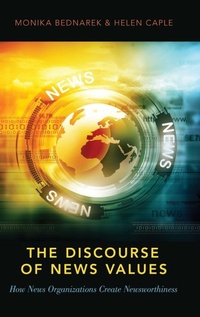
The Discourse of News Values
How News Organizations Create Newsworthiness
Published on 27. April 2017
Book
Hardback
322 pages
978-0-19-065393-4 (ISBN)
Description
The Discourse of News Values breaks new ground in multimodal news discourse, offering the first book-length treatment of the discursive analysis of news values and the construction of newsworthiness. The book explores how the news is "sold" (made newsworthy) to audiences through the semiotic resources of language and image, providing a new analytical framework which can be used by other researchers in their own subsequent studies. It combines in-depth theoretical discussion with analyses of authentic news discourse (both language and images) from around the English-speaking world, including three empirical case studies: one that analyzes news values around the topic of cycling across different English-speaking cultures; one that analyzes images disseminated by news media organizations via Facebook; and a third that focuses on the 100 "most shared" news items.
Reviews / Votes
"Clearly written, rich in examples, and meticulous in its scholarship, this book introduces state of the art methods of news research and extends the linguistic analysis of news and news values to visual and digital news. It will be essential reading for students and researchers in media studies and discourse analysis alike."--Theo van Leeuwen, Emeritus Professor, University of Technology Sydney"Continuing a large multidisciplinary research project on news discourse, Monika Bednarek and Helen Caple's present study applies a unique combination of discourse analysis, semiotics, multimodal analysis and corpus linguistics in the study of news values. Both in theoretical and in practical analytical terms, and with concrete case studies, also of social media, they thus offer explicit and systematic insight into the criteria that define what is news. Their
book also offers an excellent methodological introduction, for students of language, discourse and communication, into advanced methods of corpus-assisted multimodal analysis of the discourse and images
of the news."--Teun A. van Dijk, Professor of Discourse Studies, Pompeu Fabra University, Barcelona
"This is a timely, well-referenced and well-written book which fills a gap in the literature. The approach taken is up to date in terms of methods used, and covers a wide range of news media types from around the globe. The authors have picked interesting case studies and have an engaging writing style. It offers a significant original contribution."--Paul Baker, Professor of Linguistics, Lancaster University
"In their timely, groundbreaking paperback, Bednarek (University of Sydney) and Caple (Australian Research Council DECRA Fellow) provide in-depth research into the ways the news media industry creates newsworthiness and value through text and imagery. Through excellent interdisciplinary empirical research and their unique analytical model DNVA (discursive news value analysis), the authors challenge traditional assumptions about news value and the ways media
organizations and their representatives market contemporary events by giving them newsworthiness and economic value through the creative interplay of language and imagery...Oriented to researchers and
professional readers with expertise or specialty in areas such as linguistics, critical discourse, semiotics, communications, and journalism and media studies, the book is both thought provoking and a significant contribution to various fields of study." --.R. Kahn, University of Cincinnati, Choice
"Overall, this book breaks new ground and makes an original contribution to the
field by offering (a) a new theoretical approach to the study of discursive construction
of news values, (b) a comprehensive analytical framework for linguistic and visual
analysis of news values, and (c) a range of corpus techniques and tools that can generate
well-grounded findings. The approach and findings also bear pedagogical implications
by informing the teaching and learning of journalistic semiotic practices. Hence,
this well-organized and clearly written monograph is recommended for both emerging
and established researchers who are engaged in discourse analysis, multimodal analysis,
and corpus linguistics, as well as for journalism educators." --Journalism & Mass Communication Quarterly
More details
Language
English
Place of publication
New York
United States
Target group
College/higher education
Dimensions
Height: 240 mm
Width: 161 mm
Thickness: 22 mm
Weight
649 gr
ISBN-13
978-0-19-065393-4 (9780190653934)
Copyright in bibliographic data and cover images is held by Nielsen Book Services Limited or by the publishers or by their respective licensors: all rights reserved.
Schweitzer Classification
Other editions
Additional editions
Monika Bednarek | Helen Caple
The Discourse of News Values
How News Organizations Create Newsworthiness
Book
05/2017
Oxford University Press Inc
€74.60
Shipment within 15-20 days
Monika Bednarek | Helen Caple
The Discourse of News Values
How News Organizations Create Newsworthiness
E-Book
02/2017
1st Edition
OUP eBook
€34.99
Available for download
Monika Bednarek | Helen Caple
The Discourse of News Values
How News Organizations Create Newsworthiness
E-Book
02/2017
1st Edition
OUP eBook
€34.99
Available for download
Persons
Monika Bednarek is Senior Lecturer in Linguistics at the University of Sydney, Australia. In recent years, she was a Visiting Fellow at the Reuters Institute for the Study of Journalism at the University of Oxford (2013) and a FRIAS Senior Fellow/Marie Curie Fellow of the European Union at the Freiburg Institute of Advanced Studies, Germany (2015-2016). She has published widely in media linguistics and corpus linguistics.
Helen Caple is a Senior Lecturer in Journalism and an ARC DECRA Fellow at the University of New South Wales, Australia. Her research interests centre on news photography, text-image relations and the construction of news values in images. She is currently exploring the role of citizen photography in contemporary journalism, and has published widely in the area of photojournalism and social semiotics.
Helen Caple is a Senior Lecturer in Journalism and an ARC DECRA Fellow at the University of New South Wales, Australia. Her research interests centre on news photography, text-image relations and the construction of news values in images. She is currently exploring the role of citizen photography in contemporary journalism, and has published widely in the area of photojournalism and social semiotics.
Content
Table of contents
List of tables
List of figures
Acknowledgements
Chapter 1: Introduction
1. The discourse of news values
2. Why study news values?
3. Key terms
4. Corpus assisted multimodal discourse analysis (CAMDA)
5. Summary and overview of chapters
PART I Theory
Chapter 2: News values
1. Journalism/Communications Studies
2. Linguistics
3. A new approach to news values
Chapter 3: Discursive news values analysis (DNVA)
1. The discursive construction of news values
2. Our list and labels
3. Conceptualising news values
4. Context-dependency, preferred meaning and the target audience
5. Example analysis and concluding remarks
PART II Analytical Frameworks
Chapter 4: Language and news values
1. Introduction
2. Towards an inventory of linguistic resources
3. Combining news values and example analysis
4. Summary
Chapter 5: Visuals and news values
1. Introduction
2. The relationship between images and news values
3. Visual resources in images
4. Other semiotic resources constructing news value
5. Front page news: An example analysis
6. Concluding remarks
PART III Empirical Analysis
Chapter 6: What is newsworthy about cyclists?
1. Introduction
2. The corpus
3. Analysis of 'typical' news values
4. Analysis of news values around cyclists
5. Summary and conclusion
Chapter 7: Image, news values and Facebook
1. Introduction
2. Social media and news feeds
3. Data and methodology
4. Results
5. Conclusion
Chapter 8: 'All the news that's fit to share': News values in 'most shared' news
1. Introduction
2. Data and methodology
3. Verbal patterns
4. Visual patterns
5. Visual-verbal patterns
6. Conclusion
PART IV Extensions
Chapter 9: DNVA as an opportunity for diachronic and cross-cultural research
1. Salacious Fiends and News from the Dead: Diachronic research
2. El terror yihadista, Terroralarm, terrordramat: Cross-cultural research
3. Concluding remarks
Chapter 10: Reflections
1. From little things, big things grow (Chapter 1)
2. Surveying the field: It's a jungle out there (Chapter 2)
3. Situating our own approach to news values: Which corner of the jungle do we inhabit? (Chapter 3)
4. The discourse of news values (Chapters 4 and 5)
5. Case Study 1: 'Pedaling' a critical, topic-based approach to DNVA (Chapter 6)
6. Case Study 2: DNVA and the digital disrupters of social media (Chapter 7)
7. Case Study 3: Combining DNVA and CAMDA (Chapter 8)
8. Xinwen jiazhi, arzeshe khabari, Khabari Iqdaar (Chapter 9)
9. Concluding remarks
Appendices
References
Index
List of tables
List of figures
Acknowledgements
Chapter 1: Introduction
1. The discourse of news values
2. Why study news values?
3. Key terms
4. Corpus assisted multimodal discourse analysis (CAMDA)
5. Summary and overview of chapters
PART I Theory
Chapter 2: News values
1. Journalism/Communications Studies
2. Linguistics
3. A new approach to news values
Chapter 3: Discursive news values analysis (DNVA)
1. The discursive construction of news values
2. Our list and labels
3. Conceptualising news values
4. Context-dependency, preferred meaning and the target audience
5. Example analysis and concluding remarks
PART II Analytical Frameworks
Chapter 4: Language and news values
1. Introduction
2. Towards an inventory of linguistic resources
3. Combining news values and example analysis
4. Summary
Chapter 5: Visuals and news values
1. Introduction
2. The relationship between images and news values
3. Visual resources in images
4. Other semiotic resources constructing news value
5. Front page news: An example analysis
6. Concluding remarks
PART III Empirical Analysis
Chapter 6: What is newsworthy about cyclists?
1. Introduction
2. The corpus
3. Analysis of 'typical' news values
4. Analysis of news values around cyclists
5. Summary and conclusion
Chapter 7: Image, news values and Facebook
1. Introduction
2. Social media and news feeds
3. Data and methodology
4. Results
5. Conclusion
Chapter 8: 'All the news that's fit to share': News values in 'most shared' news
1. Introduction
2. Data and methodology
3. Verbal patterns
4. Visual patterns
5. Visual-verbal patterns
6. Conclusion
PART IV Extensions
Chapter 9: DNVA as an opportunity for diachronic and cross-cultural research
1. Salacious Fiends and News from the Dead: Diachronic research
2. El terror yihadista, Terroralarm, terrordramat: Cross-cultural research
3. Concluding remarks
Chapter 10: Reflections
1. From little things, big things grow (Chapter 1)
2. Surveying the field: It's a jungle out there (Chapter 2)
3. Situating our own approach to news values: Which corner of the jungle do we inhabit? (Chapter 3)
4. The discourse of news values (Chapters 4 and 5)
5. Case Study 1: 'Pedaling' a critical, topic-based approach to DNVA (Chapter 6)
6. Case Study 2: DNVA and the digital disrupters of social media (Chapter 7)
7. Case Study 3: Combining DNVA and CAMDA (Chapter 8)
8. Xinwen jiazhi, arzeshe khabari, Khabari Iqdaar (Chapter 9)
9. Concluding remarks
Appendices
References
Index