

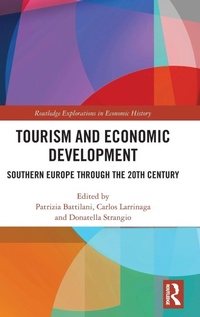
Tourism and Economic Development
Southern Europe through the 20th Century
1st Edition
Published on 30. June 2025
Book
Hardback
172 pages
978-1-032-62895-0 (ISBN)
Description
By the end of the 19th century, there were already some countries in southern Europe whose economies benefitted from the arrival of tourists. But it was during the 20th century, and particularly after the Second World War, that the phenomenon of mass tourism arrived and dramatically impacted the economies of southern Europe.
This edited volume analyses when, how, and why tourism gained an important role in the economy and social life of Southern Europe. It contributes to a reassessment of mass tourism focusing on two main dimensions: first, the impact on the economic development of the different southern European countries and second, the building of a new sociality focusing on the rituals and values of middle and the working class. This book adopts a comparative approach that opens with a comparison of European countries in terms of international market share and tourist products. The other chapters focus on national case studies that allow the reader to better understand not only the similarities and differences between some countries and others, but also the phenomenon as a whole. Since tourism is a transnational phenomenon, this book makes an important contribution to not only the study of tourism development and its economy but also social, impact in Southern Europe.
The book will be of great interest to readers of economic history, business history, tourism history, and European history more broadly.
This edited volume analyses when, how, and why tourism gained an important role in the economy and social life of Southern Europe. It contributes to a reassessment of mass tourism focusing on two main dimensions: first, the impact on the economic development of the different southern European countries and second, the building of a new sociality focusing on the rituals and values of middle and the working class. This book adopts a comparative approach that opens with a comparison of European countries in terms of international market share and tourist products. The other chapters focus on national case studies that allow the reader to better understand not only the similarities and differences between some countries and others, but also the phenomenon as a whole. Since tourism is a transnational phenomenon, this book makes an important contribution to not only the study of tourism development and its economy but also social, impact in Southern Europe.
The book will be of great interest to readers of economic history, business history, tourism history, and European history more broadly.
More details
Series
Language
English
Place of publication
London
United Kingdom
Publishing group
Taylor & Francis Ltd
Target group
College/higher education
Postgraduate
Illustrations
22 s/w Abbildungen, 6 s/w Photographien bzw. Rasterbilder, 16 s/w Zeichnungen, 22 s/w Tabellen
22 Tables, black and white; 16 Line drawings, black and white; 6 Halftones, black and white; 22 Illustrations, black and white
Dimensions
Height: 240 mm
Width: 161 mm
Thickness: 15 mm
Weight
452 gr
ISBN-13
978-1-032-62895-0 (9781032628950)
Copyright in bibliographic data and cover images is held by Nielsen Book Services Limited or by the publishers or by their respective licensors: all rights reserved.
Schweitzer Classification
Other editions
Additional editions
Patrizia Battilani | Carlos Larrinaga | Donatella Strangio
Tourism and Economic Development
Southern Europe through the 20th Century
E-Book
06/2025
1st Edition
Routledge
€60.49
Available for download
Patrizia Battilani | Carlos Larrinaga | Donatella Strangio
Tourism and Economic Development
Southern Europe through the 20th Century
E-Book
06/2025
1st Edition
Routledge
€60.49
Available for download
Persons
Patrizia Battilani is a Full Professor in Economic History at the University of Bologna. She headed the Center for Advanced Studies in Tourism from 2018 to 2021.
Carlos Larrinaga is a Full Professor in Economic History at the University of Granada (Andalusia, Spain). His research is in the history of tourism, railways in the 19th century, and the service sector.
Donatella Strangio is a Full Professor of Economic History and Director of the Department of Methods and Models for the Economy, Territory and Finance - Sapienza University of Rome. She is currently the Rector's Delegate for Latin America for Chile and Brazil.
Carlos Larrinaga is a Full Professor in Economic History at the University of Granada (Andalusia, Spain). His research is in the history of tourism, railways in the 19th century, and the service sector.
Donatella Strangio is a Full Professor of Economic History and Director of the Department of Methods and Models for the Economy, Territory and Finance - Sapienza University of Rome. She is currently the Rector's Delegate for Latin America for Chile and Brazil.
Content
Introduction 1.The place of Southern Europe in international tourism: a global historical perspective 2. Dynamics and tensions of innovation paths in the French tourism industry in the 20th century (1890-1980) 3. Tourism in Italy during the 20th century between innovation and tradition. 4. The impact of tourism on the Spanish economy in the first third of the 20th century. 5. Tourism in Spain in the second half of the 20th century: a fundamental key for economic development 6. Sunny Adriatic: tourism development in Yugoslavia during the second half of the 20th century 7. Tourism and economic development in Portugal throughout the 20th century: theories and achievements 8. Connections and conflicts in tourism development in the second half of the 20th century: Insights from Malta. 9. Developing tourism in small island states: the case of the Republic of Cyprus Index