

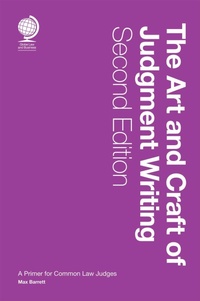
The Art and Craft of Judgment Writing
A Primer for Common Law Judges, Second Edition
2nd Edition
Published on 2. June 2025
Book
Hardback
680 pages
978-1-83723-070-9 (ISBN)
Description
In this second edition of The Art and Craft of Judgment Writing, Max Barrett, an experienced and practising judge working in Ireland, will not only enhance your judgment writing skills but elevate them to a new level of clarity, precision and style. With the first edition already used by judges around the globe, this new edition goes beyond the fundamentals to dive into cutting-edge areas of interest that today's judges need to navigate.
Subjects new to the second edition:
The use (and misuse) of artificial intelligence in judgment writing. Stay ahead of the curve as AI begins to influence legal writing.
Visual aids in judgments: learn how diagrams, graphs and infographics can make judgments more comprehensible and memorable.
Effective use of precedent: read about the challenging balance between being thorough and overwhelming your readers.
The power of storytelling: discover how narrative techniques can make your judgments clearer and more powerful.
Structured writing and editing: develop a process that ensures your judgments are well-organised and polished.
Proper use of footnotes and gender-inclusive language: enhance the professionalism and inclusivity of your work.
Collaborative judgment-writing: understand better the dynamics of working on a judgment-writing team.
With more real-world examples from case law, a 'key learnings and question' section with each chapter to help judges turn theory into practice and an entirely new exploration of what great fiction writers have taught about writing, The Art and Craft of Judgment Writing is not just a book: it's a roadmap to becoming a better writer and a more effective judge.
Subjects new to the second edition:
The use (and misuse) of artificial intelligence in judgment writing. Stay ahead of the curve as AI begins to influence legal writing.
Visual aids in judgments: learn how diagrams, graphs and infographics can make judgments more comprehensible and memorable.
Effective use of precedent: read about the challenging balance between being thorough and overwhelming your readers.
The power of storytelling: discover how narrative techniques can make your judgments clearer and more powerful.
Structured writing and editing: develop a process that ensures your judgments are well-organised and polished.
Proper use of footnotes and gender-inclusive language: enhance the professionalism and inclusivity of your work.
Collaborative judgment-writing: understand better the dynamics of working on a judgment-writing team.
With more real-world examples from case law, a 'key learnings and question' section with each chapter to help judges turn theory into practice and an entirely new exploration of what great fiction writers have taught about writing, The Art and Craft of Judgment Writing is not just a book: it's a roadmap to becoming a better writer and a more effective judge.
Reviews / Votes
The real value of this vastly expanded new edition of The Art & Craft of Judgment Writing lies in the additional practical material it contains, bringing the original volume up to date with, in particular, new sections on artificial intelligence (AI), the use of visual aids, and the use of gender-inclusive language. -- Paul MagrathMore details
Edition
2nd New edition
Language
English
Place of publication
London
United Kingdom
Target group
Professional and scholarly
Edition type
New edition
Product notice
sewn/stitched
Cloth over boards
Dimensions
Height: 236 mm
Width: 158 mm
Thickness: 41 mm
Weight
1111 gr
ISBN-13
978-1-83723-070-9 (9781837230709)
Copyright in bibliographic data and cover images is held by Nielsen Book Services Limited or by the publishers or by their respective licensors: all rights reserved.
Schweitzer Classification
Other editions
Additional editions
E-Book
05/2025
2nd Edition
Globe Law and Business
€245.99
Available for download
Previous edition
Book
04/2022
Globe Law and Business Ltd
€141.13
Article exhausted; check for reprint
Content
Preface
Foreword
Part 1: General
1. On judgments
2. Judgments: purpose and audience
3. Judgment length
4. Judgment style
5. Judgment structure
6. Dissenting and concurring judgments
7. Children, families, and immigrants
8. Ex tempore judgments
9. The judgment as the art of truth
Part 2: Some specific aspects of judgment writing
10. Writing a judgment using AI
11. The ethics of using AI
12. AI and legal research
13. Visual aids
14. Storytelling
15. Structured writing
16. Using precedents
17. Sensitive information
18. Writing long judgments
19. Judgment summaries
20. Editing
21. Footnotes
22. Collaborative judgment writing
23. Media sensitivity
24. Gender-inclusive language
25. The future of judgment writing
Part 3: Some great judges and their writing
26. Three great women judges
27. Three great American judges
28. Three great British judges
29. Some great judges from the wider world
Part 4: Some lessons from great writers
30. Barbauld
31. Besant
32. Conrad
33. Crawford
34. De Maupassant
35. De Quincey
36. Forster
37. Hardy
38. The Hawthornes
39. Hazlitt
40. Howells
41. James
42. Johnson
43. Lawrence
44. Lewes
45. Lewis
46. Matthews
47. Maugham
48. Orwell
49. Pater
50. Poe
51. Raleigh
52. Saintsbury
53. Schopenhauer
54. Spencer
55. Stevenson
56. Thompson
57. Trollope
58. Twain
59. Wharton
60. Woolf
Part 5: A judgment writing code
61. A proposed code on judgment writing
Appendix A: A Handbook on Judgment Writing
Foreword
Part 1: General
1. On judgments
2. Judgments: purpose and audience
3. Judgment length
4. Judgment style
5. Judgment structure
6. Dissenting and concurring judgments
7. Children, families, and immigrants
8. Ex tempore judgments
9. The judgment as the art of truth
Part 2: Some specific aspects of judgment writing
10. Writing a judgment using AI
11. The ethics of using AI
12. AI and legal research
13. Visual aids
14. Storytelling
15. Structured writing
16. Using precedents
17. Sensitive information
18. Writing long judgments
19. Judgment summaries
20. Editing
21. Footnotes
22. Collaborative judgment writing
23. Media sensitivity
24. Gender-inclusive language
25. The future of judgment writing
Part 3: Some great judges and their writing
26. Three great women judges
27. Three great American judges
28. Three great British judges
29. Some great judges from the wider world
Part 4: Some lessons from great writers
30. Barbauld
31. Besant
32. Conrad
33. Crawford
34. De Maupassant
35. De Quincey
36. Forster
37. Hardy
38. The Hawthornes
39. Hazlitt
40. Howells
41. James
42. Johnson
43. Lawrence
44. Lewes
45. Lewis
46. Matthews
47. Maugham
48. Orwell
49. Pater
50. Poe
51. Raleigh
52. Saintsbury
53. Schopenhauer
54. Spencer
55. Stevenson
56. Thompson
57. Trollope
58. Twain
59. Wharton
60. Woolf
Part 5: A judgment writing code
61. A proposed code on judgment writing
Appendix A: A Handbook on Judgment Writing