

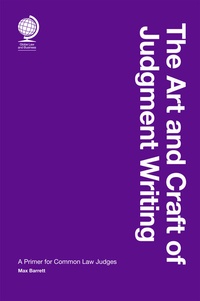
The Art and Craft of Judgment Writing
A Primer for Common Law Judges
Published on 8. April 2022
Book
Hardback
373 pages
978-1-78742-857-7 (ISBN)
Description
Judges are increasingly aware that the best way of enhancing public confidence in court systems is not only by providing a quality service but doing so compassionately and respectfully. The art and craft of judgment-writing is a critical element of this process. This book looks at the judgments of historically great judgment-writers from the US, UK and wider common law world (in particular Australia, Canada, India, Ireland, Israel and New Zealand). It is written not from the perspective of what the author can teach but with the aim of identifying essential elements of good judgment-writing in great judgments and insightful commentary.
Written by Dr Max Barrett, a judge of the High Court of Ireland, individual chapters focus on subjects such as judgment purpose, length, style and structure, concurring and dissenting judgments, judgment-writing for children and vulnerable parties, as well as more general lessons in good writing offered by great authors from Orwell to Twain. Among the lessons to be taken from great common law judges are that:
a good judgment possesses an ability to rise above immediate facts and to see a problem in its wider perspective;
a sense of empathy/sympathy for those faring badly is always important; and
there is nothing wrong with language that is occasionally flowery and ornate; however, the best judgments are crisp and persuasive.
A great author such as Mark Twain teaches, for example, that:
every element of a judgment should be necessary to that judgment and any unnecessary element excised;
any person or event included in a judgment should be included for a reason; and
a judge should always use the right word for what she wants to state, 'not its second cousin'.
This book is intended for novice superior court judges, their more seasoned colleagues and all with an interest in legal writing (including legal practitioners, law teachers and law students). Lower-court judges required to write judgments should find the book valuable; and judges at all levels should find the additional chapter on ex tempore judgments of use.
Written by Dr Max Barrett, a judge of the High Court of Ireland, individual chapters focus on subjects such as judgment purpose, length, style and structure, concurring and dissenting judgments, judgment-writing for children and vulnerable parties, as well as more general lessons in good writing offered by great authors from Orwell to Twain. Among the lessons to be taken from great common law judges are that:
a good judgment possesses an ability to rise above immediate facts and to see a problem in its wider perspective;
a sense of empathy/sympathy for those faring badly is always important; and
there is nothing wrong with language that is occasionally flowery and ornate; however, the best judgments are crisp and persuasive.
A great author such as Mark Twain teaches, for example, that:
every element of a judgment should be necessary to that judgment and any unnecessary element excised;
any person or event included in a judgment should be included for a reason; and
a judge should always use the right word for what she wants to state, 'not its second cousin'.
This book is intended for novice superior court judges, their more seasoned colleagues and all with an interest in legal writing (including legal practitioners, law teachers and law students). Lower-court judges required to write judgments should find the book valuable; and judges at all levels should find the additional chapter on ex tempore judgments of use.
Reviews / Votes
This is a marvellous book, full of wisdom and literary references. It is written by a leading Irish judge and brings with it an international flavour, featuring judgments from common law jurisdictions across the world. -- David Pickup I very much enjoyed the opportunity this book gave me for dipping in and out of a wide range of judgments across a wide span of geography and time, absorbing their literary qualities and individual styles...I found myself turning down the corners of pages so I could better find again some little quote from a judgment that I rather liked, and which had current potency or particular relevance to my field of work or areas of interest...I thought this was an excellent book and recommend it to other legal professionals, not just judges. -- Lucy Reed KCMore details
Language
English
Place of publication
London
United Kingdom
Target group
Professional and scholarly
Dimensions
Height: 240 mm
Width: 160 mm
Weight
790 gr
ISBN-13
978-1-78742-857-7 (9781787428577)
Copyright in bibliographic data and cover images is held by Nielsen Book Services Limited or by the publishers or by their respective licensors: all rights reserved.
Schweitzer Classification
Other editions
New editions
Book
06/2025
2nd Edition
Globe Law and Business Ltd
€230.50
Shipment within 3-4 weeks
Content
Preface 5
Sir Robin Jacob
University College London
Foreword 7
Mr Justice Max Barrett
Part I: The theory of the art and craft of judgment writing 13
1. On judgments 15
2. Judgments: purpose and audience 29
3. Judgment length 39
4. Judgment style 47
5. Judgment structure 79
6. Dissenting and concurring judgments 103
7. Children, families and immigrants 119
8. Authors and judges 135
Part II: The practice of the art and craft of judgment writing 151
9. Three great and pioneering women judges: Justices O'Connor, Ginsburg and Wilson 153
10. Three great American judges: Justices Holmes, Jackson and Scalia 187
11. Three great British judges: Lords Atkin, Denning and Bingham 219
12. Some great judges from the wider common law world 253
Part III: Ex tempore judgments 285
13. The art and craft of ex tempore judgments 287
Appendix: The judgment as the art of truth 303
Table of cases 309
Select bibliography 315
Index 353
About the author 371
About Globe Law and Business 373
Sir Robin Jacob
University College London
Foreword 7
Mr Justice Max Barrett
Part I: The theory of the art and craft of judgment writing 13
1. On judgments 15
2. Judgments: purpose and audience 29
3. Judgment length 39
4. Judgment style 47
5. Judgment structure 79
6. Dissenting and concurring judgments 103
7. Children, families and immigrants 119
8. Authors and judges 135
Part II: The practice of the art and craft of judgment writing 151
9. Three great and pioneering women judges: Justices O'Connor, Ginsburg and Wilson 153
10. Three great American judges: Justices Holmes, Jackson and Scalia 187
11. Three great British judges: Lords Atkin, Denning and Bingham 219
12. Some great judges from the wider common law world 253
Part III: Ex tempore judgments 285
13. The art and craft of ex tempore judgments 287
Appendix: The judgment as the art of truth 303
Table of cases 309
Select bibliography 315
Index 353
About the author 371
About Globe Law and Business 373