

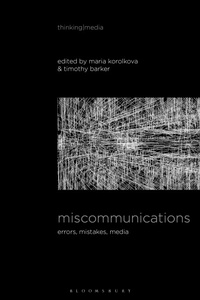
Miscommunications
Errors, Mistakes, Media
Published on 14. January 2021
Book
Hardback
344 pages
978-1-5013-6385-6 (ISBN)
Description
What happens when communication breaks down? Is it the condition for mistakes and errors that is characteristic of digital culture? And if mistakes and errors have a certain power, what stands behind it?
To address these questions, this collection assembles a range of cutting-edge philosophical, socio-political, art historical and media theoretical inquiries that address contemporary culture as a terrain of miscommunication. If the period since the industrial revolution can be thought of as marked by the realisation of the possibilities for global communication, in terms of the telephone, telegraph, television, and finally the internet, Miscommunications shows that to think about the contemporary historical moment, a new history and theory of these devices needs to be written, one which illustrates the emergence of the current cultures of miscommunication and the powers of the false.
The essays in the book chart the new conditions for discourse in the 21st century and collectively show how studies of communication can be refigured when we focus on the capacity for errors, accidents, mistakes, malfunctions and both intentional and non-intentional miscommunications.
To address these questions, this collection assembles a range of cutting-edge philosophical, socio-political, art historical and media theoretical inquiries that address contemporary culture as a terrain of miscommunication. If the period since the industrial revolution can be thought of as marked by the realisation of the possibilities for global communication, in terms of the telephone, telegraph, television, and finally the internet, Miscommunications shows that to think about the contemporary historical moment, a new history and theory of these devices needs to be written, one which illustrates the emergence of the current cultures of miscommunication and the powers of the false.
The essays in the book chart the new conditions for discourse in the 21st century and collectively show how studies of communication can be refigured when we focus on the capacity for errors, accidents, mistakes, malfunctions and both intentional and non-intentional miscommunications.
Reviews / Votes
In the so-called post-truth age it is important to critically reflect on the construction, or constructedness, of any type of communication, from human dialogues to news reporting, from fictional media forms to electronic signals, from artistic practices to computer algorithms. With respect to the current waves of fake news, new academic research about miscommunication and misinformation is not only welcome, but also urgently needed. It is especially essential to distinguish between communication and information, or even better, to rethink communication as a process of (mis)information transfer, as an action of human and non-human actors, each with their own intentions, inattentions, imperfections, material qualities, etc. In order to grasp the complexity of this topical subject, it is crucial to adopt a combined media technological, media philosophical and media historical approach. This is precisely what the volume Miscommunication: Errors, Mistakes and the Media, edited by Maria Korolkova and Timothy Barker, is offering. * Wanda Strauven, Adjunct Professor, Institute of Theater, Film and Media Studies, Goethe University, Germany * Miscommunications promises to turn media studies and media theory inside out, by taking seriously the ways in which glitches, noise, and distortion do not just interfere with the transmission of messages, but actually contribute to such messages by transforming their meanings. * Steven Shaviro, DeRoy Professor of English, Wayne State University, USA *More details
Series
Language
English
Place of publication
New York
United States
Publishing group
Bloomsbury Publishing Plc
Target group
College/higher education
Illustrations
10 bw illus
Dimensions
Height: 222 mm
Width: 145 mm
Thickness: 22 mm
Weight
565 gr
ISBN-13
978-1-5013-6385-6 (9781501363856)
Copyright in bibliographic data and cover images is held by Nielsen Book Services Limited or by the publishers or by their respective licensors: all rights reserved.
Schweitzer Classification
Other editions
Additional editions
E-Book
01/2021
1st Edition
Bloomsbury Academic USA
€35.49
Available for download
Persons
Maria Korolkova is a senior lecturer in media and film studies and academic portfolio lead in media at the University of Greenwich, UK, specialising in visual culture, intermediality, film, architecture, cultural theory, and Russian culture. In her research, Maria explores themes of miscommunication and chaos, global media, visual and sonic cultures, as well as the relationship between film and architecture. Maria has curated public events in internationally renowned institutions such as The Barbican, Courtauld Institute of Arts, Regents Street Cinema, London, Centre Pompidou, Paris, and others.
Timothy Barker is a senior lecturer in digital media and the head of Film and Television Studies at the University of Glasgow, UK. He is the author of two books, Time and the Digital (2012) and Against Transmission (Bloomsbury, 2017), both of which outline a media philosophical approach for addressing questions of time and mediation in the contemporary world. His broad research interests include digital media theory, philosophies of technology, game studies and process philosophy.
Timothy Barker is a senior lecturer in digital media and the head of Film and Television Studies at the University of Glasgow, UK. He is the author of two books, Time and the Digital (2012) and Against Transmission (Bloomsbury, 2017), both of which outline a media philosophical approach for addressing questions of time and mediation in the contemporary world. His broad research interests include digital media theory, philosophies of technology, game studies and process philosophy.
Content
INTRODUCTION: Bad Operators
Timothy Barker, University of Glasgow, UK, and Maria Korolkova, University of Greenwich, UK
PART 1: MIS-THEORIES
Chapter 1: Affirmative Imperfection Rhetoric and Aesthetics: A Genealogy
Ellen Rutten, University of Amsterdam, the Netherlands
Chapter 2: Post Communication Theory: The Non-Dialogical
Timothy Barker, University of Glasgow, UK
Chapter 3: Miscommunication and Democratic Membership
Reidar Due, University of Oxford, UK
Chapter 4: There is No 'Error' in Techo-logics: A Radically Media-Archaeological Approach
Wolfgang Ernst, Humboldt University, Berlin, Germany
PART 2: MIS-SOUNDS
Chapter 5: Quiet in the Forest
Frances Dyson, University of California, USA
Chapter 6: The Guardians of the Possible
Stephen Kennedy, University of Greenwich, UK
Chapter 7: Communicating the Incommunicable: Formalism and Noise in Michel Serres
Thomas Sutherland, University of Lincoln, UK
PART 3: MIS-MATTERS
Chapter 8: Objects Mis-taken: Towards the Aesthetics of Displaced Materiality
Maria Korolkova, University of Greenwich, UK
Chapter 9: Fai(lure): Encounter with the Unstable Medium in the Work of Art
Maryam Muliaee and Mani Mehrvarz, University at Buffalo, USA
Chapter 10: A Relational Materialist Approach to Errant Media Systems: The Case of Internet Video Producers
John Hondros, City, University of London, UK
Chapter 11: Negotiating Two Models of Truth: Satire, Miscommunication and Critique in Elle (2016)
Alex Lichtenfels, University of Salford, UK
PART 4: MIS-HAPPENINGS
Chapter 12: Disastrous Communication: Walter Benjamin's 'The Railway Disaster at the Firth of Tay'
Dominic Smith, University of Dundee, UK
Chapter 13: Accidental Recordings: Unintentional Media Aesthetics
Ella Klik, The Polonsky Academy, Israel
Chapter 14: Desert Media. Glitches, Breakdowns, and Media Arrhythmia in the Sahara
Andrea Mariani, University of Udine, Italy
PART 5: MIS-FUNCTIONS
Chapter 15: The Error at the End of the Internet
Peter Krapp, University of California, Irvine, USA
Chapter 16: From Bugs to Features: An Archaeology of Errors and/in/as Computer Games
Stefan Hoeltgen, Humboldt University, Berlin, Germany
Chapter 17: We Interrupt This Programme: On the Cultural Techniques of 'Technical Difficulties'
Joergen Rahm-Skageby, Stockholm University, Sweden
Chapter 18: Glitches as Fictional (Mis)Communication
Nele Van de Mosselaer, University of Antwerp, Belgium, and Nathan Wildman, Tilburg University, the Netherlands
Index
Timothy Barker, University of Glasgow, UK, and Maria Korolkova, University of Greenwich, UK
PART 1: MIS-THEORIES
Chapter 1: Affirmative Imperfection Rhetoric and Aesthetics: A Genealogy
Ellen Rutten, University of Amsterdam, the Netherlands
Chapter 2: Post Communication Theory: The Non-Dialogical
Timothy Barker, University of Glasgow, UK
Chapter 3: Miscommunication and Democratic Membership
Reidar Due, University of Oxford, UK
Chapter 4: There is No 'Error' in Techo-logics: A Radically Media-Archaeological Approach
Wolfgang Ernst, Humboldt University, Berlin, Germany
PART 2: MIS-SOUNDS
Chapter 5: Quiet in the Forest
Frances Dyson, University of California, USA
Chapter 6: The Guardians of the Possible
Stephen Kennedy, University of Greenwich, UK
Chapter 7: Communicating the Incommunicable: Formalism and Noise in Michel Serres
Thomas Sutherland, University of Lincoln, UK
PART 3: MIS-MATTERS
Chapter 8: Objects Mis-taken: Towards the Aesthetics of Displaced Materiality
Maria Korolkova, University of Greenwich, UK
Chapter 9: Fai(lure): Encounter with the Unstable Medium in the Work of Art
Maryam Muliaee and Mani Mehrvarz, University at Buffalo, USA
Chapter 10: A Relational Materialist Approach to Errant Media Systems: The Case of Internet Video Producers
John Hondros, City, University of London, UK
Chapter 11: Negotiating Two Models of Truth: Satire, Miscommunication and Critique in Elle (2016)
Alex Lichtenfels, University of Salford, UK
PART 4: MIS-HAPPENINGS
Chapter 12: Disastrous Communication: Walter Benjamin's 'The Railway Disaster at the Firth of Tay'
Dominic Smith, University of Dundee, UK
Chapter 13: Accidental Recordings: Unintentional Media Aesthetics
Ella Klik, The Polonsky Academy, Israel
Chapter 14: Desert Media. Glitches, Breakdowns, and Media Arrhythmia in the Sahara
Andrea Mariani, University of Udine, Italy
PART 5: MIS-FUNCTIONS
Chapter 15: The Error at the End of the Internet
Peter Krapp, University of California, Irvine, USA
Chapter 16: From Bugs to Features: An Archaeology of Errors and/in/as Computer Games
Stefan Hoeltgen, Humboldt University, Berlin, Germany
Chapter 17: We Interrupt This Programme: On the Cultural Techniques of 'Technical Difficulties'
Joergen Rahm-Skageby, Stockholm University, Sweden
Chapter 18: Glitches as Fictional (Mis)Communication
Nele Van de Mosselaer, University of Antwerp, Belgium, and Nathan Wildman, Tilburg University, the Netherlands
Index