

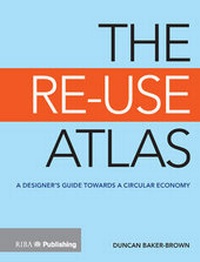
The Re-Use Atlas
A Designer's Guide Towards a Circular Economy
1st Edition
Published on 3. April 2017
Book
Paperback/Softback
192 pages
978-1-85946-644-5 (ISBN)
Description
This book is a highly illustrated
'atlas', taking the reader on a journey via four distinct 'steps'
(recycling, reuse, reduce, closed loop), from a linear
economy towards a system emulating the natural world, i.e, a circular economy. Featuring over 25 detailed case studies
describing design exemplars from the worlds of textile and fashion design, product design, interior architecture,
architecture and urban design, this book's purpose is to show designers how they
can successfully navigate and exploit the emerging field of resource management
and the circular economy.
Each step is supplemented with an in depth interview
with an expert who is successfully tackling one or more of
these challenges that present all designers today and includes contributory essays from, among others, Professor Walter Stahel of
the Product-Life Institute, and Professor Jonathan Chapman, author of Emotionally Durable Design.
'atlas', taking the reader on a journey via four distinct 'steps'
(recycling, reuse, reduce, closed loop), from a linear
economy towards a system emulating the natural world, i.e, a circular economy. Featuring over 25 detailed case studies
describing design exemplars from the worlds of textile and fashion design, product design, interior architecture,
architecture and urban design, this book's purpose is to show designers how they
can successfully navigate and exploit the emerging field of resource management
and the circular economy.
Each step is supplemented with an in depth interview
with an expert who is successfully tackling one or more of
these challenges that present all designers today and includes contributory essays from, among others, Professor Walter Stahel of
the Product-Life Institute, and Professor Jonathan Chapman, author of Emotionally Durable Design.
More details
Language
English
Place of publication
London
United Kingdom
Target group
Professional and scholarly
Product notice
Paperback (UK-A)
Dimensions
Height: 210 mm
Width: 170 mm
Weight
498 gr
ISBN-13
978-1-85946-644-5 (9781859466445)
Copyright in bibliographic data and cover images is held by Nielsen Book Services Limited or by the publishers or by their respective licensors: all rights reserved.
Schweitzer Classification
Other editions
New editions
Book
09/2024
2nd Edition
RIBA Publishing
€50.00
Shipment within 3-4 weeks
Additional editions
E-Book
07/2019
1st Edition
RIBA Publishing
€48.49
Available for download
E-Book
07/2019
1st Edition
RIBA Publishing
€48.49
Available for download
Person
Duncan Baker-Brown has taught architecture at the University of Brighton at both undergraduate, post-graduate and RIBA Part 3 levels for over 20 years. From 2011-2014 Duncan designed, coordinated and built Europe's first permanent public building made from material others had discarded, The Brighton Waste House, on campus at the College of Arts & Humanities.
Content
Foreword - Prof. Dr Walter Stahel
and Graeme Brooker
Introduction
Part 1: Setting the Waste Scene
Chapter 1: It's all about managing resources
Chapter 2. Some facts about waste
Chapter 3. What is a Circular Economy?
Chapter 4: Big Business
Part 2: Circular
Inspirations
Step 1: Reprocessing Waste
Step 2: Reusing Waste
Step 3: Reducing Waste
Step 4: Zero Waste
Part 3: The Waste House
Story
Part 4: Looking Forward
Chapter 5: Circular Speculations
Chapter 6: Emerging Narratives
Chapter 7: The Political Narrative
and Graeme Brooker
Introduction
Part 1: Setting the Waste Scene
Chapter 1: It's all about managing resources
Chapter 2. Some facts about waste
Chapter 3. What is a Circular Economy?
Chapter 4: Big Business
Part 2: Circular
Inspirations
Step 1: Reprocessing Waste
Step 2: Reusing Waste
Step 3: Reducing Waste
Step 4: Zero Waste
Part 3: The Waste House
Story
Part 4: Looking Forward
Chapter 5: Circular Speculations
Chapter 6: Emerging Narratives
Chapter 7: The Political Narrative