

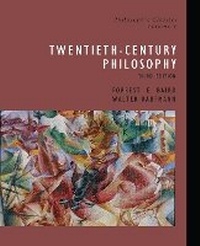
Philosophic Classics, Volume V
20th-Century Philosophy
3rd Edition
Published on 23. July 2002
Book
Paperback/Softback
460 pages
978-0-13-048563-2 (ISBN)
Description
For courses in 20th-century Philosophy, recent Continental Philosophy, Anglo-American Philosophy; as part of courses in Contemporary Philosophy; or courses on Epistemology or Metaphysics that take a historical approach.
This anthology in 20th-century philosophical classics includes recent European and American philosophers, and contains texts that are presently seen as classics or as emerging classics. It features complete works or complete sections of works. Includes introductions to each philosopher, an abundance of drawings, diagrams, photographs, and a timeline.
This anthology in 20th-century philosophical classics includes recent European and American philosophers, and contains texts that are presently seen as classics or as emerging classics. It features complete works or complete sections of works. Includes introductions to each philosopher, an abundance of drawings, diagrams, photographs, and a timeline.
Reviews / Votes
"Students with little or no background in philosophy would likely find it difficult-if not impossible-to comprehend the works of many of the philosophers addressed in [each] volume on their own. However, this text's informative introductions and careful selection of readings make it possible for students to get a foothold in their primary texts....[S]tudents are afforded the opportunity to engage with the works of these illustrious but often inscrutable thinkers." - Jennifer McMahon, Centre College"This collection is by far the best I have seen in this area....And I certainly prefer having all of my material together in one text rather than having students purchase half a dozen books, which then still require supplementation. I cannot imagine a better format or selection of materials that would tempt me away from this collection for another." - Ted Toadvine, Emporia State University
More details
Series
Edition
3rd edition
Language
English
Place of publication
New York
United States
Publishing group
Taylor & Francis Inc
Target group
Professional and scholarly
Dimensions
Height: 246 mm
Width: 174 mm
Weight
850 gr
ISBN-13
978-0-13-048563-2 (9780130485632)
Copyright in bibliographic data and cover images is held by Nielsen Book Services Limited or by the publishers or by their respective licensors: all rights reserved.
Schweitzer Classification
Other editions
Additional editions
E-Book
05/2023
3rd Edition
Routledge
€185.99
Available for download
E-Book
05/2023
3rd Edition
Routledge
€185.99
Available for download
Book
09/2018
3rd Edition
Routledge
€327.37
Shipment within 10-20 days
Previous edition
Book
01/2000
2nd Edition
Routledge
€32.24
Article exhausted; check for reprint
Person
Forrest E. Baird is Professor and Chair of Philosophy & Religion at Whitworth College, Spokane, Washington.
Content
Introduction: A Map of Twentieth-Century Philosophy by Hans Bynagle.
Edmund Husserl.
Phenomenology (from Encyclopaedia Brittanica). The Crisis of European Science and Transcendental Phenomenology (Part III, A, ?33 and ?34).
John Dewey.
The Quest for Certainty (Chapter 10).
W.E.B. Du Bois.
The Souls of Black Folks (Chapter 1).
Bertrand Russell.
The Problems of Philosophy (Chapters 1, 5, and 15). Logical Atomism.
G.E. Moore.
The Refutation of Idealism.
Martin Heidegger.
An Introduction to Metaphysics (Chapter 1). Building Dwelling Thinking.
Ludwig Wittgenstein.
Tractatus Logico-Philosophicus (in part). Philosophical Investigations (A1-47, 65-71, 241, 257-258, 305, and 309).
A.J. Ayer.
Language, Truth and Logic, (Preface and Chapter 1).
Hans-Georg Gadamer.
Truth and Method (Selections from Part II).
Jean-Paul Sartre.
Being and Nothingness (Chapter 2). Existentialism Is a Humanism.
Simone De Beauvoir.
The Second Sex (Introduction).
Willard Van Orman Quine.
Two Dogmas of Empiricism.
Maurice Merleau-Ponty.
Phenomenology of Perception (Preface).
J.L. Austin.
How to Do Things with Words (Lectures 1 and 2).
Donald Davidson.
The Method of Truth in Metaphysics.
John Rawls.
A Theory of Justice (Chapter 1, Sections 1-4).
Michel Foucault.
What Is an Author? Truth and Power.
Jacques Derrida.
Signature, Event, Context.
Richard Rorty.
Philosophy and the Mirror of Nature (Selections from Chapter 4).
The Conversation Continues: Emerging Classics Since 1980.
Luce Irigaray, The Sex Which Is Not One (Selections), Alasdair MacIntyre, After Virtue (Chapter 15), Juergen Habermas, The Philosophical Discourse of Modernity (Lecture XI, Parts II and III), Charles Taylor, Overcoming Epistemology.
Edmund Husserl.
Phenomenology (from Encyclopaedia Brittanica). The Crisis of European Science and Transcendental Phenomenology (Part III, A, ?33 and ?34).
John Dewey.
The Quest for Certainty (Chapter 10).
W.E.B. Du Bois.
The Souls of Black Folks (Chapter 1).
Bertrand Russell.
The Problems of Philosophy (Chapters 1, 5, and 15). Logical Atomism.
G.E. Moore.
The Refutation of Idealism.
Martin Heidegger.
An Introduction to Metaphysics (Chapter 1). Building Dwelling Thinking.
Ludwig Wittgenstein.
Tractatus Logico-Philosophicus (in part). Philosophical Investigations (A1-47, 65-71, 241, 257-258, 305, and 309).
A.J. Ayer.
Language, Truth and Logic, (Preface and Chapter 1).
Hans-Georg Gadamer.
Truth and Method (Selections from Part II).
Jean-Paul Sartre.
Being and Nothingness (Chapter 2). Existentialism Is a Humanism.
Simone De Beauvoir.
The Second Sex (Introduction).
Willard Van Orman Quine.
Two Dogmas of Empiricism.
Maurice Merleau-Ponty.
Phenomenology of Perception (Preface).
J.L. Austin.
How to Do Things with Words (Lectures 1 and 2).
Donald Davidson.
The Method of Truth in Metaphysics.
John Rawls.
A Theory of Justice (Chapter 1, Sections 1-4).
Michel Foucault.
What Is an Author? Truth and Power.
Jacques Derrida.
Signature, Event, Context.
Richard Rorty.
Philosophy and the Mirror of Nature (Selections from Chapter 4).
The Conversation Continues: Emerging Classics Since 1980.
Luce Irigaray, The Sex Which Is Not One (Selections), Alasdair MacIntyre, After Virtue (Chapter 15), Juergen Habermas, The Philosophical Discourse of Modernity (Lecture XI, Parts II and III), Charles Taylor, Overcoming Epistemology.