

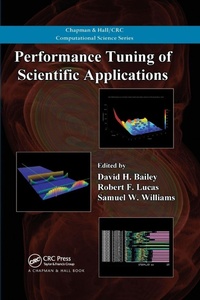
Performance Tuning of Scientific Applications
1st Edition
Published on 18. October 2019
Book
Paperback/Softback
400 pages
978-0-367-38330-5 (ISBN)
Description
With contributions from some of the most notable experts in the field, Performance Tuning of Scientific Applications presents current research in performance analysis. The book focuses on the following areas.
Performance monitoring: Describes the state of the art in hardware and software tools that are commonly used for monitoring and measuring performance and managing large quantities of data
Performance analysis: Discusses modern approaches to computer performance benchmarking and presents results that offer valuable insight into these studies
Performance modeling: Explains how researchers deduce accurate performance models from raw performance data or from other high-level characteristics of a scientific computation
Automatic performance tuning: Explores ongoing research into automatic and semi-automatic techniques for optimizing computer programs to achieve superior performance on any computer platform
Application tuning: Provides examples that show how the appropriate analysis of performance and some deft changes have resulted in extremely high performance
Performance analysis has grown into a full-fledged, sophisticated field of empirical science. Describing useful research in modern performance science and engineering, this book helps real-world users of parallel computer systems to better understand both the performance vagaries arising in scientific applications and the practical means for improving performance.
Read about the book on HPCwire and insideHPC
Performance monitoring: Describes the state of the art in hardware and software tools that are commonly used for monitoring and measuring performance and managing large quantities of data
Performance analysis: Discusses modern approaches to computer performance benchmarking and presents results that offer valuable insight into these studies
Performance modeling: Explains how researchers deduce accurate performance models from raw performance data or from other high-level characteristics of a scientific computation
Automatic performance tuning: Explores ongoing research into automatic and semi-automatic techniques for optimizing computer programs to achieve superior performance on any computer platform
Application tuning: Provides examples that show how the appropriate analysis of performance and some deft changes have resulted in extremely high performance
Performance analysis has grown into a full-fledged, sophisticated field of empirical science. Describing useful research in modern performance science and engineering, this book helps real-world users of parallel computer systems to better understand both the performance vagaries arising in scientific applications and the practical means for improving performance.
Read about the book on HPCwire and insideHPC
More details
Language
English
Place of publication
London
United Kingdom
Publishing group
Taylor & Francis Ltd
Target group
Professional and scholarly
Professional Practice & Development
Dimensions
Height: 234 mm
Width: 156 mm
Thickness: 22 mm
Weight
608 gr
ISBN-13
978-0-367-38330-5 (9780367383305)
Copyright in bibliographic data and cover images is held by Nielsen Book Services Limited or by the publishers or by their respective licensors: all rights reserved.
Schweitzer Classification
Other editions
Additional editions
David H. Bailey | Robert F. Lucas | Samuel Williams
Performance Tuning of Scientific Applications
Book
11/2010
1st Edition
CRC Press
€197.40
Shipment within 15-20 days
David H. Bailey | Robert F. Lucas | Samuel Williams
Performance Tuning of Scientific Applications
E-Book
11/2010
1st Edition
CRC Press
€86.99
Available for download
David H. Bailey | Robert F. Lucas | Samuel Williams
Performance Tuning of Scientific Applications
E-Book
11/2010
CRC Press
€86.99
Available for download
Persons
David Bailey is a chief technologist in the High Performance Computational Research Department at the Lawrence Berkeley National Laboratory. Dr. Bailey has published several books and numerous research studies on computational and experimental mathematics. He has been a recipient of the ACM Gordon Bell Prize, the IEEE Sidney Fernbach Award, and the MAA Chauvenet Prize and Merten Hasse Prize.
Robert Lucas is the director of computational sciences in the Information Sciences Institute and a research associate professor in computer science in the Viterbi School of Engineering at the University of Southern California. Dr. Lucas has many years of experience working with high-end defense, national intelligence, and energy applications and simulations. His linear solvers are the computational kernels of electrical and mechanical CAD tools.
Samuel Williams is a researcher in the Future Technologies Group at the Lawrence Berkeley National Laboratory. Dr. Williams has authored or co-authored thirty technical papers, including several award-winning papers. His research interests include high-performance computing, auto-tuning, computer architecture, performance modeling, and VLSI.
Robert Lucas is the director of computational sciences in the Information Sciences Institute and a research associate professor in computer science in the Viterbi School of Engineering at the University of Southern California. Dr. Lucas has many years of experience working with high-end defense, national intelligence, and energy applications and simulations. His linear solvers are the computational kernels of electrical and mechanical CAD tools.
Samuel Williams is a researcher in the Future Technologies Group at the Lawrence Berkeley National Laboratory. Dr. Williams has authored or co-authored thirty technical papers, including several award-winning papers. His research interests include high-performance computing, auto-tuning, computer architecture, performance modeling, and VLSI.
Content
Introduction. Parallel Computer Architecture. Software Interfaces to Hardware Counters. Measurement and Analysis of Parallel Program Performance using TAU and HPCToolkit. Trace-Based Tools. Large-Scale Numerical Simulations on High-End Computational Platforms. Performance Modeling: The Convolution Approach. Analytic Modeling for Memory Access Patterns Based on Apex-MAP. The Roofline Model. End-to-End Auto-Tuning with Active Harmony. Languages and Compilers for Auto-Tuning. Empirical Performance Tuning of Dense Linear Algebra Software. Auto-Tuning Memory-Intensive Kernels for Multicore. Flexible Tools Supporting a Scalable First-Principles MD Code. The Community Climate System Model. Tuning an Electronic Structure Code. Bibliography. Index.