

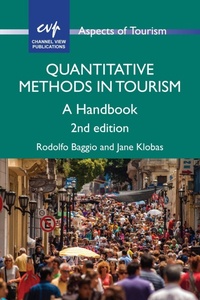
Quantitative Methods in Tourism
A Handbook
2nd Edition
Published on 6. July 2017
Book
Paperback/Softback
272 pages
978-1-84541-618-8 (ISBN)
Description
In this revised second edition, Baggio and Klobas build upon the work of their previous volume, offering a presentation of quantitative research methods for tourism researchers. This accessible and rigorous guide goes beyond the approaches usually covered in introductory textbooks on quantitative methods to consider useful techniques for statistical inquiry into tourism matters of all but the most econometrically complex kind. The first part of the book concerns common issues in statistical analysis of data and the most widely-used techniques, while the second part describes and discusses several newer and less common approaches to data analysis that are valuable for tourism researchers and analysts.
Updates to the second edition include:
* a new chapter on "Big Data"
* consideration of data screening and cleaning
* the use of similarity and diversity indexes for comparing samples
* observations about the partial least squares (PLS) approach to path modelling
* a new section on multi-group structural equation modelling
* a new section on common method variance and its treatment
* revised and updated section on software
* fully updated references and examples
Updates to the second edition include:
* a new chapter on "Big Data"
* consideration of data screening and cleaning
* the use of similarity and diversity indexes for comparing samples
* observations about the partial least squares (PLS) approach to path modelling
* a new section on multi-group structural equation modelling
* a new section on common method variance and its treatment
* revised and updated section on software
* fully updated references and examples
Reviews / Votes
New material in the second edition of this handbook includes a chapter on big data and updated coverage of agent-based modelling. Illustrated throughout with a variety of well-chosen examples pertaining to a wide range of tourism topics, this is an essential addition to the book shelves of all tourism graduate students and researchers. * Sarah Nicholls, Michigan State University, USA * With wide coverage of quantitative approaches and practical examples in tourism, this book walks readers through the essentials of quantitative methods that are required to keep pace with the fast-changing tourism industry. The book provides a thorough review of quantitative techniques and addresses pressing issues such as "Big Data", making it a must-read reference for researchers, educators, practitioners, and students. * Rob Law, The Hong Kong Polytechnic University, Hong Kong * An excellent practical guide for researchers, analysts, industry consultants and students, providing a rigorous yet readable account of standard and new quantitative statistical applications in tourism contexts. This usable reference book deserves a prominent place on every tourism scholar's bookshelf. * Larry Dwyer, University of Ljubljana, Slovenia * I highly recommend the reading of this book to all tourism researchers using quantitative methods. It offers a complete vision of all the methods that can be used, and provides important and extensive information. From a technical point of view, it is the most rigorous and reliable book in this field. -- Sylvain Petit, University of French Polynesia and University of Valenciennes, France * Tourism Analysis, Vol. 25 *More details
Series
Edition
2nd edition
Language
English
Place of publication
Bristol
United Kingdom
Publishing group
Channel View Publications Ltd
Target group
Adult education
College/higher education
Dimensions
Height: 234 mm
Width: 156 mm
Thickness: 15 mm
Weight
421 gr
ISBN-13
978-1-84541-618-8 (9781845416188)
DOI
10.21832/BAGGIO6195
Copyright in bibliographic data and cover images is held by Nielsen Book Services Limited or by the publishers or by their respective licensors: all rights reserved.
Schweitzer Classification
Other editions
Additional editions
Book
07/2017
2nd Edition
Channel View Publications
€169.30
Shipment within 10-20 days
E-Book
07/2017
2nd Edition
Channel View Publications
€24.49
Available for download
Previous edition
Book
03/2011
Channel View Publications
€57.14
Article exhausted; check for reprint
Persons
Rodolfo Baggio is Professor of the Master of Economics and Tourism at Bocconi University, Italy. His research interests focus on information technology and tourism and his current work combines complexity theory and network analysis methods to the study of tourism destinations.
Jane Klobas is an Education and Research Consultant, based in Australia and Italy. She is an Adjunct Professor at Murdoch University, Australia and a Visiting Professor at the University of Bergamo, Italy and other universities in Europe and Asia. Her interests include research development, adult learning, knowledge and information management and applications of the theory of planned behaviour.
Jane Klobas is an Education and Research Consultant, based in Australia and Italy. She is an Adjunct Professor at Murdoch University, Australia and a Visiting Professor at the University of Bergamo, Italy and other universities in Europe and Asia. Her interests include research development, adult learning, knowledge and information management and applications of the theory of planned behaviour.
Content
Foreword
Introduction to the Second Edition
Introduction
Part I - The Analysis of Data
Introduction to Part I
Chapter 1 - The Nature of Data in Tourism
Chapter 2 - Testing Hypotheses and Comparing Samples
Chapter 3 - Data Reduction
Chapter 4 - Model Building
Chapter 5 - Time Dependent Phenomena and Forecasting
Part II - Numerical Methods
Introduction to Part II
Chapter 6 - Maximum Likelihood Estimation
Chapter 7 - Monte Carlo Methods
Chapter 8 - Big Data
Chapter 9 - Simulations and Agent-Based Modelling
Appendix: Software Programs
Introduction to the Second Edition
Introduction
Part I - The Analysis of Data
Introduction to Part I
Chapter 1 - The Nature of Data in Tourism
Chapter 2 - Testing Hypotheses and Comparing Samples
Chapter 3 - Data Reduction
Chapter 4 - Model Building
Chapter 5 - Time Dependent Phenomena and Forecasting
Part II - Numerical Methods
Introduction to Part II
Chapter 6 - Maximum Likelihood Estimation
Chapter 7 - Monte Carlo Methods
Chapter 8 - Big Data
Chapter 9 - Simulations and Agent-Based Modelling
Appendix: Software Programs