

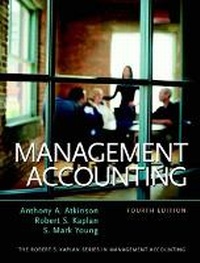
Management Accounting
International Edition
4th Edition
Published on 21. August 2003
Book
Paperback/Softback
624 pages
978-0-13-123026-2 (ISBN)
Description
For undergraduate and MBA courses in management accounting.
Each of the text authors is both a scholar and a top consultant for Fortune 500 and smaller companies. As a result, they have a unique focus: to help students better understand management accounting topics, research, and issues from the perspective of a business manager.
Each of the text authors is both a scholar and a top consultant for Fortune 500 and smaller companies. As a result, they have a unique focus: to help students better understand management accounting topics, research, and issues from the perspective of a business manager.
Reviews / Votes
"The principles contained in this book are relevant to us on a daily basis as we make decisions that impact the sales and profits of the Butterfinger candy bar franchise. We use the tools to evaluate media spending, to determine the extent to which we customize product offerings for retailers, to determine when to increase/decrease number of SKUs in the franchise, to identify significant consumer complaints with the product so as to determine corrective action, etc. This is a must read for anyone interested in growing a business." - Anne Loveland, Associate Marketing Manager, Nestle USA"The workplace has changed and so must the workforce. Accountants must now do more than keep the score-they must help make it. The creation and measurement of value is what business is about. The new edition provides the reader with the toolset to take on these new challenges. Filled with practical cases studies and examples, here's the roadmap to finance's new job requirements." - Peter A. Zampino, Director of Research, Consortium for Advanced Manufacturing International (CAM-I)
"I've used this book ...since 1995. From the outset this text has been revolutionary in its focus on creating value through innovative performance measurement and control. This theme resonates with our students who have taken financial accounting, finance and corporate strategy and understand the importance of securing competitive advantage through distinctive managerial practices." - Shannon Anderson, Rice University
More details
Edition
4th edition
Language
English
Place of publication
United States
Publishing group
Pearson Education (US)
Target group
Professional and scholarly
Dimensions
Height: 253 mm
Width: 204 mm
Thickness: 22 mm
Weight
1112 gr
ISBN-13
978-0-13-123026-2 (9780131230262)
Copyright in bibliographic data and cover images is held by Nielsen Book Services Limited or by the publishers or by their respective licensors: all rights reserved.
Schweitzer Classification
Other editions
New editions
Anthony A. Atkinson | Robert S. Kaplan | Ella Mae Matsumura
Management Accounting
Book
01/2007
5th Edition
Pearson
€61.89
Article is exhausted; no reprint
Previous edition
Book
10/2000
3rd Edition
Pearson
€49.51
Article exhausted; check for reprint
Content
1. Management Accounting: Information that Creates Value.
2. Cost Management Concepts and Cost Behavior.
3. Traditional Cost Management Systems.
4. Activity-Based Cost Management Systems.
5. Management Accounting Information for Activity and Process Decisions.
6. Cost Information for Pricing and Product Planning.
7. Management Accounting and Control Systems: Assessing Performance over the Value Chain.
8. Motivating Behavior in Management Accounting and Control Systems.
9. The Balanced Scorecard.
10. Using Budgets to Achieve Organizational Objectives.
11. Capital Budgeting.
12. Financial Control.
2. Cost Management Concepts and Cost Behavior.
3. Traditional Cost Management Systems.
4. Activity-Based Cost Management Systems.
5. Management Accounting Information for Activity and Process Decisions.
6. Cost Information for Pricing and Product Planning.
7. Management Accounting and Control Systems: Assessing Performance over the Value Chain.
8. Motivating Behavior in Management Accounting and Control Systems.
9. The Balanced Scorecard.
10. Using Budgets to Achieve Organizational Objectives.
11. Capital Budgeting.
12. Financial Control.