

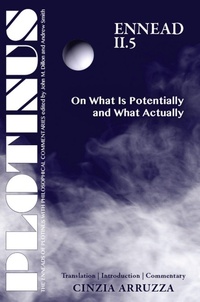
Plotinus Ennead II.5
On What Is Potentially and What Actually
Published on 30. July 2015
Book
Paperback/Softback
212 pages
978-1-930972-63-6 (ISBN)
Description
The term dunamis (potentiality) entered into the philosophical vocabulary with Plato, but it was with Aristotle that it acquired, together with energeia (actuality), the strong technical meaning that the two terms have maintained, with variations, throughout subsequent philosophical tradition.
The significance of the notions of actuality and potentiality in Plotinus' thought can hardly be overstated. Throughout the Enneads, they are crucial to understanding the specific causality of intelligible realities and the relation of participation between intelligible and sensible realms.
In Ennead II.5, Plotinus for the first time provides a systematic clarification of his peculiar use of these terms, through a sustained revision of Aristotle's own elaboration of the topic and of his terminology. The treatise discusses the different meanings of potentiality and actuality as well as the way each of them applies or does not apply to the sensible realm, to the intelligible realm, and to matter.
While the structure of the text unfolds in a coherent and cohesive manner, Plotinus' writing in this treatise is dense and at times dry in its technicality. The detailed commentary guides the reader step by step, making an otherwise particularly difficult text accessible.
The significance of the notions of actuality and potentiality in Plotinus' thought can hardly be overstated. Throughout the Enneads, they are crucial to understanding the specific causality of intelligible realities and the relation of participation between intelligible and sensible realms.
In Ennead II.5, Plotinus for the first time provides a systematic clarification of his peculiar use of these terms, through a sustained revision of Aristotle's own elaboration of the topic and of his terminology. The treatise discusses the different meanings of potentiality and actuality as well as the way each of them applies or does not apply to the sensible realm, to the intelligible realm, and to matter.
While the structure of the text unfolds in a coherent and cohesive manner, Plotinus' writing in this treatise is dense and at times dry in its technicality. The detailed commentary guides the reader step by step, making an otherwise particularly difficult text accessible.
Reviews / Votes
This text is difficult due to Plotinus' dense style. Based on the inclusion of important research in recent years, such as that of Narbonne and Kalligas, and on the author's own contributions, Cinzia Arruzza's new English translation is an improvement compared with the older ones. And her clear commentary not only sheds light upon the difficult text, but also offers innovative investigation of and answers to the controversial problems in this treatise"". - Bryn Mawr Classical ReviewMore details
Series
Language
English
Place of publication
Las Vegas
United States
Target group
Professional and scholarly
Dimensions
Height: 188 mm
Width: 127 mm
Thickness: 20 mm
Weight
272 gr
ISBN-13
978-1-930972-63-6 (9781930972636)
Copyright in bibliographic data and cover images is held by Nielsen Book Services Limited or by the publishers or by their respective licensors: all rights reserved.
Schweitzer Classification
Other editions
Additional editions
Cinzia Arruzza
PLOTINUS Ennead II.5 On What Is Potentially and What Actually
Translation, with an Introduction, and Commentary
E-Book
07/2015
Parmenides Publishing
€39.99
Available for download
Person
Cinzia Arruzza is Assistant Professor of Philosophy at the New School for Social Research, in New York City, USA. She received her Ph.D. from the University of Rome "Tor Vergata" and subsequently studied at the Universities of Fribourg (Switzerland) and Bonn (Germany). She has a special interest in ancient metaphysics and political philosophy, with a particular focus on Plato, Aristotle, Plotinus, and Patristic thought. She is the author of Les Mesaventures de la theodicee. Plotin, Origene et Gregoire de Nysse (Turnhout: Brepols Publishers, 2011).