

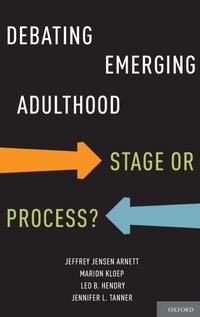
Debating Emerging Adulthood
Stage or Process?
1st Edition
Published on 3. February 2011
Book
Hardback
192 pages
978-0-19-975717-6 (ISBN)
Description
The transition from adolescence to adulthood has undergone significant changes in recent decades. Unlike a half century ago, when young people in industrialized countries moved from adolescence into young adulthood in relatively short order at around age 20, now the decade from the late teens to the late twenties is seen as an extended time of self-focused exploration and education in pursuit of optimally fulfilling relationships and careers. Recognition of this new period is stronger than ever, but an important question remains: should emerging adulthood be considered a developmental stage, or a process?
In Debating Emerging Adulthood: Stage or Process? two pairs of developmental psychologists take sides in a debate that is central to the very concept of emerging adulthood. Arnett and Tanner argue that as young people around the world share demographic similarities, such as longer education and later marriage, the years between the ages 18 and 25 are best understood as entailing a new life stage. However, because the experiences of emerging adults worldwide vary according to cultural context, educational attainment, and social class, these two scholars suggest that there may not be one but many different emerging adulthoods. An important issue for this burgeoning area of inquiry is to explore and describe this variation. In contrast, Hendry and Kloep assert that stage theories have never been able to explain individual transitions across the life course; in their view, stage theories-including the theory of emerging adulthood-ought to be abolished altogether, and explanations found for the processes and mechanisms that govern human change at any age. This engaging book maps out the argument of "stage or process" in detail, with vigorous disagreements, conflicting alternatives, and some leavening humor, ultimately even finding some common ground. Debating Emerging Adulthood is an absolute must-read for developmental psychologists as well as anyone interested in this indisputably important time of life.
In Debating Emerging Adulthood: Stage or Process? two pairs of developmental psychologists take sides in a debate that is central to the very concept of emerging adulthood. Arnett and Tanner argue that as young people around the world share demographic similarities, such as longer education and later marriage, the years between the ages 18 and 25 are best understood as entailing a new life stage. However, because the experiences of emerging adults worldwide vary according to cultural context, educational attainment, and social class, these two scholars suggest that there may not be one but many different emerging adulthoods. An important issue for this burgeoning area of inquiry is to explore and describe this variation. In contrast, Hendry and Kloep assert that stage theories have never been able to explain individual transitions across the life course; in their view, stage theories-including the theory of emerging adulthood-ought to be abolished altogether, and explanations found for the processes and mechanisms that govern human change at any age. This engaging book maps out the argument of "stage or process" in detail, with vigorous disagreements, conflicting alternatives, and some leavening humor, ultimately even finding some common ground. Debating Emerging Adulthood is an absolute must-read for developmental psychologists as well as anyone interested in this indisputably important time of life.
Reviews / Votes
"This book is a real treat as advocates of emerging adulthood as a stage, present their evidence and then invite opponents to offer an economic-cultural argument with their data. A point-counter-point exchange follows as the adversaries collaborate in lively debate. Who wins? First, the reader whose intelligence is challenged with rich material worthy of emerging adulthood's complexity. And second, our discipline which comes of age when false attacks on 'strawmen' are set aside so that a complex reality can be forthrightly considered from multiple perspectives."--James Youniss, Ph.D., Research Professor, Department of Psychology, Catholic University of
America, and co-editor of Engaging Young People in Civic Life (Vanderbilt University Press 2009)
"This multi-authored volume provides a much-needed, multi-perspective analysis of the model of emerging adulthood proposed by Jeffrey Arnett. While Arnett and Tanner present a useful description of the currently prolonged transition to adulthood, Hendry and Kloep show readers how to critically analyze Arnett's model, with an eye to discerning the limitations of that description as well as the error of the implicit prescriptions of the model regarding how young
people ought to be negotiating this prolonged transition."--James Cote, Ph.D., Professor, Department of Sociology, University of Western Ontario, Canada
"Developmental science has a long and rich history regarding the philosophical, conceptual, and theoretical issues that must be addressed in order to successfully postulate the presence of a stage of human ontogeny. Accordingly, to advance developmental theory appropriately and, as well, to adequately use theory to frame research, it is necessary to embed ideas about the nature of the developmental process within both the long-understood issues about positing
stages of development and, today, within the cutting-edge of contemporary developmental theory, that is, within developmental systems theoretical models. This book clearly shows the necessity of
continuing academic debate about the necessity for such philosophical, historical, and theoretical framing."--Richard M. Lerner, Ph.D, Bergstrom Chair in Applied Developmental Science and Director, Institute for Applied Research in Youth Development, Eliot-Pearson Department of Child Development, Tufts University
More details
Language
English
Place of publication
New York
United States
Target group
Professional and scholarly
Dimensions
Height: 240 mm
Width: 161 mm
Thickness: 15 mm
Weight
455 gr
ISBN-13
978-0-19-975717-6 (9780199757176)
Copyright in bibliographic data and cover images is held by Nielsen Book Services Limited or by the publishers or by their respective licensors: all rights reserved.
Schweitzer Classification
Other editions
Additional editions
E-Book
01/2011
1st Edition
OUP eBook
€35.49
Available for download
E-Book
12/2010
1st Edition
OUP eBook
€35.49
Available for download
Persons
Jeffrey Jensen Arnett is a Research Professor in the Department of Psychology at Clark University in Worcester, Massachusetts, USA. He is the editor of the Journal of Adolescent Research and author of the book Emerging Adulthood: The Winding Road from the Late Teens Through the Twenties, published in 2004 by Oxford University Press.
Marion Kloep is a Professor of Psychology at the University of Glamorgan, Scotland. She has conducted research projects on human development in Scandinavia, Germany, Great Britain, Turkey and Albania. For the last fifteen years, she has worked in close co-operation with Leo B. Hendry.
Leo B. Hendry is Professor of Psychology at the University of Glamorgan and Emeritus Professor at the University of Aberdeen. He has written over 150 research journal articles, 30 book chapters and 15 books, which have been published in several languages including Spanish, Italian, Japanese, Korean, Norwegian and Danish.
Jennifer L. Tanner is a Visiting
Assistant Research Professor at The Institute for Health, Health Care Policy and Aging Research at Rutgers University, USA. Dr. Tanner has contributed theoretical work on emerging adulthood, specifically the theory of recentering, and has contributed empirical research on pathways of mental health problems through emerging adulthood and beyond.
Marion Kloep is a Professor of Psychology at the University of Glamorgan, Scotland. She has conducted research projects on human development in Scandinavia, Germany, Great Britain, Turkey and Albania. For the last fifteen years, she has worked in close co-operation with Leo B. Hendry.
Leo B. Hendry is Professor of Psychology at the University of Glamorgan and Emeritus Professor at the University of Aberdeen. He has written over 150 research journal articles, 30 book chapters and 15 books, which have been published in several languages including Spanish, Italian, Japanese, Korean, Norwegian and Danish.
Jennifer L. Tanner is a Visiting
Assistant Research Professor at The Institute for Health, Health Care Policy and Aging Research at Rutgers University, USA. Dr. Tanner has contributed theoretical work on emerging adulthood, specifically the theory of recentering, and has contributed empirical research on pathways of mental health problems through emerging adulthood and beyond.
Content
Introduction
Chapter 1. The curtain rises: A brief overview of the book
Jeffrey J. Arnett, Leo B. Hendry, Marion Kloep, and Jennifer L. Tanner
Section I: Arguments for a stage
Chapter 2. Presenting "emerging adulthood": What makes it developmentally distinctive?
Jennifer L. Tanner and Jeffrey J. Arnett
Chapter 3. Themes and variations in emerging adulthood across social classes
Jeffrey J. Arnett and Jennifer L. Tanner
Section II: Arguments for a process
Chapter 4. A systemic approach to the transitions to adulthood
Marion Kloep and Leo B. Hendry
Chapter 5. Lifestyles in emerging adulthood: Who needs stages anyway?
Leo B. Hendry and Marion Kloep
Section III: Rejoinders
Chapter 6. Rejoinder to Chapters 2 and 3: Critical comments on Arnett's and Tanner's approach
Marion Kloep and Leo B. Hendry
Chapter 7. In defense of emerging adulthood as a life stage: Rejoinder to Kloep's & Hendry's Chapter 4 and 5
Jeffrey J. Arnett and Jennifer L. Tanner
Conclusion
Chapter 8: Bringing down the curtain
Part I: Jeffrey J. Arnett: One stage, many paths
Part II: Marion Kloep: What we can learn from polar bears: Changing a stage or staging a change?
Part III: Leo B. Hendry: "As John McEnroe used to say..."
Part IV: Jennifer L. Tanner: It's not about winning, it's how you play the game
Chapter 1. The curtain rises: A brief overview of the book
Jeffrey J. Arnett, Leo B. Hendry, Marion Kloep, and Jennifer L. Tanner
Section I: Arguments for a stage
Chapter 2. Presenting "emerging adulthood": What makes it developmentally distinctive?
Jennifer L. Tanner and Jeffrey J. Arnett
Chapter 3. Themes and variations in emerging adulthood across social classes
Jeffrey J. Arnett and Jennifer L. Tanner
Section II: Arguments for a process
Chapter 4. A systemic approach to the transitions to adulthood
Marion Kloep and Leo B. Hendry
Chapter 5. Lifestyles in emerging adulthood: Who needs stages anyway?
Leo B. Hendry and Marion Kloep
Section III: Rejoinders
Chapter 6. Rejoinder to Chapters 2 and 3: Critical comments on Arnett's and Tanner's approach
Marion Kloep and Leo B. Hendry
Chapter 7. In defense of emerging adulthood as a life stage: Rejoinder to Kloep's & Hendry's Chapter 4 and 5
Jeffrey J. Arnett and Jennifer L. Tanner
Conclusion
Chapter 8: Bringing down the curtain
Part I: Jeffrey J. Arnett: One stage, many paths
Part II: Marion Kloep: What we can learn from polar bears: Changing a stage or staging a change?
Part III: Leo B. Hendry: "As John McEnroe used to say..."
Part IV: Jennifer L. Tanner: It's not about winning, it's how you play the game