

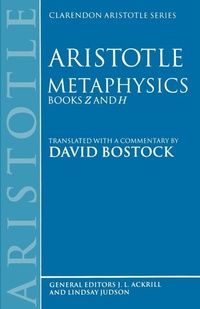
Metaphysics Books Z and H
Books Z and H
Published on 28. April 1994
Book
Paperback/Softback
314 pages
978-0-19-823947-5 (ISBN)
Description
The books translated in this volume are seventh and eighth in the traditional ordering of Aristotle's Metaphysics. They are central to Aristotle's metaphysical system: in them he discusses the nature of perceptible 'substance' or reality. In particular, he compares the claims of matter and of form to be the basic reality of things, and he frequently contrasts his own view of form with the Platonic view. Several other topics are treated which are of central importance to his metaphysics, e.g. the notions of essence and definition, the status of universals, and the concept of a unity.
David Bostock provides an authoritative guide to these difficult and important books, assuming no knowledge of Greek on the part of the reader. He offers a clear new translation that follows the original closely, and a thorough and careful philosophical commentary.
David Bostock provides an authoritative guide to these difficult and important books, assuming no knowledge of Greek on the part of the reader. He offers a clear new translation that follows the original closely, and a thorough and careful philosophical commentary.
Reviews / Votes
Bostock reads passages closely, dissects arguments skillfully, and makes astute and informed judgements. As one philosopher reading another, he demands a lot of the text and often finds the argument wanting-and with good reason. But whether one is a defender or a critic of Aristotle, one will find Bostock's commentary enlightening and stimulating...Whatever may be one's preferences in the substance debate, one may profit by consulting this close and relatively undogmatic reading of Books Z and H./Daniel W.Graham/"Ancient Philosophy". There is a great deal to applaud in the volume. The translation is splendidly faithful to the Greek. It reads smoothly without lapsing into paraphrase ... Now Bostock has provided us with something much more straightforward, clearly written, packed iwth learning, and as detailed as we could wish. It is a splendid new resource for Aristotelian scholarship. * C. J. F. Williams, International Philosophical Quarterly * There is freshness in Bostock's approach to these books, and novelty in the proposed explanations of what can account for the "unexpected" that enriches the philosophical content of these works ... Bostock offers a very good translation of the text ... He also offers adequate introductions and resumes, which add cohesion, making the exposition "user friendly". The book will prove to be a valuable addition to the Zeta-Eta literature. * Times Higher Education Supplement * David Bostock has produced a translation that admirably fulfills the Clarendon Aristotle Series' goal of making Aristotle's texts accessible to the Greekless philosophical reader. It is accurate without being overly literal and is probably the best available in English. ... the translation is, on the whole, highly readable and brings out perspicuously the structure of Aristotle's arguments. The commentary offers much to the reader inexperienced in the details of Aristotle's thought. ... Particularly nice are Bostock's explanations (and defense) of the various Platonic positions Aristotle undertakes. ... Bostock does pay Aristotle the ultimate philosophical compliment of engaging seriously and in detail with his arguments, and the reader who works through the text in conjunction with the commentary will find that she has learned a good deal from Aristotle after all. * The Philosophical Review, vol.104, no.4, October 1995 *More details
Series
Language
English
Place of publication
Oxford
United Kingdom
Publishing group
Oxford University Press
Target group
Professional and scholarly
Dimensions
Height: 216 mm
Width: 140 mm
Thickness: 19 mm
Weight
448 gr
ISBN-13
978-0-19-823947-5 (9780198239475)
Copyright in bibliographic data and cover images is held by Nielsen Book Services Limited or by the publishers or by their respective licensors: all rights reserved.
Schweitzer Classification
Other editions
Additional editions
Persons
Aristotle (384-322 BC) was a Greek philosopher during the Classical period in Ancient Greece, the founder of the Lyceum and the Peripatetic school of philosophy and Aristotelian tradition. Along with his teacher Plato, he has been called the Father of Western Philosophy. His writings cover many subjects - including physics, biology, zoology, metaphysics, logic, ethics, aesthetics, poetry, theatre, music, rhetoric, psychology, linguistics, economics, politics and government.
Aristotle provided a complex synthesis of the various philosophies existing prior to him, and it was above all from his teachings that the West inherited its intellectual lexicon, as well as problems and methods of inquiry. As a result, his philosophy has exerted a unique influence on almost every form of knowledge in the West and it continues to be a subject of contemporary philosophical discussion.
Little is known about his life. Aristotle was born in the city of Stagira in Northern Greece. His father, Nicomachus, died when Aristotle was a child, and he was brought up by a guardian. At seventeen or eighteen years of age, he joined Plato's Academy in Athens and remained there until the age of thirty-seven (c. 347 BC). Shortly after Plato died, Aristotle left Athens and, at the request of Philip II of Macedon, tutored Alexander the Great beginning in 343 BC. He established a library in the Lyceum which helped him to produce many of his hundreds of books on papyrus scrolls. Though Aristotle wrote many elegant treatises and dialogues for publication, only around a third of his original output has survived, none of it intended for publication.