

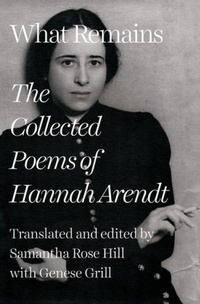
What Remains
The Collected Poems of Hannah Arendt
Published on 10. December 2024
Book
Hardback
208 pages
978-1-324-09052-6 (ISBN)
Description
Internationally renowned as one of the twentieth century's foremost public intellectuals, Hannah Arendt was also intensely private. Though she often acknowledged that the language of poetry-especially that of Dickinson, Goethe and Lowell-informed her work, only a few people knew that Arendt herself wrote poems.
In fact, between 1923 and 1961, Arendt wrote seventy-four poems, many of them signposts in an otherwise unwritten autobiography. For nearly forty years after her death, these poems remained hidden among the archives of the Library of Congress, until 2011, when they were rediscovered by scholar and translator Samantha Rose Hill. Now, for the first time in English, Hill and Genese Grill present Arendt's poems in chronological order, taking us from the zenith of the Weimar Republic to the Cold War, and from Marburg, Germany, to New York's Upper West Side.
Throughout, Arendt uses poetry to mark moments of joy, love, loss and reflection. In "W. B.," written in 1942, she remembers Walter Benjamin, who died near the French-Spanish border while attempting to flee the Nazis: "Gentle whispering melodies / Sound from the darkness. / We listen so we can let go." So, too, she reflects on mutability and transience in 1946: "I know that the houses have fallen. / We entered the world in them, wonderfully sure, that they / were more durable than ourselves." She tries to understand her place in the world: "Ironically foolish, / I've forgotten nothing, / I know the emptiness, / I know the burden, / I dance, I dance / In ironic splendor." A gift to all readers of Arendt, this stunning, dual-language edition provides an unparalleled view into the inner sanctum of one of our most original thinkers.
In fact, between 1923 and 1961, Arendt wrote seventy-four poems, many of them signposts in an otherwise unwritten autobiography. For nearly forty years after her death, these poems remained hidden among the archives of the Library of Congress, until 2011, when they were rediscovered by scholar and translator Samantha Rose Hill. Now, for the first time in English, Hill and Genese Grill present Arendt's poems in chronological order, taking us from the zenith of the Weimar Republic to the Cold War, and from Marburg, Germany, to New York's Upper West Side.
Throughout, Arendt uses poetry to mark moments of joy, love, loss and reflection. In "W. B.," written in 1942, she remembers Walter Benjamin, who died near the French-Spanish border while attempting to flee the Nazis: "Gentle whispering melodies / Sound from the darkness. / We listen so we can let go." So, too, she reflects on mutability and transience in 1946: "I know that the houses have fallen. / We entered the world in them, wonderfully sure, that they / were more durable than ourselves." She tries to understand her place in the world: "Ironically foolish, / I've forgotten nothing, / I know the emptiness, / I know the burden, / I dance, I dance / In ironic splendor." A gift to all readers of Arendt, this stunning, dual-language edition provides an unparalleled view into the inner sanctum of one of our most original thinkers.
Reviews / Votes
"...a new volume of [Arendt's] poetry reveals that the author of sobering works like The Origins of Totalitarianism and The Human Condition was writing ardent and intimate verse in her off-hours." -- Srikanth Reddy - The Paris Review "These poems construct a most personal, subtle, and affecting autobiography. They are intense, emotional and yet do not yield to our voyeuristic nature. Together these poems offer what the best impressionistic painters offered, a concentration on the underlying constituent parts of reality and a retention of intimacy." -- Percival Everett "Hannah Arendt's poems bear out her belief that poetry itself is a kind of thinking. Aphoristic, intuitive, and often surprising in their immediacy, they will interest every reader of her major work. 'Poetic language,' she wrote, 'is a place, not a refuge.' These poems-finely translated and with conscientious notes by Samantha Rose Hill-allow us to enter a place that resembles no other." -- David Bromwich "Hannah Arendt never stopped thinking deep and hard whatever new realities she faced: exile, totalitarianism, grief, love. These poems show her wresting her innermost thoughts into form. They are a revelation. Beautifully translated and 'thought' by Samantha Rose Hill and Genese Grill, What Remains is an essential addition to our understanding of this complex, fearless, and ever more relevant writer." -- Lyndsey StonebridgeMore details
Language
English
Place of publication
New York
United States
Illustrations
1 illustration
Dimensions
Height: 215 mm
Width: 143 mm
Thickness: 28 mm
Weight
344 gr
ISBN-13
978-1-324-09052-6 (9781324090526)
Copyright in bibliographic data and cover images is held by Nielsen Book Services Limited or by the publishers or by their respective licensors: all rights reserved.
Schweitzer Classification
Other editions
Additional editions
Book
approx. 12/2026
Liveright Publishing Corporation
€16.50
Not yet published
E-Book
12/2024
Liveright
€24.99
Available for download
Persons
Hannah Arendt (1906-1975) was a German-born political scientist and philosopher. She is the author of The Origins of Totalitarianism, The Human Condition, and Eichmann in Jerusalem, among other books. Samantha Rose Hill is the author of Critical Lives: Hannah Arendt, and a writer and professor at the Brooklyn Institute for Social Research. Genese Grill is a translator and scholar of Germanic literature.