

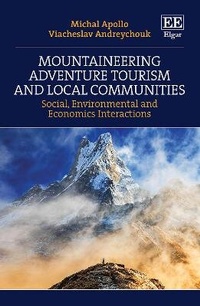
Mountaineering Adventure Tourism and Local Communities
Social, Environmental and Economics Interactions
Published on 6. September 2022
Book
Hardback
178 pages
978-1-80220-937-2 (ISBN)
Description
This timely book explores how hiking, trekking and climbing mountains, increasingly popular leisure activities, can stimulate change and create opportunities for sustainable development. Using empirical evidence from interviews held in the Himalayas combined with a theoretical grounding, it focuses on the socio-economic and environmental issues of the impact of mountaineering adventure tourism on local communities.
Chapters highlight the progressive stages of the host-guest interactions between local communities and tourists, moving from initial, indirect and final tourism development, and the unique sociocultural phenomena these create. The book examines how, with a planned and systematic approach, mountaineering can be a key factor in promoting an overall improvement in local people's quality of life through initiatives in economic development and environmental conservation. It offers a look towards the future to create sustainable tourism development in mountain regions.
This is an invigorating read for adventure tourism and human geography scholars, particularly with the blend of theory and first-hand studies of local impacts of mountain tourism. It will also be an interesting read for industry representatives, policy makers and professionals in the field.
Chapters highlight the progressive stages of the host-guest interactions between local communities and tourists, moving from initial, indirect and final tourism development, and the unique sociocultural phenomena these create. The book examines how, with a planned and systematic approach, mountaineering can be a key factor in promoting an overall improvement in local people's quality of life through initiatives in economic development and environmental conservation. It offers a look towards the future to create sustainable tourism development in mountain regions.
This is an invigorating read for adventure tourism and human geography scholars, particularly with the blend of theory and first-hand studies of local impacts of mountain tourism. It will also be an interesting read for industry representatives, policy makers and professionals in the field.
Reviews / Votes
'Michal Apollo and Viacheslav Andreychouk have embarked on an ambitious journey as they document the social, natural and economic impacts of mountaineering tourism, a rapidly evolving field. Logically well-structured, with deeper insights from the field, this remarkable book makes a convincing case of why mountains deserve a special scholarly attention.' -- Sanjay K. Nepal, University of Waterloo, Canada 'This marvellous book engages with the world's greatest mountains and how they can be judiciously developed for the benefit of their inhabitants and of tourists visiting for nature and adventure. If we can learn from the wisdom of this work, future generations will be grateful.' -- Thomas Pogge, Yale University, USMore details
Language
English
Place of publication
Cheltenham
United Kingdom
Target group
Professional and scholarly
Dimensions
Height: 234 mm
Width: 156 mm
ISBN-13
978-1-80220-937-2 (9781802209372)
Copyright in bibliographic data and cover images is held by Nielsen Book Services Limited or by the publishers or by their respective licensors: all rights reserved.
Schweitzer Classification
Persons
Michal Apollo, Assistant Professor, Institute of Earth Sciences, Faculty of Natural Sciences, University of Silesia in Katowice, Poland; Fellow, Global Justice Program, Yale University, US; Visiting Scholar, Hainan University - Arizona State University Joint International Tourism College, Haikou, China; Visiting Fellow, Center for Tourism Research, Wakayama University, Japan and Viacheslav Andreychouk, Professor, Faculty of Geography and Regional Studies, University of Warsaw, Poland
Content
Contents: Foreword Dallen J. Timothy Preface: Sustainable tourism development in mountain regions - an attempt to foresee the future 1. Mountains, humans and mountaineering adventure tourism 2. Host-guest relations: an overview 3. Transformation of the mountain environment under the influence of mountaineering tourism: diversity of the dimensions 4. Areas of study and their representativeness as mountaineering destinations 5. Methodology used for researching mountaineering tourism and its limitations 6. Characteristics of the study population and its dynamics under mountaineering tourism 7. The dynamics of the impact of mountaineering tourism 8. The progressive nature (stages) of host-guest interactions in mountaineering tourism 9. Regulation and management of mountaineering tourism in local communities 10. Management implications for mountaineering tourism and conclusions Index