

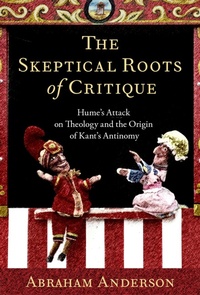
The Skeptical Roots of Critique
Hume's Attack on Theology and the Origin of Kant's Antinomy
Published on 25. March 2025
Book
Hardback
200 pages
978-0-19-768400-9 (ISBN)
Description
"It was the objection of David Hume," Kant wrote, "that first [. . .] interrupted my dogmatic slumber"; "it was the fourfold Antinomy [. . .]", he wrote later, "that first woke me from dogmatic slumber." How can Kant have been woken both by Hume and by the Antinomy? In The Skeptical Roots of Critique, Abraham Anderson solves this problem by showing that the Antinomy was inspired by Hume's skepticism, whose primary target was metaphysics and especially theology. The Critique is not the refutation of that skepticism, but "the execution of Hume's problem in its broadest possible elaboration." In showing that the Antinomy flows from Hume, this work connects Kant with the skeptical tradition, and particularly with the antitheological skepticism of Hume's master Bayle. Like Hume's Enquiry and Dialogues, the Critique is part of the battle for Enlightenment, the struggle against the "despotic" reign of theological dogmatism.
More details
Language
English
Place of publication
New York
United States
Target group
College/higher education
Product notice
sewn/stitched
Cloth over boards
Dimensions
Height: 217 mm
Width: 149 mm
Thickness: 22 mm
Weight
322 gr
ISBN-13
978-0-19-768400-9 (9780197684009)
Copyright in bibliographic data and cover images is held by Nielsen Book Services Limited or by the publishers or by their respective licensors: all rights reserved.
Schweitzer Classification
Other editions
Additional editions
Abraham Anderson
The Skeptical Roots of Critique
Hume's Attack on Theology and the Origin of Kant's Antinomy
E-Book
01/2025
OUP eBook
€85.99
Available for download
Abraham Anderson
The Skeptical Roots of Critique
Hume's Attack on Theology and the Origin of Kant's Antinomy
E-Book
01/2025
OUP eBook
€85.99
Available for download
Person
Abraham Anderson is Professor of Philosophy at Sarah Lawrence College. He held graduate fellowships at the Ecole normale superieure (rue d'Ulm) and the University of Munich. He has also taught at the University of New Mexico, the Universidad Autonoma de Mexico, St. John's College (Santa Fe) and the American University in Cairo. He is the author of The Treatise of the Three Impostors and the Problem of Enlightenment and of Kant, Hume, and the Interruption of Dogmatic Slumber.
Content
Bibliographical Note
Preface
Acknowledgments Introduction: The State of the Question
1. Awakening from Dogmatic Slumber: Sextus, Hume, and the Roots of Transcendental Idealism
2. The Impact of the Dialogues
3. Skeptical Method in the Discipline and the Antinomy: The Debt to the Dialogues
4. Rousseau, Hume, and the Dreams of a Spirit-Seer
5. The Logik Blomberg on Skeptical Method and Kant's Reading of the Enquiry
6. The Philosopher and the Common Understanding: Beattie vs. Hume, and the First Interruption of Dogmatic Slumber in the Antinomy
7. <"That impious maxim of the ancient philosophy> "
8. <"All the philosophers of antiquity, with the sole exception of the Epicurean School> ": Clarke, Bayle, and Hume on the creation of matter and the roots of the Antinomy
9. Hume and Clarke in the Beweisgrund
10. <"If, for instance, I at this moment arise from my chair> ": Clarke's Demonstration and the Antinomy
Afterword Bibliography
Index
Preface
Acknowledgments Introduction: The State of the Question
1. Awakening from Dogmatic Slumber: Sextus, Hume, and the Roots of Transcendental Idealism
2. The Impact of the Dialogues
3. Skeptical Method in the Discipline and the Antinomy: The Debt to the Dialogues
4. Rousseau, Hume, and the Dreams of a Spirit-Seer
5. The Logik Blomberg on Skeptical Method and Kant's Reading of the Enquiry
6. The Philosopher and the Common Understanding: Beattie vs. Hume, and the First Interruption of Dogmatic Slumber in the Antinomy
7. <"That impious maxim of the ancient philosophy> "
8. <"All the philosophers of antiquity, with the sole exception of the Epicurean School> ": Clarke, Bayle, and Hume on the creation of matter and the roots of the Antinomy
9. Hume and Clarke in the Beweisgrund
10. <"If, for instance, I at this moment arise from my chair> ": Clarke's Demonstration and the Antinomy
Afterword Bibliography
Index