

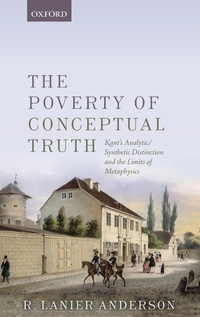
The Poverty of Conceptual Truth
Kant's Analytic/Synthetic Distinction and the Limits of Metaphysics
Published on 22. January 2015
Book
Hardback
428 pages
978-0-19-872457-5 (ISBN)
Description
The Poverty of Conceptual Truth is based on a simple idea. Kant's distinction between analytic and synthetic judgments underwrites a powerful argument against the metaphysical program of his Leibnizian-Wolffian predecessors--an argument from fundamental limits on its expressive power. In that tradition, metaphysics promised to reveal the deep rational structure of the world through a systematic philosophy consisting of strictly conceptual truths, which flow from a logically perspicuous relation of 'containment' among concepts. That is, all truths would be 'analytic,' in Kant's sense. Kant's distinction shows to the contrary that far reaching and scientifically indispensable parts of our knowledge of the world (including mathematics, the foundations of natural science, all knowledge from experience, and the central principles of metaphysics itself) are essentially synthetic and could never be restated in analytic form. Thus, the metaphysics of Kant's predecessors is doomed, because knowledge crucial to any adequate theory of the world cannot even be expressed in the idiom to which it restricts itself (and which was the basis of its claim to provide a transparently rational account of things). Traditional metaphysics founders on the expressive poverty of conceptual truth.
To establish these claims, R. Lanier Anderson shows how Kant's distinction can be given a clear basis within traditional logic, and traces Kant's long, difficult path to discovering it. Once analyticity is framed in clear logical terms, it is possible to reconstruct compelling arguments that elementary mathematics must be synthetic, and then to show how similar considerations about irreducible syntheticity animate Kant's famous arguments against traditional metaphysics in the Critique of Pure Reason.
To establish these claims, R. Lanier Anderson shows how Kant's distinction can be given a clear basis within traditional logic, and traces Kant's long, difficult path to discovering it. Once analyticity is framed in clear logical terms, it is possible to reconstruct compelling arguments that elementary mathematics must be synthetic, and then to show how similar considerations about irreducible syntheticity animate Kant's famous arguments against traditional metaphysics in the Critique of Pure Reason.
Reviews / Votes
This book is a masterpiece on Kant's theory of analyticity. It culminates in a new story of how Kant arrived at his mature view... With thirteen chapters and three substantial appendixes, the book is remarkably rich in content. Most impressively, Anderson weaves all the complex interpretive and philosophical issues together in such a masterful way that the big picture is always clearly in sight and the reader is constantly enticed to read on. A supremely edifying read indeed. * Journal of the History of Philosophy * ... I want to emphasize that this is an extraordinarily rich book, and I've been able to discuss only a few central aspects of it. It is also clearly and engagingly written ... I highly recommend the book, not only to Kant scholars but also to those interested in the history of the analytic/synthetic distinction as well as the history of German rationalism more generally. * Colin McLear, Notre Dame Philosophical Reviews Online * There is much to admire in this book, and much to learn from it. On interpretive, philosophical, and meta-philosophical levels, it is a major accomplishment and richly deserves the attention it will no doubt receive for many years to come. * Robert Pippin, The New Rambler *More details
Language
English
Place of publication
Oxford
United Kingdom
Target group
College/higher education
Dimensions
Height: 240 mm
Width: 161 mm
Thickness: 27 mm
Weight
804 gr
ISBN-13
978-0-19-872457-5 (9780198724575)
Copyright in bibliographic data and cover images is held by Nielsen Book Services Limited or by the publishers or by their respective licensors: all rights reserved.
Schweitzer Classification
Other editions
Additional editions
R. Lanier Anderson
The Poverty of Conceptual Truth
Kant's Analytic/Synthetic Distinction and the Limits of Metaphysics
Book
11/2017
Oxford University Press
€45.87
Shipment within 15-20 days
R. Lanier Anderson
The Poverty of Conceptual Truth
Kant's Analytic/Synthetic Distinction and the Limits of Metaphysics
E-Book
01/2015
1st Edition
OUP eBook
€24.99
Available for download
Person
R. Lanier Anderson is Associate Professor of Philosophy (and by courtesy, of German Studies) at Stanford University, where he currently chairs the Philosophy Department. He works in the history of late modern philosophy with primary focus on Kant and nineteenth century philosophy, and is the author of a numerous articles about Kant, Nietzsche, and the neo-Kantian movement. His other research interests include Nietzsche's moral psychology and various topics in the philosophy of Montaigne.
Content
PART I-THE TRADITIONAL LOGIC OF CONCEPT CONTAINMENT AND ITS (ALLEGED) METAPHYSICAL IMPLICATIONS; PART II-A DIFFICULT BIRTH: THE EMERGENCE OF KANT'S ANALYTIC/SYNTHETIC DISTINCTION; PART III-INELIMINABLE SYNTHETIC TRUTH IN ELEMENTARY MATHEMATICS; PART IV-THE POVERTY OF CONCEPTUAL TRUTH AND THE MASTER ARGUMENT OF THE 'TRANSCENDENTAL DIALECTIC'; EPILOGUE