

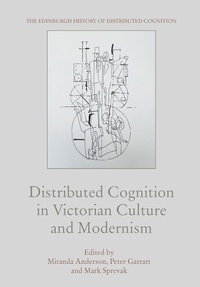
Distributed Cognition in Victorian Culture and Modernism
Published on 15. September 2020
Book
Hardback
304 pages
978-1-4744-4224-4 (ISBN)
Description
This book brings together 11 essays by international specialists in Victorian culture and modernism and provides a general and period-specific introduction to distributed cognition and the cognitive humanities. The essays revitalise our reading of Victorian and modernist works in the fields of history of technology, science and medicine, material culture, philosophy, art and literary studies by bringing to bear recent insights in cognitive science and philosophy of mind on the ways in which cognition is distributed across brain, body and world.
Reviews / Votes
A period of inward and outward expansion, of conflict and suspicion, of innovation and alienation, a time that underscored the continuities of life, mind, and society. As this exciting collection shows, we find in Victorian and modernist culture not just a prefiguration, but the very roots of distributed cognition. * Ezequiel A. Di Paolo, Ikerbasque, Basque Foundation for Science. * Offers diverse, engaging discussions of the aesthetics of distributed cognition: fresh analyses of modernism and its antecedents are ingeniously developed from views of 'art and literature as both expressing, and reflecting on, our cognitively embodied life'. * Randall Stevenson, University of Edinburgh *More details
Series
Language
English
Place of publication
Edinburgh
United Kingdom
Target group
Professional and scholarly
Product notice
sewn/stitched
Cloth over boards
Illustrations
21 colour illustrations
Dimensions
Height: 251 mm
Width: 178 mm
Thickness: 27 mm
Weight
720 gr
ISBN-13
978-1-4744-4224-4 (9781474442244)
Copyright in bibliographic data and cover images is held by Nielsen Book Services Limited or by the publishers or by their respective licensors: all rights reserved.
Schweitzer Classification
Other editions
Additional editions
Miranda Anderson | Peter Garratt | Mark Sprevak
Distributed Cognition in Victorian Culture and Modernism
E-Book
08/2020
1st Edition
Edinburgh University Press
€0.00
Available for download
Persons
Miranda Anderson is an Anniversary Fellow at the University of Stirling and an Honorary Fellow at the University of Edinburgh. Her research focuses on cognitive approaches to literature and culture. She is the author of The Renaissance Extended Mind (Palgrave Macmillan, 2015). Peter Garratt is Associate Professor of English Studies at Durham University. He is the author of Victorian Empiricism: Self, Knowledge and Reality in Ruskin, Bain, Lewes, Spencer and George Eliot (Fairleigh Dickinson University Press, 2010). He is editor of The Cognitive Humanities: Embodied Mind in Literature and Culture (Palgrave Macmillan, 2016). Mark Sprevak is Senior Lecturer in Philosophy at the University of Edinburgh. He is the co-editor of The Routledge Handbook to the Computational Mind (Routledge, 2018), The Turing Guide: Life, Work, Legacy (OUP, 2017) and New Waves in Philosophy of Mind (Palgrave Macmillan, 2014).
Content
List of illustrations
Series Preface
1. Series Introduction: Distributed Cognition and the Humanities
Miranda Anderson, Michael Wheeler and Mark Sprevak
2. Introduction
i. Distributed Cognition in Victorian and Modernism Studies - An Overview
Peter Garratt
ii. Distributed Cognition in Victorian and Modernism Studies - Our Volume
Miranda Anderson
3. The Victorian Extended Mind: George Eliot, Psychology, and the Bounds of Cognition
Peter Garratt
4. Instrumental Eyes: Enacted and Interactive Perception in Victorian Optical Technologies and Victorian Fiction
Nicole Garrod-Bush
5. Aesthetic Perception and Embodied Cognition: Art and Literature at the Fin de Siecle
Marion Thain
6. The Heterocosmic Self: Analogy, Temporality and Structural Couplings in Proust's Swann's Way
Marco Bernini
7. Distributed Cognition and the Phenomenology of Modernist Painting and Poetry (Rilke and Cezanne)
Jennifer Anna Gosetti-Ferencei
8. Directionality and Duration in Distributed Consciousness: Modernist Perspectives on Photographic Objectivity
Adam Lively
9. Walking, Identity and Visual Perception in Romantic and Modernist Literature
Andrew Michael Roberts and Eleanore Widger
10. Surrealism, Chance and the Extended Mind
Kerry Watson
11. Distributed Cognition, Porous Qualia, and Modernist Narrative
Melba Cuddy-Keane
12. Nietzsche's Genealogie der Moral pro and contra distributed cognition
E. T. Troscianko
13. A 5th E: Distributed Cognition and the Question of Ethics in Benjamin and Vygotsky, and Horkheimer and DeweyBen Morgan
Notes on contributors
Bibliography
Index
Series Preface
1. Series Introduction: Distributed Cognition and the Humanities
Miranda Anderson, Michael Wheeler and Mark Sprevak
2. Introduction
i. Distributed Cognition in Victorian and Modernism Studies - An Overview
Peter Garratt
ii. Distributed Cognition in Victorian and Modernism Studies - Our Volume
Miranda Anderson
3. The Victorian Extended Mind: George Eliot, Psychology, and the Bounds of Cognition
Peter Garratt
4. Instrumental Eyes: Enacted and Interactive Perception in Victorian Optical Technologies and Victorian Fiction
Nicole Garrod-Bush
5. Aesthetic Perception and Embodied Cognition: Art and Literature at the Fin de Siecle
Marion Thain
6. The Heterocosmic Self: Analogy, Temporality and Structural Couplings in Proust's Swann's Way
Marco Bernini
7. Distributed Cognition and the Phenomenology of Modernist Painting and Poetry (Rilke and Cezanne)
Jennifer Anna Gosetti-Ferencei
8. Directionality and Duration in Distributed Consciousness: Modernist Perspectives on Photographic Objectivity
Adam Lively
9. Walking, Identity and Visual Perception in Romantic and Modernist Literature
Andrew Michael Roberts and Eleanore Widger
10. Surrealism, Chance and the Extended Mind
Kerry Watson
11. Distributed Cognition, Porous Qualia, and Modernist Narrative
Melba Cuddy-Keane
12. Nietzsche's Genealogie der Moral pro and contra distributed cognition
E. T. Troscianko
13. A 5th E: Distributed Cognition and the Question of Ethics in Benjamin and Vygotsky, and Horkheimer and DeweyBen Morgan
Notes on contributors
Bibliography
Index