

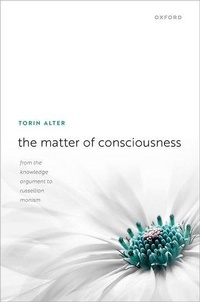
The Matter of Consciousness
From the Knowledge Argument to Russellian Monism
Published on 2. March 2023
Book
Hardback
280 pages
978-0-19-884045-9 (ISBN)
Description
Torin Alter presents a compelling defence of the 'knowledge argument' against physicalism, pioneered by Frank Jackson. According to physicalism, consciousness is a physical phenomenon. The knowledge argument stars Mary, who learns all objective, physical information through black-and-white media and yet acquires new information when she first sees colors for herself: information about what it is like to see in color. Based partly on that case, Jackson concludes that not all information is physical. Alter argues that the knowledge argument succeeds in refuting all standard versions of physicalism: versions on which consciousness is grounded by what objective science reveals. Alter also argues that given further, plausible assumptions, the knowledge argument leads to Russellian monism, according to which there are intrinsic properties that both constitute consciousness and underlie properties described by physics, such as mass and charge. Alter explains how the knowledge argument establishes those two conclusions and defend it against numerous objections.
Reviews / Votes
What can Mary know about the conscious experience of color from inside her black and white room, and what follows for the metaphysics of consciousness? Torin Alter gives a state-of-the-art analysis of these issues. He focuses especially on the crucial gap between structural and phenomenal aspects of reality, and articulates a powerful version of Russellian monism that traces this gap to a deep level of the physical world. Along the way he gives a definitive defense of anti-materialist arguments from objections old and new, shedding new light on this crucial nexus between consciousness, knowledge, and reality. * David Chalmers, New York University * The Matter of Consciousness is a thorough and comprehensive treatment of the knowledge argument, one of the most compelling and influential arguments against physicalism about consciousness. Torin Alter's treatment of this argument and the objections that have been raised against it is unsurpassed in quality and clarity. This book is essential reading for anyone with a serious interest in the contemporary case against physicalism about the mind. * Derk Pereboom, Cornell University * It's an impressive piece of work, and well worth reading both for specialists...and perhaps even more for those less knowledgeable...It is written with great efficiency, occasional panache, immense fairness, and exceptional breadth and depth of knowledge. To be so patient in discussion, yet so concise in exposition and argument, is an achievement I could not dream of getting close to. This is peak analytic philosophy of mind. * Sam Coleman, Australasian Journal of Philosophy * Alter's The Matter of Consciousness is not only the most systematic defense of the knowledge argument, it is so crystal clear, so compelling, that it should be required reading not only for those interested in consciousness, but for those interested in clear philosophical writing. * Robert J. Howell, Philosophia * In The Matter of Consciousness: From the Knowledge Argument to Russellian Monism, Torin Alter argues for something surprising: despite being widely rejected by philosophers, including Frank Jackson himself (1994), Jackson's (1982, 1986) knowledge argument ... succeeds. Alter's defense of Jackson's argument is not only surprising; it's also exciting: the knowledge argument, if it's sound, underscores the power of armchair philosophy, the power of pure thought to arrive at substantial conclusions about the world. * Barbara Montero, Philosophia * I agree with much of what Torin Alter says in this important book. * Frank Jackson, Philosophia * ...Torin Alter's excellent book The Matter of Consciousness. * Amy Kind, Philosophia *More details
Language
English
Place of publication
Oxford
United Kingdom
Target group
Professional and scholarly
Product notice
sewn/stitched
Cloth over boards
Dimensions
Height: 239 mm
Width: 162 mm
Thickness: 26 mm
Weight
596 gr
ISBN-13
978-0-19-884045-9 (9780198840459)
Copyright in bibliographic data and cover images is held by Nielsen Book Services Limited or by the publishers or by their respective licensors: all rights reserved.
Schweitzer Classification
Other editions
Additional editions
E-Book
04/2023
1st Edition
OUP eBook
€45.99
Available for download
E-Book
01/2023
1st Edition
OUP eBook
€45.99
Available for download
Person
Torin Alter is Professor of Philosophy at The University of Alabama, USA. He is author of articles in Mind, Philosophical Studies, and elsewhere; co-author of A Dialogue on Consciousness and The God Dialogues: A Philosophical Journey (both OUP); and co-editor of Consciousness and the Mind-Body Problem: A Reader and Phenomenal Concepts and Phenomenal Knowledge: New Essays on Consciousness and Physicalism (both OUP).
Content
Part I: The case for the epistemic gap
1: Introduction
2: The significance of structure
3: Structure, physical knowledge, and ignorance
4: Phenomenal knowledge without experience
5: Non-propositional phenomenal knowledge
6: Phenomenal representation
Part II: The case for the modal gap
7: Deduction and necessity
8: Epistemic-modal bridge principles
9: The phenomenal concept strategy and Chalmers's dilemma
10: Consequences of social externalism
11: The conditional analysis of phenomenal concepts
Part III: The case for the ontological gap
12: The supervenience requirement on physicalism
13: Two final objections
14: Two final objections
15: The knowledge argument, Russellian monism, and causal integration
Conclusion
1: Introduction
2: The significance of structure
3: Structure, physical knowledge, and ignorance
4: Phenomenal knowledge without experience
5: Non-propositional phenomenal knowledge
6: Phenomenal representation
Part II: The case for the modal gap
7: Deduction and necessity
8: Epistemic-modal bridge principles
9: The phenomenal concept strategy and Chalmers's dilemma
10: Consequences of social externalism
11: The conditional analysis of phenomenal concepts
Part III: The case for the ontological gap
12: The supervenience requirement on physicalism
13: Two final objections
14: Two final objections
15: The knowledge argument, Russellian monism, and causal integration
Conclusion