

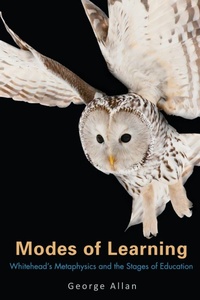
Modes of Learning
Whitehead's Metaphysics and the Stages of Education
Published on 2. January 2013
Book
Paperback/Softback
238 pages
978-1-4384-4188-7 (ISBN)
Description
A highly accessible reading of Whitehead's writings on education and their connection to his metaphysics.
Educators are familiar with Alfred North Whitehead's three stages of education: romance, precision, and generalization. Philosophers are familiar with his metaphysical theories about the primacy of temporal processes. In Modes of Learning, George Allan brings these two sides of Whitehead's thought together for the first time in a book suitable for both those initially approaching Whitehead's metaphysics and experts alike.
Allan develops a series of analogies between Whitehead's ideas about how we learn and key concepts in his later metaphysical writings, demonstrating that both how we learn and how the world changes involve a tension between open-ended exploration and systematic organization. Novel ideas free us from the blinders imposed by old habits and beliefs. Yet only when these ideas are integrated with the old ways are we able to improve our individual and collective lives-until changing circumstances call for further new ideas and fresh integrations.
Using a rich variety of examples, Allan illuminates the metaphysical ideas he explores by tethering them concretely to the educational practices in which they are rooted. This shows a key but neglected feature of Whitehead's thought: his pragmatic theory of truth, with its functionalist approach to experience and its humanistic appreciation of the frailty of all human endeavors.
Educators are familiar with Alfred North Whitehead's three stages of education: romance, precision, and generalization. Philosophers are familiar with his metaphysical theories about the primacy of temporal processes. In Modes of Learning, George Allan brings these two sides of Whitehead's thought together for the first time in a book suitable for both those initially approaching Whitehead's metaphysics and experts alike.
Allan develops a series of analogies between Whitehead's ideas about how we learn and key concepts in his later metaphysical writings, demonstrating that both how we learn and how the world changes involve a tension between open-ended exploration and systematic organization. Novel ideas free us from the blinders imposed by old habits and beliefs. Yet only when these ideas are integrated with the old ways are we able to improve our individual and collective lives-until changing circumstances call for further new ideas and fresh integrations.
Using a rich variety of examples, Allan illuminates the metaphysical ideas he explores by tethering them concretely to the educational practices in which they are rooted. This shows a key but neglected feature of Whitehead's thought: his pragmatic theory of truth, with its functionalist approach to experience and its humanistic appreciation of the frailty of all human endeavors.
Reviews / Votes
"The book is highly recommended for, as Allan says, professional educators-and all 'intelligent readers,' which 'include[s] parents.'" - CHOICEMore details
Language
English
Place of publication
Albany, NY
United States
Target group
College/higher education
US School Grade: College Graduate Student and over
Product notice
Paperback (trade)
Dimensions
Height: 229 mm
Width: 152 mm
Thickness: 14 mm
Weight
393 gr
ISBN-13
978-1-4384-4188-7 (9781438441887)
Copyright in bibliographic data and cover images is held by Nielsen Book Services Limited or by the publishers or by their respective licensors: all rights reserved.
Schweitzer Classification
Other editions
Additional editions
E-Book
05/2012
1st Edition
De Gruyter
€35.99
Available for download
Person
George Allan is Professor Emeritus of Philosophy at Dickinson College. He is the author of many books, including The Importances of the Past: A Meditation on the Authority of Tradition; The Realizations of the Future: An Inquiry into the Authority of Praxis; The Patterns of the Present: Interpreting the Authority of Form; and Higher Education in the Making: Pragmatism, Whitehead, and the Canon, all also published by SUNY Press.
Content
Introduction
1. The Rhythm of Learning
Brave New Worlds
Masterpieces
The Art of Life
2. Learning Helically
Closed Systems
The Enchanter's Wand
Spiral Weaving
3. Learning to Be Free
Experience
Perception
Analysis
Freedom
4. Learning to Reason
Precisely Ulysses
Platonic Romance
Scheming Greeks
Solomon's Dream
5. Learning to Create the Future
Two Ultimate Notions
Assemblage
Systemization
Further Assemblage
Rationalization
Philosophy and Poetry
The Task of Education
6. Learning to Be Good
Wanting to Be Good
Becoming Good
Being Good
7. Recollecting
Romance
Precision
Generalization
Metaphysics
Conclusion
Works Cited
Index
1. The Rhythm of Learning
Brave New Worlds
Masterpieces
The Art of Life
2. Learning Helically
Closed Systems
The Enchanter's Wand
Spiral Weaving
3. Learning to Be Free
Experience
Perception
Analysis
Freedom
4. Learning to Reason
Precisely Ulysses
Platonic Romance
Scheming Greeks
Solomon's Dream
5. Learning to Create the Future
Two Ultimate Notions
Assemblage
Systemization
Further Assemblage
Rationalization
Philosophy and Poetry
The Task of Education
6. Learning to Be Good
Wanting to Be Good
Becoming Good
Being Good
7. Recollecting
Romance
Precision
Generalization
Metaphysics
Conclusion
Works Cited
Index