

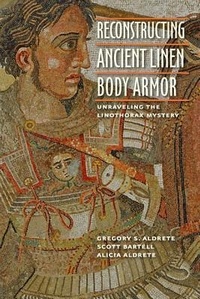
Reconstructing Ancient Linen Body Armor
Unraveling the Linothorax Mystery
Will be published approx. on 26. June 2013
Book
Hardback
304 pages
978-1-4214-0819-4 (ISBN)
Description
Alexander the Great led one of the most successful armies in history and conquered nearly the entirety of the known world while wearing armor made of cloth. How is that possible? In "Reconstructing Ancient Linen Body Armor", Gregory S. Aldrete, Scott Bartell, and Alicia Aldrete provide the answer. An extensive multiyear project in experimental archaeology, this pioneering study presents a thorough investigation of the linothorax, linen armor worn by the Greeks, Macedonians, and other ancient Mediterranean warriors. Because the linothorax was made of cloth, no examples of it have survived. As a result, even though there are dozens of references to the linothorax in ancient literature and nearly a thousand images of it in ancient art, this linen armor remains relatively ignored and misunderstood by scholars. Combining traditional textual and archaeological analysis with hands-on reconstruction and experimentation, the authors unravel the mysteries surrounding the linothorax.
They have collected and examined all of the literary, visual, historical, and archaeological evidence for the armor and detail their efforts to replicate the armor using materials and techniques that are as close as possible to those employed in antiquity. By reconstructing actual examples using authentic materials, the authors were able to scientifically assess the true qualities of linen armor for the first time in 1,500 years. The tests reveal that the linothorax provided surprisingly effective protection for ancient warriors, that it had several advantages over bronze armor, and that it even shared qualities with modern-day Kevlar. Previously featured in documentaries on the Discovery Channel and the Canadian History Channel, as well as in U.S. News and World Report, MSNBC Online, and other international venues, this groundbreaking work will be a landmark in the study of ancient warfare.
They have collected and examined all of the literary, visual, historical, and archaeological evidence for the armor and detail their efforts to replicate the armor using materials and techniques that are as close as possible to those employed in antiquity. By reconstructing actual examples using authentic materials, the authors were able to scientifically assess the true qualities of linen armor for the first time in 1,500 years. The tests reveal that the linothorax provided surprisingly effective protection for ancient warriors, that it had several advantages over bronze armor, and that it even shared qualities with modern-day Kevlar. Previously featured in documentaries on the Discovery Channel and the Canadian History Channel, as well as in U.S. News and World Report, MSNBC Online, and other international venues, this groundbreaking work will be a landmark in the study of ancient warfare.
Reviews / Votes
Reconstructing Ancient Linen Body Armor is essential for anyone interested in ancient warfare and/or experimental archaeology, from academic to layman, and is a defining and valuable contribution to our understanding of the ancient world. -- Christopher Matthew Bryn Mawr Classical Review Anyone interested in archeological textiles, historical textiles, historical reenactment, military history, costume construction, or flax and linen should consider this fascinating and unique book. -- Joanne Robbins Hicken The Complex Weaver Reconstructing Ancient Linen Body Armor is a model example of the benefits that can come from creative engagement with historical re-enactors. -- Peter Thonemann Times Literary Supplement In introducing the developing disciplines of experimental and reconstructive archaeology alongside the traditional approaches of textual and visual analysis, the authors provide a challenging and illuminating exploration of a poorly understood piece of ancient body armour that will satisfy both academic scholars and military history aficionados alike HermathenaMore details
Language
English
Place of publication
Baltimore, MD
United States
Target group
Professional and scholarly
Product notice
sewn/stitched
Cloth over boards
Illustrations
21 s/w Abbildungen, 16 s/w Zeichnungen, 8 farbige Bildtafeln
8 Plates, color; 16 Line drawings, black and white; 21 Illustrations, black and white
Dimensions
Height: 236 mm
Width: 156 mm
Thickness: 27 mm
Weight
553 gr
ISBN-13
978-1-4214-0819-4 (9781421408194)
DOI
10.1353/book.22170
Copyright in bibliographic data and cover images is held by Nielsen Book Services Limited or by the publishers or by their respective licensors: all rights reserved.
Schweitzer Classification
Other editions
Additional editions
Gregory S. Aldrete | Scott M. Bartell | Alicia Aldrete
Reconstructing Ancient Linen Body Armor
Unraveling the Linothorax Mystery
E-Book
06/2013
Johns Hopkins University Press
€24.99
Available for download
Persons
Gregory S. Aldrete is a professor of humanistic studies and history at the University of Wisconsin, Green Bay. He is the author of Floods of the Tiber in Ancient Rome and Gestures and Acclamations in Ancient Rome, both published by Johns Hopkins. Scott Bartell is an independent scholar who has published and presented on linen body armor and Alexander the Great. Alicia Aldrete is coauthor (with Gregory S. Aldrete) of The Long Shadow of Antiquity: What Have the Greeks and Romans Done for Us?
Content
Acknowledgments
Introduction
The State of Linothorax Scholarship and Typologies of Greek Armor
The Structure of This Book
Methodology and Audience
1. Ancient Evidence for Linen Armor
Literary Sources
Linen in the Ancient World
Visual Sources
2. Structural Variants and Decorations on Type IV Armor
Structural Elements I: Shoulder Flaps
Structural Elements II: Shoulder Flap Ties
Structural Elements III: Pteruges
Structural Elements IV: Structural Elements IV
Decorative Elements I: Painted Designs
Decorative Elements II: Color
Distinctive Aspects of Etruscan Type IV Armor
3. What Material Was Used to Make Type IV Armor?
Leather versus Linen Construction
Sewn versus Laminated Construction
Composite Construction
4. Reconstructing the Linothorax
Developing a Basic Pattern
Fabrics and Glues
The Lamination Process
Heroic Nudity and Armor Length
Decoration
Thickness
5. Arrow Test Methodology and Materials
Arrow Test Rationale
Test Patches
Arrows and Bows
Arrow Test Procedure
6. Arrow Test Results
General Observations
Less Significant Test Variables
Hand-Produced versus Modern Linens
Laminated versus Sewn and Quilted
Different Arrowheads
Depth of Penetration and Lethality of Injury
Angled Shots
Test Results Compared to Ancient Source Testimony
Testing Other Types of Attacks
Arrow versus Unarmored Warrior
Arrow versus Test Patch: Test Result Tables
Linen versus Metal Armor
7. Wearability Issues
Potential Vulnerability to Moisture
Waterproofing Experiments
Durability and Repair
Range of Motion, Mobility, and Fit
Heat, Weight, and Endurance
8. Economic and Social Considerations
Labor Required to Construct a Linothorax
The Cost of Linen Armor
Cost and Availability of Leather versus Linen
Large- Scale Production
Gender Issues
Conclusion
Appendix: Database of Visual Sources for Type IV Armor
Black-Figure Vases
White- Ground Technique Vases
Red- Figure Vases
Stone Sculptures and Reliefs
Terracotta Sculptures and Reliefs
Metal Objects
Paintings
Notes
Bibliography
Index
Introduction
The State of Linothorax Scholarship and Typologies of Greek Armor
The Structure of This Book
Methodology and Audience
1. Ancient Evidence for Linen Armor
Literary Sources
Linen in the Ancient World
Visual Sources
2. Structural Variants and Decorations on Type IV Armor
Structural Elements I: Shoulder Flaps
Structural Elements II: Shoulder Flap Ties
Structural Elements III: Pteruges
Structural Elements IV: Structural Elements IV
Decorative Elements I: Painted Designs
Decorative Elements II: Color
Distinctive Aspects of Etruscan Type IV Armor
3. What Material Was Used to Make Type IV Armor?
Leather versus Linen Construction
Sewn versus Laminated Construction
Composite Construction
4. Reconstructing the Linothorax
Developing a Basic Pattern
Fabrics and Glues
The Lamination Process
Heroic Nudity and Armor Length
Decoration
Thickness
5. Arrow Test Methodology and Materials
Arrow Test Rationale
Test Patches
Arrows and Bows
Arrow Test Procedure
6. Arrow Test Results
General Observations
Less Significant Test Variables
Hand-Produced versus Modern Linens
Laminated versus Sewn and Quilted
Different Arrowheads
Depth of Penetration and Lethality of Injury
Angled Shots
Test Results Compared to Ancient Source Testimony
Testing Other Types of Attacks
Arrow versus Unarmored Warrior
Arrow versus Test Patch: Test Result Tables
Linen versus Metal Armor
7. Wearability Issues
Potential Vulnerability to Moisture
Waterproofing Experiments
Durability and Repair
Range of Motion, Mobility, and Fit
Heat, Weight, and Endurance
8. Economic and Social Considerations
Labor Required to Construct a Linothorax
The Cost of Linen Armor
Cost and Availability of Leather versus Linen
Large- Scale Production
Gender Issues
Conclusion
Appendix: Database of Visual Sources for Type IV Armor
Black-Figure Vases
White- Ground Technique Vases
Red- Figure Vases
Stone Sculptures and Reliefs
Terracotta Sculptures and Reliefs
Metal Objects
Paintings
Notes
Bibliography
Index