

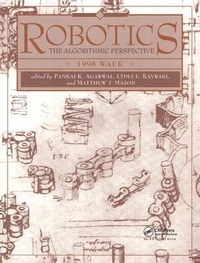
Robotics: The Algorithmic Perspective
1998 WAFR
1st Edition
Published on 15. December 1998
Book
389 pages
978-1-56881-081-2 (ISBN)
Description
This volume gathers together cutting-edge research from the Third Workshop on Algorithmic Foundations of Robotics and gives a solid overview of the state of the art in robot algorithms. The papers cover core problems in robotics, such as motion planning, sensor-based planning, manipulation, and assembly planning. They also examine the application of robotic algorithms in domains like molecular modeling, geometric modeling, and computer-assisted surgery.
More details
Other editions
Additional editions
Pankaj K. Agarwal | Lydia E. Kavraki | Matthew T. Mason
Robotics: The Algorithmic Perspective
WAFR 1998
E-Book
12/1998
1st Edition
CRC Press
€73.99
Available for download
Pankaj K. Agarwal | Lydia E. Kavraki | Matthew T. Mason
Robotics: The Algorithmic Perspective
WAFR 1998
E-Book
12/1998
1st Edition
CRC Press
€73.99
Available for download
Persons
Pankaj K. Agarwal, Lydia E. Kavraki, Matthew T. Mason
Content
Foreword, Participants, Chapter 1: Algorithmic MEMS, Chapter 2: Universal Part Manipulation in the Plane with a Single Horizontally-Vibrating Plate, Chapter 3: Velocity Field Design for the Modular Distributed Manipulator System (MDMS), Chapter 4: The Complexity of the Two Dimensional Curvature-Constrained Shortest-Path Problem, Chapter 5: Approximation and Decision Algorithms for Curvature-Constrained Path Planning: A State-Space Approach, Chapter 6: Elastic Bands for Nonholonomic Car-Like Robots: Algorithms and Combinatorial Issues, Chapter 7: Trajectory Generation for Mechanical Systems with Application to Robotic Locomotion, Chapter 8: Mechanics, Planning, and Control for Tapping, Chapter 9: Planning for In-Hand Dextrous Manipulation, Chapter 10: Shape Recovery from Passive Locally Dense Tactile Data, Chapter 11: Geometric Algorithms in AdeptRAPID, Chapter 12: On Finding Narrow Passages with Probabilistic Roadmap Planners, Chapter 13: OBPRM: An Obstacle-Based PRM for 3D Workspaces, Chapter 14: Subdivision: A Technique for Modeling Curved Shape, Chapter 15: Spherical Shell: A Higher Order Bounding Volume for Fast Proximity Queries, Chapter 16: Kinetic Data Structures: A State of the Art Report, Chapter 17: The Polygon Exploration Problem: A New Strategy and a New Analysis Technique, Chapter 18: The Computational Power of Frictional Mechanical Systems, Chapter 19: Issues in Nonprehensile Manipulation, Chapter 20: Local Observability of Rolling, Chapter 21: Geometry for Modeling Biomolecules, Chapter 22: Algorithms for Fence Design, Chapter 23: Shape Tolerance in Feeding and Fixturing, Chapter 24: Towards Planning for Elastic Objects, Chapter 25: Models and Algorithms for the Collision of Rigid and Deformable Bodies, Chapter 26: Numerical Computation of Optimal Navigation Functions on a Simplical Complex, Chapter 27: Synergistic Robots for Surgery: An Algorithmic View of the Approach, Chapter 28: Fourier Methods on Groups: Applications in Robot Kinematics and Motion Planning, Chapter 29: The Self-Reconfiguring Robotic Molecule: Design and Control Algorithms, Author Index