

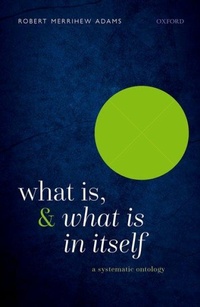
What Is, and What Is In Itself
A Systematic Ontology
Published on 30. December 2021
Book
Hardback
240 pages
978-0-19-285613-5 (ISBN)
Description
This work is ''a systematic ontology.'' Ontology is the study of being as such, and a systematic ontology is an account of the most fundamental ways of being something or other - of what they are and of how they are related to each other. The questions it pursues are not primarily about what causes things, but about what things are or consist in - though causal questions cannot be totally avoided. The title of the work, What Is, and What Is in Itself, marks the most important distinction in ways of being. What is includes everything there is, but not everything there is included in what is in itself. The first five chapters of the book define and examine the ways of being: in chapters 1 and 2, being actual or existing, or even just being something without existing or being actual; in chapter 3, being an intentional object, and perhaps a merely intentional object; in chapter 4, relations between things and their properties; and in chapter 5, being a thing in itself. Chapter 6 discusses whether only conscious beings are things in themselves, and suggests an affirmative answer. Chapter 7 discusses the epistemology of ontology. Chapters 8 and 9 discuss issues about thisness and identity. And chapters 10 and 11 discuss mainly occasionalist and panentheist answers to questions about the causal unity of the universe.
Reviews / Votes
In this volume, Adams (emer., Yale Univ.) puts forth a very intense contribution to analytic metaphysics that is in dialogue with contemporary thinkers such as Peter van Inwagen, David Lewis, and Willard Van Orman Quine, and important early modern philosophers such as Descartes, Leibniz, and Malebranche.While the text is certainly dense and meant for higher-level students and scholars, it gives a skillful and necessary summary and analysis of modern metaphysical thought up to the present. * J. Sienkiewicz, CHOICE *More details
Language
English
Place of publication
Oxford
United Kingdom
Target group
Professional and scholarly
Product notice
sewn/stitched
Cloth over boards
Dimensions
Height: 236 mm
Width: 158 mm
Thickness: 18 mm
Weight
484 gr
ISBN-13
978-0-19-285613-5 (9780192856135)
Copyright in bibliographic data and cover images is held by Nielsen Book Services Limited or by the publishers or by their respective licensors: all rights reserved.
Schweitzer Classification
Other editions
Additional editions
E-Book
12/2021
1st Edition
OUP eBook
€48.99
Available for download
E-Book
12/2021
1st Edition
OUP eBook
€48.99
Available for download
Person
Robert Merrihew Adams got an AB in philosophy at Princeton University, 1955-59, a BA in theology at Oxford University, 1959-61, and a BD at Princeton Theological Seminary, 1961-62, following which he served as pastor of a Presbyterian church in Montauk at the eastern tip of Long Island, 1962-65. He got his PhD in Philosophy at Cornell University, 1965-69. He then taught Philosophy full time at the University of Michigan, 1968-72, at UCLA 1972-93, and at Yale 1999-2003. He became a non-stipendiary Senior Research Fellow and very part-time Visiting Professor of Philosophy at Oxford University 2004-09, and a part-time Professor of Philosophy at UNC Chapel Hill 2009-13 and at Rutgers 2013-16.
Content
Introduction and Overview
1: Actuality
2: Existence
3: Intentional Objects, Existent, and Nonexistent
4: Things and Properties
5: Intrinsic Reality, Relationality, and Consciousness
6: Reality and the Physical
7: The Epistemology of Being
8: Thisness
9: Identity, Time, and Self
10: God and the Causal Unity of the World
11: God and Possibilities
1: Actuality
2: Existence
3: Intentional Objects, Existent, and Nonexistent
4: Things and Properties
5: Intrinsic Reality, Relationality, and Consciousness
6: Reality and the Physical
7: The Epistemology of Being
8: Thisness
9: Identity, Time, and Self
10: God and the Causal Unity of the World
11: God and Possibilities