

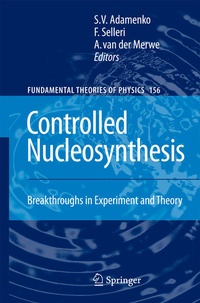
Controlled Nucleosynthesis
Breakthroughs in Experiment and Theory
Published on 18. November 2010
Book
Paperback/Softback
XVI, 782 pages
978-90-481-7464-5 (ISBN)
Description
This book ushers in a new era of experimental and theoretical investigations into collective processes, structure formation, and self-organization of nuclear matter. It reports the results of experiments wherein for the first time the nuclei constituting our world (those displayed in Mendeleev's table as well as the super-heavy ones) have been artificially created. Pioneering breakthroughs are described, achieved at the "Proton-21" Laboratory, Kiev, Ukraine in a variety of new physical and technological directions.
More details
Series
Edition
Softcover reprint of hardcover 1st ed. 2007
Language
English
Place of publication
Dordrecht
Netherlands
Target group
Professional and scholarly
Research
Illustrations
XVI, 782 p.
Dimensions
Height: 235 mm
Width: 155 mm
Thickness: 43 mm
Weight
1188 gr
ISBN-13
978-90-481-7464-5 (9789048174645)
DOI
10.1007/978-1-4020-5874-5
Schweitzer Classification
Other editions
Additional editions
Stanislav Adamenko | Franco Selleri | Alwyn Van Der Merwe
Controlled Nucleosynthesis
Breakthroughs in Experiment and Theory
Book
06/2007
1st Edition
Springer
€213.99
Shipment within 15-20 days
Content
Approach to the Problem.- Prehistory.- Self-Organizing Nucleosynthesis in Superdense Plasma.- Experimental Setup.- Some Experimental Results.- Optical Emission of a Hot Dot (HD).- Measurements of X-ray Emission of HD.- Registration of Fast Particles from the arget Explosion.- Experiments on the Neutralization of Radioactivity.- Isotope and Element Compositions of Target Explosion Products.- Synthesis of Superheavy Elements in the Explosive Experiments.- On the Detection of Superheavy Elements in Target Explosion Products.- Physical Model and Discovery of Superheavy Transuranium Elements Produced in the Process of Controlled Collapse.- Preliminary Résumé of Obtained Results, Theories, and Physical Models.- Stability of Electron-Nucleus form of Matter and Methods of Controlled Collapse.- Nuclear Combustion and Collective Nucleosynthesis.