

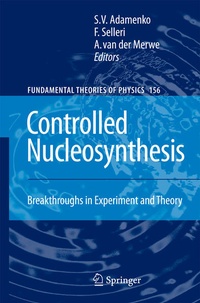
Controlled Nucleosynthesis
Breakthroughs in Experiment and Theory
1st Edition
Published on 28. June 2007
Book
Hardback
XVI, 782 pages
978-1-4020-5873-8 (ISBN)
Description
This book ushers in a new era of experimental and theoretical investigations into collective processes, structure formation, and self-organization of nuclear matter. It reports the results of experiments wherein for the first time the nuclei constituting our world (those displayed in Mendeleev's table as well as the super-heavy ones) have been artificially created. Pioneering breakthroughs are described, achieved at the "Proton-21" Laboratory, Kiev, Ukraine in a variety of new physical and technological directions.
More details
Series
Language
English
Place of publication
Dordrecht
Netherlands
Target group
Professional and scholarly
Research
Illustrations
XVI, 782 p.
Dimensions
Height: 241 mm
Width: 160 mm
Thickness: 47 mm
Weight
1349 gr
ISBN-13
978-1-4020-5873-8 (9781402058738)
DOI
10.1007/978-1-4020-5874-5
Schweitzer Classification
Other editions
Additional editions
Stanislav Adamenko | Franco Selleri | Alwyn Van Der Merwe
Controlled Nucleosynthesis
Breakthroughs in Experiment and Theory
Book
11/2010
Springer
€213.99
Shipment within 15-20 days
Stanislav Adamenko | Franco Selleri | Alwyn Van Der Merwe
Controlled Nucleosynthesis
Breakthroughs in Experiment and Theory
E-Book
04/2007
1st Edition
Springer
€213.99
Available for download
Content
Approach to the Problem.- Prehistory.- Self-Organizing Nucleosynthesis in Superdense Plasma.- Experimental Setup.- Some Experimental Results.- Optical Emission of a Hot Dot (HD).- Measurements of X-ray Emission of HD.- Registration of Fast Particles from the arget Explosion.- Experiments on the Neutralization of Radioactivity.- Isotope and Element Compositions of Target Explosion Products.- Synthesis of Superheavy Elements in the Explosive Experiments.- On the Detection of Superheavy Elements in Target Explosion Products.- Physical Model and Discovery of Superheavy Transuranium Elements Produced in the Process of Controlled Collapse.- Preliminary Résumé of Obtained Results, Theories, and Physical Models.- Stability of Electron-Nucleus form of Matter and Methods of Controlled Collapse.- Nuclear Combustion and Collective Nucleosynthesis.