

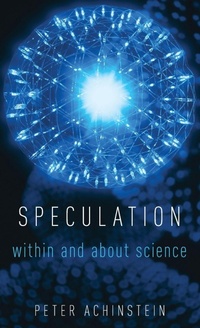
Speculation
Within and About Science
Published on 20. December 2018
Book
Hardback
296 pages
978-0-19-061505-5 (ISBN)
Description
Newton urged scientists never to speculate, only to prove by establishing experimental facts. By contrast, Einstein urged scientists to speculate freely, since only daring speculations, not experimental facts, can advance science. Who, if either, is right? Is speculation a legitimate part of science, even in the absence of testing? If so, can speculations be evaluated without testing? How?
To answer these questions it must first be determined what counts as a speculation, a task not usually investigated by those who express strong views about speculation. In Speculation, Peter Achinstein develops the basic idea that speculating involves introducing assumptions, under certain "theorizing" conditions, without knowing that there is evidence for those assumptions. This idea is made precise by utilizing a concept of "evidence" Achinstein has introduced in previous writings and also explains here. With this concept, Achinstein defends a view according to which, by contrast with Newton, speculations are crucial in science, and by contrast with Einstein, they are subject to constraints. The latter include pragmatic ones, reflecting the particular aims of the scientist in speculating, and epistemic ones that are subject to a different standard then "evidence sufficient for belief." This viewpoint is illustrated and evaluated by critically examining historical and contemporary speculations in fundamental physics as well as more general speculations within or about science, including these: nature is simple, and simplicity is a sign of truth (Newton, Einstein); a theory can only be tested "holistically" (Duhem and Quine); and there is, and must be, a "Theory of Everything" (string theorists and reductionists).
To answer these questions it must first be determined what counts as a speculation, a task not usually investigated by those who express strong views about speculation. In Speculation, Peter Achinstein develops the basic idea that speculating involves introducing assumptions, under certain "theorizing" conditions, without knowing that there is evidence for those assumptions. This idea is made precise by utilizing a concept of "evidence" Achinstein has introduced in previous writings and also explains here. With this concept, Achinstein defends a view according to which, by contrast with Newton, speculations are crucial in science, and by contrast with Einstein, they are subject to constraints. The latter include pragmatic ones, reflecting the particular aims of the scientist in speculating, and epistemic ones that are subject to a different standard then "evidence sufficient for belief." This viewpoint is illustrated and evaluated by critically examining historical and contemporary speculations in fundamental physics as well as more general speculations within or about science, including these: nature is simple, and simplicity is a sign of truth (Newton, Einstein); a theory can only be tested "holistically" (Duhem and Quine); and there is, and must be, a "Theory of Everything" (string theorists and reductionists).
Reviews / Votes
Over the past 50 years, Peter Achinstein has earned a reputation in the philosophy of science for careful, thought-provoking, and methodologically significant conceptual analyses. This new book matches that reputation...Within a crowded literature on the topic, Achinstein offers a book that is novel, rigorous, and helpful for both philosophers and scientists * Metapsychology * Highly recommended. * M. Latzer, CHOICE *More details
Language
English
Place of publication
New York
United States
Dimensions
Height: 222 mm
Width: 145 mm
Thickness: 20 mm
Weight
506 gr
ISBN-13
978-0-19-061505-5 (9780190615055)
Copyright in bibliographic data and cover images is held by Nielsen Book Services Limited or by the publishers or by their respective licensors: all rights reserved.
Schweitzer Classification
Other editions
Additional editions
E-Book
11/2018
OUP eBook
€19.99
Available for download
E-Book
11/2018
OUP eBook
€19.99
Available for download
Person
Peter Achinstein who received his B.A. and Ph.D.
degrees from Harvard, is the author of seven influential books in the philosophy of science, including Particles and Waves: Historical Essays in the Philosophy of Science (OUP 1991), which received the Lakatos Award in 1993. A festschrift in his honor, Philosophy of Science Matters: The Philosophy of Peter Achinstein, was published by Oxford University Press in 2011.
degrees from Harvard, is the author of seven influential books in the philosophy of science, including Particles and Waves: Historical Essays in the Philosophy of Science (OUP 1991), which received the Lakatos Award in 1993. A festschrift in his honor, Philosophy of Science Matters: The Philosophy of Peter Achinstein, was published by Oxford University Press in 2011.
Content
- Chapter 1: Scientific Speculation: A Pragmatic Approach
- Chapter 2: The Complex Story Of Simplicity: Ontological and
- Epistemic Speculations
- Chapter 3: Non-Epistemic Simplicity: Maxwell, Newton, and
- Speculation
- Chapter 4: Holism Vs. Particularism: An Evidential Debate
- ("Find the Ether")
- Chapter 5: The Ultimate Speculation: A "Theory Of
- Everything" (What Is It, and Why Should We Want One?)
- Chapter 6: Summing Up