

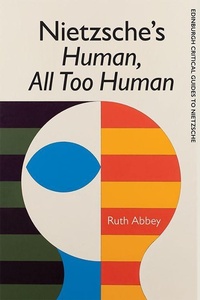
Nietzsche's Human, All Too Human
Published on 15. January 2020
Book
Paperback/Softback
256 pages
978-1-4744-3082-1 (ISBN)
Description
Human, All Too Human marks the beginning of what is often called Nietzsche's middle or positivist period (which ends with the conclusion of Book IV of The Gay Science). It initiates some important features that become permanent in his work, such as his experiments in multiple writing styles within one work, his self-representation as a psychologist, his genealogical excavations of morality and his appeal to fellow Europeans to overcome the parochialism and antagonism of nationalism. Ruth Abbey shows Nietzsche to be more receptive to the Enlightenment tradition than he is typically taken to be. She assumes no knowledge of the text or of Nietzsche. She maps her chapters onto those of Nietzsche's text, allowing you to read the guide alongside the book. Altogether, she opens up Human, All Too Human for new readers, while more experienced Nietzsche scholars will appreciate the new perspective.
Reviews / Votes
Abbey rises admirably to the challenge of the massive second edition of Human, All-too-Human, identifying themes and continuities within and between the original works, interpreting charitably but also pinpointing inconsistencies and unreasonable views. This fine work will aid both new and experienced readers of Nietzsche's (unjustly neglected) middle works. * Jonathan Cohen, University of Maine at Farmington *More details
Series
Language
English
Place of publication
Edinburgh
United Kingdom
Target group
Professional and scholarly
Dimensions
Height: 213 mm
Width: 136 mm
Thickness: 15 mm
Weight
322 gr
ISBN-13
978-1-4744-3082-1 (9781474430821)
Copyright in bibliographic data and cover images is held by Nielsen Book Services Limited or by the publishers or by their respective licensors: all rights reserved.
Schweitzer Classification
Person
Ruth Abbey is a Professor in the Department of Social Sciences, Swinburne University, Australia. She is the author of Nietzsche's Middle Period (OUP, 2000), Charles Taylor (Princeton University Press, 2000) and The Return of Feminist Liberalism (McGill-Queens University Press, 2011). She is the editor of Contemporary Philosophy in Focus: Charles Taylor (Cambridge University Press, 2004) and Feminist Interpretations of Rawls (Penn State University Press, 2013).
Content
IntroductionStyleEnlightenmentEpistemology-PlusStructureChapter Summary
1: Of First and Last ThingsHistorical PhilosophyEpistemology-PlusImpediments to TruthFree Spirits
2: On the History of the Moral SensationsThe Origins of MoralityPsychologyThe Historical and the PsychologicalThe Ego and its OwnRegarding OthersFree Will
3: The Religious LifeA Scientific View of ReligionChristianityParagons of ChristianityBeyond Christianity
4: From the Souls of Artists and WritersWho and What?Art and ScienceThe Genius
5: Signs of Higher and Lower CultureConservatism and ChangeFree SpiritsIngeniousContours of Higher Culture
6: The Human in SocietyThe French MoralistsAmour-PropreUnsocial SociabilityFriendship
7: Woman and ChildThe Female IntellectCourtship and MarriageParenthoodFree SpiritsRee on Women
8: A Glance at the State Democracy and EqualityReligion and PoliticsSocialism and NationalismRevolutionPolitics and Culture
9: Conclusion to HAH: Alone With Oneself Convictions
10: Mixed Opinions and MaximsOf First and Last ThingsThe History of the Moral SensationsThe Religious LifeFrom the Souls of Artists and WritersWoman and ChildGlancing at the State
11: The Wanderer and His ShadowThe ProtagonistsCare of the SelfFree WillPunishmentArtPolitics
1: Of First and Last ThingsHistorical PhilosophyEpistemology-PlusImpediments to TruthFree Spirits
2: On the History of the Moral SensationsThe Origins of MoralityPsychologyThe Historical and the PsychologicalThe Ego and its OwnRegarding OthersFree Will
3: The Religious LifeA Scientific View of ReligionChristianityParagons of ChristianityBeyond Christianity
4: From the Souls of Artists and WritersWho and What?Art and ScienceThe Genius
5: Signs of Higher and Lower CultureConservatism and ChangeFree SpiritsIngeniousContours of Higher Culture
6: The Human in SocietyThe French MoralistsAmour-PropreUnsocial SociabilityFriendship
7: Woman and ChildThe Female IntellectCourtship and MarriageParenthoodFree SpiritsRee on Women
8: A Glance at the State Democracy and EqualityReligion and PoliticsSocialism and NationalismRevolutionPolitics and Culture
9: Conclusion to HAH: Alone With Oneself Convictions
10: Mixed Opinions and MaximsOf First and Last ThingsThe History of the Moral SensationsThe Religious LifeFrom the Souls of Artists and WritersWoman and ChildGlancing at the State
11: The Wanderer and His ShadowThe ProtagonistsCare of the SelfFree WillPunishmentArtPolitics