

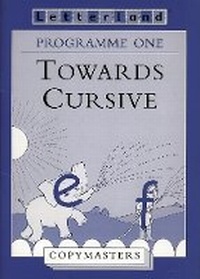
Towards Cursive Copymasters
Published on 1. April 1999
Other
Copymasters
96 pages
978-0-00-303450-9 (ISBN)
Description
This 80-page book combines the former Stage One and Stage Two Towards Cursive Copymasters in one more manageable volume. There are 72 photocopiaple pages of handwriting practice, compatible with the NLS requirements, and 8 pages of clear instructions on how to use the copymasters effectively.
These copymasters include practice in:
* pencil control and left-to-right hand movement
* patterns to support letter formation
* letter formation using the correct sequence of movements
* the relative height and positions of capital and lower case letters
* forming lower case letters correctly in a script that will be easy to join later
* spelling in conjunction with handwriting
* diagonal and horizontal joins
These copymasters include practice in:
* pencil control and left-to-right hand movement
* patterns to support letter formation
* letter formation using the correct sequence of movements
* the relative height and positions of capital and lower case letters
* forming lower case letters correctly in a script that will be easy to join later
* spelling in conjunction with handwriting
* diagonal and horizontal joins
More details
Series
Language
English
Place of publication
London
United Kingdom
Publishing group
HarperCollins Publishers
Target group
Primary & secondary/elementary & high school
Interest Age: From 4 to 6 years
Illustrations
80 b/w plates
Dimensions
Height: 297 mm
Width: 210 mm
Thickness: 6 mm
Weight
225 gr
ISBN-13
978-0-00-303450-9 (9780003034509)
Copyright in bibliographic data and cover images is held by Nielsen Book Services Limited or by the publishers or by their respective licensors: all rights reserved.
Schweitzer Classification
Other editions
New editions
Person
Lyn Wendon is a reading specialist who devised Letterland as a remedy for reading failure. Working among children with learning difficulties, she found that they needed a style of teaching that not only explained letter behaviour, but also fired their imaginations. The result was Letterland!