

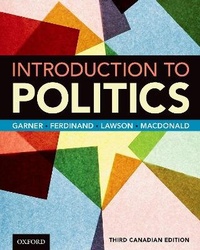
Introduction to Politics
Third Canadian Edition
Oxford University Press
Published on 16. June 2022
Other
Undefined
528 pages
978-0-19-903637-0 (ISBN)
Description
Learn the essential theories and key concepts. Explore real-world international and Canadian examples. This is your complete introduction to politics.
Now in its third Canadian edition, this truly international introduction to politics offers comprehensive coverage of key concepts and ideologies, institutions, and international relations. Balancing theory with a wealth of Canadian and international real-world examples, this text equips students with the knowledge required to think critically about the current state of global politics.
Now in its third Canadian edition, this truly international introduction to politics offers comprehensive coverage of key concepts and ideologies, institutions, and international relations. Balancing theory with a wealth of Canadian and international real-world examples, this text equips students with the knowledge required to think critically about the current state of global politics.
Reviews / Votes
This is a well-crafted introductory overview of the essential themes, ideas, and theories of political analysis that informs our understanding of the major fields of political science. As an introductory resource for the discipline, the text provides a readable and comprehensive analysis of the content that students in the discipline are expected to encounter for more in-depth coverage in senior-level courses." * Chaldeans Mensah, MacEwan University* This is an excellent textbook for an introductory course in political science, especially for Canadian audiences. Up-to-date examples, Indigenous content, and a readable text make this a top choice." * Lisa Lambert, University of Lethbridge *
More details
Language
English
Place of publication
Oxford
United Kingdom
Illustrations
86 photos; 12 tables; 1 map
ISBN-13
978-0-19-903637-0 (9780199036370)
Copyright in bibliographic data and cover images is held by Nielsen Book Services Limited or by the publishers or by their respective licensors: all rights reserved.
Schweitzer Classification
Persons
Author/originator
Professor, Department of Politics and International RelationsProfessor, Department of Politics and International Relations, University of Leicester, UK
Emeritus Reader, Department of Politics and International StudiesEmeritus Reader, Department of Politics and International Studies, University of Warwick, UK
Professor, Department of Modern History, Politics, and International RelationsProfessor, Department of Modern History, Politics, and International Relations, Macquarie University, Australia
Professor, Department of Political ScienceProfessor, Department of Political Science, University of Guelph, Canada
Content
- Note: each chapter includes:
- - Chapter outline
- - Chapter overview
- - Conclusion
- - Key questions
- - Further reading
- - Web links
- Introduction: What Is Politics and How Should We Analyze It?
- Part One: Political Concepts and Ideas
- 1: Politics and the State
- 2: Political Power, Authority, and the State
- 3: Democracy and Our Relationship to the State
- 4: Freedom and Justice
- 5: Traditional Western Ideologies
- 6: Alternative Ideologies
- Part Two: Comparative Politics
- 7: Institutions and States
- 8: Key Elements of the State: Laws, Constitutions, and Federalism
- 9: Legislatures and Legislators
- 10: Bureaucracies, Policy-Making, and Governance
- 11: Voting, Elections, and Political Parties
- 12: Civil Society, Interest Groups, and the Media
- 13: Political Culture
- Part Three: International Relations
- 14: Sovereignty, the State, and International Order
- 15: Traditional Theories of International Relations
- 16: Alternative Approaches to International Relations
- 17: Security and Insecurity
- 18: Diplomacy and Foreign Policy
- 19: International Organizations
- 20: International Political Economy
- Conclusion
- References
- Glossary
- Index
- - Chapter outline
- - Chapter overview
- - Conclusion
- - Key questions
- - Further reading
- - Web links
- Introduction: What Is Politics and How Should We Analyze It?
- Part One: Political Concepts and Ideas
- 1: Politics and the State
- 2: Political Power, Authority, and the State
- 3: Democracy and Our Relationship to the State
- 4: Freedom and Justice
- 5: Traditional Western Ideologies
- 6: Alternative Ideologies
- Part Two: Comparative Politics
- 7: Institutions and States
- 8: Key Elements of the State: Laws, Constitutions, and Federalism
- 9: Legislatures and Legislators
- 10: Bureaucracies, Policy-Making, and Governance
- 11: Voting, Elections, and Political Parties
- 12: Civil Society, Interest Groups, and the Media
- 13: Political Culture
- Part Three: International Relations
- 14: Sovereignty, the State, and International Order
- 15: Traditional Theories of International Relations
- 16: Alternative Approaches to International Relations
- 17: Security and Insecurity
- 18: Diplomacy and Foreign Policy
- 19: International Organizations
- 20: International Political Economy
- Conclusion
- References
- Glossary
- Index