

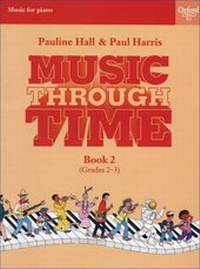
Music through Time Piano Book 2
Published on 3. June 1993
Other
Sheet music
32 pages
978-0-19-357194-5 (ISBN)
Description
A collection of repertoire books of enjoyable, interesting, and stimulating material for use in the early stages of learning. The pieces in Book 2 are of around grades 2-3 standard and are in chronological order, with brief notes placing them in history.
Reviews / Votes
A brilliant idea . . . There is now no excuse for the music student to be ignorant of the march of time, and the choice of music here is well varied . . . including the extra bonus of piano accompaniments which are playable by even the hamfisted . . . these pieces are carefully chosen, well arranged, carefully printed in the OUP tradition, and get away from the ususal run of tutorial backup material . . . It's a great idea. * Clarinet and Saxophone Magazine *More details
Series
Language
English
Place of publication
Oxford
United Kingdom
Target group
Professional and scholarly
Dimensions
Height: 311 mm
Width: 232 mm
Thickness: 3 mm
Weight
137 gr
ISBN-13
978-0-19-357194-5 (9780193571945)
Copyright in bibliographic data and cover images is held by Nielsen Book Services Limited or by the publishers or by their respective licensors: all rights reserved.
Schweitzer Classification
Persons
Paul Harris has established an international reputation as one of Britain's leading educationalists. He studied clarinet and conducting at the Royal Academy of Music, He then went on to study music education with Professor Keith Swanwick at the University of London.
He has well over 200 publications to his name; most are concerned with music education dealing primarily with stimulating and helping young players to develop their musical skills. His compositions also include a number of extended and more serious works. Recently he has made a major contribution to the English National Curriculum. He is an examiner for the Associated Board and adjudicates at music festivals and various national competitions. In addition he has undertaken research into specialist music education for the highly talented - an interest that has taken him to many musical institutions around the world.
Pauline Hall graduated from the Royal Academy of Music and then taught in schools and privately. Whilst living and teaching in Harrogate she felt the need for a piano tutor which made learning fun, and which progressed at the pace of her slowest learner. She started by writing little tunes in pupils' notebooks, and these formed the basis of Tunes for Ten Fingers; the Piano Time series developed from this.
He has well over 200 publications to his name; most are concerned with music education dealing primarily with stimulating and helping young players to develop their musical skills. His compositions also include a number of extended and more serious works. Recently he has made a major contribution to the English National Curriculum. He is an examiner for the Associated Board and adjudicates at music festivals and various national competitions. In addition he has undertaken research into specialist music education for the highly talented - an interest that has taken him to many musical institutions around the world.
Pauline Hall graduated from the Royal Academy of Music and then taught in schools and privately. Whilst living and teaching in Harrogate she felt the need for a piano tutor which made learning fun, and which progressed at the pace of her slowest learner. She started by writing little tunes in pupils' notebooks, and these formed the basis of Tunes for Ten Fingers; the Piano Time series developed from this.
Content
A Toye ; A masque ; Hornpipe ; King William's March ; Silent Worship ; Jigg ; Minuet ; Allemande ; Ecossaise ; Invitation to the Dance ; Prelude ; L'Avalanche ; Fandango ; Wild Horsemen ; Polka ; Tarantella ; March from L'Arlesienne ; Waltz ; Berceuse ; Maple Leaf Rag ; Christmas Present ; Having Fun ; Pagoda ; Playground Fun ; Oriental March