

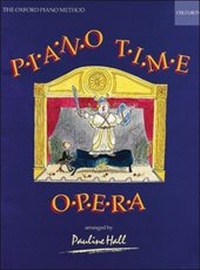
Piano Time Opera
Published on 8. January 1998
Other
Sheet music
40 pages
978-0-19-372762-5 (ISBN)
Description
31 really simple arrangements of operatic masterpieces starting at about the level of Piano Time 2 and arranged in order of difficulty.
More details
Series
Language
English
Place of publication
Oxford
United Kingdom
Target group
Professional and scholarly
Dimensions
Height: 311 mm
Width: 231 mm
Thickness: 3 mm
Weight
174 gr
ISBN-13
978-0-19-372762-5 (9780193727625)
Copyright in bibliographic data and cover images is held by Nielsen Book Services Limited or by the publishers or by their respective licensors: all rights reserved.
Schweitzer Classification
Person
Pauline Hall graduated from the Royal Academy of Music and then taught in schools and privately. Whilst living and teaching in Harrogate she felt the need for a piano tutor which made learning fun, and which progressed at the pace of her slowest learner. She started by writing little tunes in pupils' notebooks, and these formed the basis of Tunes for Ten Fingers; the Piano Time series developed from this.
Content
Habanera from Carmen ; Flower duet from Lakme ; Chorus of wedding guests from Lucia di Lammermoor ; Gavotte from Iphigenia in Aulis ; Arietta from Romeo and Juliet ; Soldier's chorus from Faust ; March from Rinaldo ; Minuet from Berenice ; 'Where'er you walk' from Semele ; 'Brother come and dance with me' from Hansel and Gretel ; Intermezzo from Cavalleria Rusticana ; 'Bei Mannern' from The Magic Flute ; Bird-catcher's song from The Magic Flute ; Dove Sono from The Marriage of Figaro ; 'La ci darem la mano' from Don Giovanni ; 'Voi che sapete' from The Marriage of Figaro ; Barcarolle from Tales of Hoffman ; 'My heart was so free' from The Beggar's Opera ; 'O mio babbino caro' from Gianni Schicchi ; One fine day from Madame Butterfly ; 'Fairest Isle' from King Arthur ; Overture from The Barber of Seville ; Dance from The Bartered Bride ; Laughing song from Die Fledermaus ; Gavotte from The Gondoliers ; 'The flowers that bloom in the Spring' from The Mikado ; Waltz from Eugene Onegin ; Chorus of the Hebrew slaves from Nabucco ; Libiamo from La Traviata ; Pilgrim's chorus from Tannhauser ; Prayer from Der Freischutz