

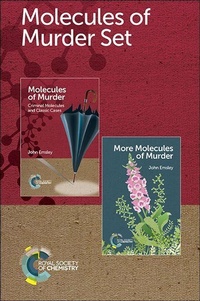
Molecules of Murder Set
Will be published approx. on 23. June 2017
Other
Multiple copy pack
524 pages
978-1-78801-116-7 (ISBN)
Description
How can a plant as beautiful as the foxglove be so deadly and yet for more than a century be used to treat heart disease? The same is true of other naturally occurring molecules as will be revealed in these two books from award-winning author and chemist, John Emsley.
Molecules of Murder and More Molecules of Murder deal with potential poisons from man-made and natural sources. Both books investigate the crimes committed with them, not from the point of view of the murderers, their victims, or the detectives, but from the poison used. In so doing the books throw new light on how these crimes were carried out and ultimately how the perpetrators were uncovered and brought to justice. The crimes include those committed by infamous murderers and also famous victims like Harold Shipman, Alexander Litvinenko and Georgi Markov.
Each chapter starts by looking at the target molecule itself, its discovery, its chemistry, its often-surprising use in medicine, its effects on the human body, and its toxicology. The rest of the chapter is devoted to murders and attempted murders in which it has been used. But, be reassured that murder by poison is not the threat it once was, thanks to laws which restrict access to such materials and to the skills of analytical chemists in detecting their presence in incredibly tiny amounts.
Molecules of Murder and More Molecules of Murder deal with potential poisons from man-made and natural sources. Both books investigate the crimes committed with them, not from the point of view of the murderers, their victims, or the detectives, but from the poison used. In so doing the books throw new light on how these crimes were carried out and ultimately how the perpetrators were uncovered and brought to justice. The crimes include those committed by infamous murderers and also famous victims like Harold Shipman, Alexander Litvinenko and Georgi Markov.
Each chapter starts by looking at the target molecule itself, its discovery, its chemistry, its often-surprising use in medicine, its effects on the human body, and its toxicology. The rest of the chapter is devoted to murders and attempted murders in which it has been used. But, be reassured that murder by poison is not the threat it once was, thanks to laws which restrict access to such materials and to the skills of analytical chemists in detecting their presence in incredibly tiny amounts.
Reviews / Votes
Most of the crimes covered in the books would be well known to those who have an interest in true crime, but don't think that because of this it is not worth the read! The uniqueness of these books is the explanation of the 'science' behind the crimes-something that is not covered as well as this in other publications. Have an interest in true crime and chemistry? These books are for you! * Biochem (Lond) (2019) 41 (6): 52-55. *More details
Language
English
Place of publication
Cambridge
United Kingdom
Dimensions
Height: 231 mm
Width: 154 mm
Thickness: 32 mm
Weight
809 gr
ISBN-13
978-1-78801-116-7 (9781788011167)
Copyright in bibliographic data and cover images is held by Nielsen Book Services Limited or by the publishers or by their respective licensors: all rights reserved.
Schweitzer Classification
Other editions
Complete work / Part of the work

John Emsley
More Molecules of Murder
Book
06/2017
Royal Society of Chemistry
€22.50
Shipment within 3-4 weeks
Book
10/2015
Royal Society of Chemistry
€21.50
Shipment within 3-4 weeks
Content
Molecules of Murder: Part I: From medicine to murder;
Chapter 1: Ricin and the assassination of Georgi Markov;
Chapter 2: Hyoscine and the murder of Belle Elmore;
Chapter 3: Atropine and Mrs Agutter's gin and tonic;
Chapter 4: Diamorphine and the Dr Jekyll of Hyde;
Chapter 5: Adrenaline and the near-perfect murders of Kirsten Gilbert;
Part II: So simple, so useful, so deadly;
Chapter 6: Chloroform and the murder of Edwin Bartlett;
Chapter 7: Life and Death and CO;
Carbon monoxide and the homemade gas chamber;
Chapter 8: Cyanide and the death on the Nile;
Chapter 9: Paraquat and the poisoned gravy;
Chapter 10: Polonium and the poisoning of Alexander Litvinenko;
More Molecules of Murder: Ethylene Glycol for Antifreeze and Loved Ones;
Oxalic Acid and Murders in Manila and Liverpool;
Acrylamide in Fried Foods and in Auckland;
Difenacoum, Amitriptyline and York;
Temazepam and the Man with a Murderous Plan;
Potassium Chloride: Essential to Life Yet Deadly;
Tetramethylenedisulfotetramine, a Mouthful Best Avoided;
Gelsemine and Cat Meat Stew;
Strychnine and Cream;
Digitalis and a Mysterious Death in Verona in 1329;
Curare and the Psychopathic Surgeon from Argentina;
Aconitine and Wimbledon;
Cantharidin and Spanish Fly;
Hemlock at the End of it All
Chapter 1: Ricin and the assassination of Georgi Markov;
Chapter 2: Hyoscine and the murder of Belle Elmore;
Chapter 3: Atropine and Mrs Agutter's gin and tonic;
Chapter 4: Diamorphine and the Dr Jekyll of Hyde;
Chapter 5: Adrenaline and the near-perfect murders of Kirsten Gilbert;
Part II: So simple, so useful, so deadly;
Chapter 6: Chloroform and the murder of Edwin Bartlett;
Chapter 7: Life and Death and CO;
Carbon monoxide and the homemade gas chamber;
Chapter 8: Cyanide and the death on the Nile;
Chapter 9: Paraquat and the poisoned gravy;
Chapter 10: Polonium and the poisoning of Alexander Litvinenko;
More Molecules of Murder: Ethylene Glycol for Antifreeze and Loved Ones;
Oxalic Acid and Murders in Manila and Liverpool;
Acrylamide in Fried Foods and in Auckland;
Difenacoum, Amitriptyline and York;
Temazepam and the Man with a Murderous Plan;
Potassium Chloride: Essential to Life Yet Deadly;
Tetramethylenedisulfotetramine, a Mouthful Best Avoided;
Gelsemine and Cat Meat Stew;
Strychnine and Cream;
Digitalis and a Mysterious Death in Verona in 1329;
Curare and the Psychopathic Surgeon from Argentina;
Aconitine and Wimbledon;
Cantharidin and Spanish Fly;
Hemlock at the End of it All