

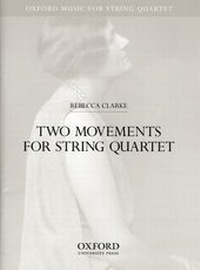
Two movements for string quartet
Score and parts
Published on 29. July 2004
Other
Sheet music
52 pages
978-0-19-386749-9 (ISBN)
Description
Rebecca Clarke worked in the string quartet medium over virtually the whole of her long life, either as a performer, a composer, or a teacher. The two movements published here are Clarke's only known 'pure' music (music that 'means only itself', as she put it) for string quartet.
Reviews / Votes
The first movement, 'Comodo e amabile', is fluid and sensuous, drawing similarities with the first movement of Debussy's String Quartet. The harmonies are largely modal and the interplay between the parts, rhythmical and harmonically, is beautifully crafted. There are no truly 'scary' moments for any player, from the technical point of view - just a few enharmonic changes in tonality to be aware of . . . A look at the score reveals how amazingly balanced and expansive Clarke's writing is. The individual parts have been thoughtfully and painstakingly edited and a clearly presented score is included. These two movements are a welcome addition to the string quartet repertoire. I think students would find them accessible and rewarding. * Kay Tucker, ESTA New and Views March 06 *More details
Edition
Score and parts
Language
English
Place of publication
Oxford
United Kingdom
Target group
Professional and scholarly
Dimensions
Height: 305 mm
Width: 229 mm
Thickness: 4 mm
Weight
192 gr
ISBN-13
978-0-19-386749-9 (9780193867499)
Copyright in bibliographic data and cover images is held by Nielsen Book Services Limited or by the publishers or by their respective licensors: all rights reserved.
Schweitzer Classification
Person
Rebecca Clarke was born in Harrow in 1886 and died in New York City in 1979.
She was one of the finest viola players of her day and a skilful composer who studied with Stanford at the Royal College of Music in London.
Her output as a composer was small, comprising about 90 works, but all these pieces are brilliant and powerful. Her Piano Trio and Viola Sonata are often played and recorded, and are now widely regarded as masterpieces. However her songs are perhaps her finest body of works, and embrace a variety of styles from Blakean simplicity to brutal tragedy and outright farce.
Rebecca Clarke's choral music was virtually unknown until Oxford University Press began to publish these works for the first time. She wrote for chorus and other vocal ensembles throughout virtually her whole career, from her earliest attempts at composition around 1906 to her final flowering in the 1940s, revising and recomposing until as late as 1976.
She was one of the finest viola players of her day and a skilful composer who studied with Stanford at the Royal College of Music in London.
Her output as a composer was small, comprising about 90 works, but all these pieces are brilliant and powerful. Her Piano Trio and Viola Sonata are often played and recorded, and are now widely regarded as masterpieces. However her songs are perhaps her finest body of works, and embrace a variety of styles from Blakean simplicity to brutal tragedy and outright farce.
Rebecca Clarke's choral music was virtually unknown until Oxford University Press began to publish these works for the first time. She wrote for chorus and other vocal ensembles throughout virtually her whole career, from her earliest attempts at composition around 1906 to her final flowering in the 1940s, revising and recomposing until as late as 1976.