

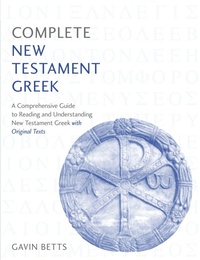
Complete New Testament Greek
A Comprehensive Guide to Reading and Understanding New Testament Greek with Original Texts
Published on 7. June 2018
Other
Cards
304 pages
978-1-4736-2789-5 (ISBN)
Description
Designed for complete beginners, and tested for years with real learners, Complete New Testament Greek offers a bridge from the textbook to the real world, enabling you to learn the grammar, understand the vocabulary and ultimately how to translate the language in which the Bible was originally written.
Structured around authentic material, placing an emphasis on the importance of reading Biblical texts in the original, and introducing both a grammar perspective and a full introduction to essential vocabulary, this course also features:
-21 learning units plus maps and verb guide
-Authentic materials - language taught through key texts
-Teaches the key skills - reading and understanding Greek grammar and vocabulary
-Self tests and learning activities - see and track your own progress
Rely on Teach Yourself, trusted by language learners for over 75 years.
Structured around authentic material, placing an emphasis on the importance of reading Biblical texts in the original, and introducing both a grammar perspective and a full introduction to essential vocabulary, this course also features:
-21 learning units plus maps and verb guide
-Authentic materials - language taught through key texts
-Teaches the key skills - reading and understanding Greek grammar and vocabulary
-Self tests and learning activities - see and track your own progress
Rely on Teach Yourself, trusted by language learners for over 75 years.
Reviews / Votes
I find the book excellent... This book would most certainly be a very good choice for any introductory module. I found it very easy to read. The author has a very pleasant and down to earth manner. The fact that most examples are taken directly from the New Testament makes the study very interesting and encouraging. -- Dr Georg Walser, Senior Lecturer, University of Gothenburg I have learned lots from this book myself - it is extremely detailed and Prof. Betts is clearly extremely knowledgeable about this particular form of Greek. -- Cressida Ryan, Instructor in New Testament Greek, Faculty of Theology and Religion, University of OxfordMore details
Language
English
Place of publication
United Kingdom
Publishing group
John Murray Press
Target group
Professional and scholarly
Product notice
Paperback (UK-trade)
Dimensions
Height: 243 mm
Width: 187 mm
Thickness: 19 mm
Weight
584 gr
ISBN-13
978-1-4736-2789-5 (9781473627895)
Copyright in bibliographic data and cover images is held by Nielsen Book Services Limited or by the publishers or by their respective licensors: all rights reserved.
Schweitzer Classification
Other editions
Additional editions
Gavin Betts
Complete New Testament Greek
A Comprehensive Guide to Reading and Understanding New Testament Greek with Original Texts
E-Book
06/2018
1st Edition
Teach Yourself
€3.99
Available for download
Gavin Betts
Complete New Testament Greek
A Comprehensive Guide to Reading and Understanding New Testament Greek with Original Texts
E-Book
04/2012
Teach Yourself Books
€3.99
Available for download
Person
Gavin Betts (retired) was Associated Professor of Classical Studies, Monash University, Victoria, Australia. His publications include Teach Yourself Latin, Teach Yourself New Testament Greek, Teach Yourself New Testament Greek and various translations of medieval and Modern Greek texts.
Content
: Introduction
: How to use this book
: Glossary of grammatical terms
: Abbreviations
: Unit 1: 1.1/1 The Greek alphabet and its pronunciation /2 Accents .2 Exercise
: Unit 2: 2.1/1 Nouns in Greek /2 Second declension and the masculine and neuter definite article /3 Basic uses of cases /4 Verbs in Greek /5 Present and future indicative active /6 Word order and elision .2 Greek reading /1 Vocabulary .3 The nature o
: Unit 3: 3.1/1 First declension (feminine nouns) and the feminine definite article /2 First declension (masculine nouns) /3 First and second declension adjectives /4 Adverbs /5 Prepositions /6 Present indicative and infinitive of 'I am' .2 Greek read
: Unit 4: 4.1/1 Imperfect indicative active and weak aorist indicative and infinitive active /2 Personal pronouns /3 Non-Greek proper nouns /4 Connecting particles .2 Greek reading /1 Vocabulary .3 Excursus-Books in antiquity
: Unit 5: 5.1/l Third declension-consonant stem nouns (1) /2 Contracted verbs /3 Further uses of the definite article .2 Greek reading /1 Vocabulary
: Unit 6: 6.1/1 Third declension-consonant stem nouns (2) /2 'know' /3 Compound verbs formed with prepositional prefixes /4 stems in palatals, labials, dentals .2 Greek reading /1 Vocabulary
: Unit 7: 7.1/1 Strong aorist indicative and infinitive active /2 Direct and indirect speech /3 'say' and direct speech /4 Indirect command /5 Numerals /6 Phrases expressing time and space .2 Greek reading /1 Vocabulary
: Unit 8: 8.1/1 Middle and passive voices /2 Deponent verbs /3 Negatives /4 Indirect statement /5 Third declension nouns-stems .2 Greek reading /1 Vocabulary .3 Excursus-How the New Testament has been transmitted
: Unit 9: 9.1/1 Demonstrative pronouns /2 A relative pronoun and adjectival clauses /3 Reflexive and reciprocal pronouns /4 Possessive adjectives and pronouns .2 Greek reading /1 Vocabulary
: Unit 10: 10.1/1 Questions, direct and indirect /2 First and third declension adjectives /3 Third declension adjectives .2 Greek reading
: Unit 11: 11.1/1 Aorist passive, root aorist and future passive /2 Agent and instrument /3 Crasis .2 Greek reading
: Unit 12: 12.1/1 Participles /2 Uses of participles .2 Greek reading .3 Excursus-The text of the New Testament
: Unit 13: 13.1/1 Moods of the Greek verb /2 Subjunctive mood /3 Uses of the subjunctive (1) /3 Optative mood and its uses .2 Greek reading
: Unit 14: 14.1/1 Uses of the subjunctive (2) /2 Perfect indicative active .2 Greek reading
: Unit 15: 15.1/1 Verbs used with the genitive or dative /2 Further particles 2 Greek reading
: Unit 16: 16.1/1 Pluperfect indicative active /3 Perfect and pluperfect indicative middle/passive /4 Other parts of the perfect tense .2 Greek reading
: Unit 17: 17.1/1 Imperative mood - commands and prohibitions /2 Comparison of adjectives and adverbs /3 Meaning of the comparative and superlative /4 Constructions involving the comparative .2 Greek reading .3 Excursus-The Septuagint
: Unit 18: 18.1/1 'give', 'put', 'place' /3 Conditional sentences /4 Other potential constructions .2 Greek reading
: Unit 19: 19.1/1 Eccentric verbs .2 Greek reading
: Unit 20: 20.1/1 Uses of cases (1) - nominative and accusative /3 Uses of cases (2) - genitive /4 Oddities in verbs .2 Greek reading .3 Excursus-Translations of the New Testament
: Unit 21: 21.1/1 Uses of cases (3) - dative /2 First and second declension contracted adjectives /3 Further demonstrative and relative adjectives/pronouns .2 Greek reading
: Suggestions for further study
: Appendices
: 1 Conjugation of 'loosen'
: 2 Conjugation of contracted verbs (present and imperfect)
: 3 Conjugation of 'be', 'say', 'know'
: 4 Root aorists
: 5 Conjugation of 'give', 'put', 'place', 'make stand'
: 6 Numerals
: 7 Accentuation
: Key to exercises
: Principal parts of verbs
: Vocabulary
: Index
: How to use this book
: Glossary of grammatical terms
: Abbreviations
: Unit 1: 1.1/1 The Greek alphabet and its pronunciation /2 Accents .2 Exercise
: Unit 2: 2.1/1 Nouns in Greek /2 Second declension and the masculine and neuter definite article /3 Basic uses of cases /4 Verbs in Greek /5 Present and future indicative active /6 Word order and elision .2 Greek reading /1 Vocabulary .3 The nature o
: Unit 3: 3.1/1 First declension (feminine nouns) and the feminine definite article /2 First declension (masculine nouns) /3 First and second declension adjectives /4 Adverbs /5 Prepositions /6 Present indicative and infinitive of 'I am' .2 Greek read
: Unit 4: 4.1/1 Imperfect indicative active and weak aorist indicative and infinitive active /2 Personal pronouns /3 Non-Greek proper nouns /4 Connecting particles .2 Greek reading /1 Vocabulary .3 Excursus-Books in antiquity
: Unit 5: 5.1/l Third declension-consonant stem nouns (1) /2 Contracted verbs /3 Further uses of the definite article .2 Greek reading /1 Vocabulary
: Unit 6: 6.1/1 Third declension-consonant stem nouns (2) /2 'know' /3 Compound verbs formed with prepositional prefixes /4 stems in palatals, labials, dentals .2 Greek reading /1 Vocabulary
: Unit 7: 7.1/1 Strong aorist indicative and infinitive active /2 Direct and indirect speech /3 'say' and direct speech /4 Indirect command /5 Numerals /6 Phrases expressing time and space .2 Greek reading /1 Vocabulary
: Unit 8: 8.1/1 Middle and passive voices /2 Deponent verbs /3 Negatives /4 Indirect statement /5 Third declension nouns-stems .2 Greek reading /1 Vocabulary .3 Excursus-How the New Testament has been transmitted
: Unit 9: 9.1/1 Demonstrative pronouns /2 A relative pronoun and adjectival clauses /3 Reflexive and reciprocal pronouns /4 Possessive adjectives and pronouns .2 Greek reading /1 Vocabulary
: Unit 10: 10.1/1 Questions, direct and indirect /2 First and third declension adjectives /3 Third declension adjectives .2 Greek reading
: Unit 11: 11.1/1 Aorist passive, root aorist and future passive /2 Agent and instrument /3 Crasis .2 Greek reading
: Unit 12: 12.1/1 Participles /2 Uses of participles .2 Greek reading .3 Excursus-The text of the New Testament
: Unit 13: 13.1/1 Moods of the Greek verb /2 Subjunctive mood /3 Uses of the subjunctive (1) /3 Optative mood and its uses .2 Greek reading
: Unit 14: 14.1/1 Uses of the subjunctive (2) /2 Perfect indicative active .2 Greek reading
: Unit 15: 15.1/1 Verbs used with the genitive or dative /2 Further particles 2 Greek reading
: Unit 16: 16.1/1 Pluperfect indicative active /3 Perfect and pluperfect indicative middle/passive /4 Other parts of the perfect tense .2 Greek reading
: Unit 17: 17.1/1 Imperative mood - commands and prohibitions /2 Comparison of adjectives and adverbs /3 Meaning of the comparative and superlative /4 Constructions involving the comparative .2 Greek reading .3 Excursus-The Septuagint
: Unit 18: 18.1/1 'give', 'put', 'place' /3 Conditional sentences /4 Other potential constructions .2 Greek reading
: Unit 19: 19.1/1 Eccentric verbs .2 Greek reading
: Unit 20: 20.1/1 Uses of cases (1) - nominative and accusative /3 Uses of cases (2) - genitive /4 Oddities in verbs .2 Greek reading .3 Excursus-Translations of the New Testament
: Unit 21: 21.1/1 Uses of cases (3) - dative /2 First and second declension contracted adjectives /3 Further demonstrative and relative adjectives/pronouns .2 Greek reading
: Suggestions for further study
: Appendices
: 1 Conjugation of 'loosen'
: 2 Conjugation of contracted verbs (present and imperfect)
: 3 Conjugation of 'be', 'say', 'know'
: 4 Root aorists
: 5 Conjugation of 'give', 'put', 'place', 'make stand'
: 6 Numerals
: 7 Accentuation
: Key to exercises
: Principal parts of verbs
: Vocabulary
: Index