

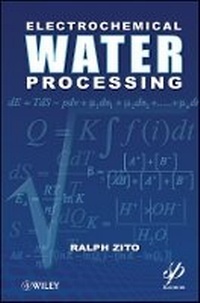
Electrochemical Water Processing
Published on 6. July 2011
Software
Other digital
336 pages
978-1-118-10467-5 (ISBN)
Description
Even though most of the Earth's surface is covered with water, most of it is not directly usable for human consumption or applications. As the population increases and our general style of living standards increase, the importance useable water is becoming acute. This book addresses this issue with approaches to treating water sources that require removal of unwanted or dissolved substances. In particular, it covers various methods for removing dissolved ionic materials. There are numerous methods for accomplishing this end, and the book reviews most of them in some depth.
More details
Language
English
Place of publication
New York
United States
Target group
Professional and scholarly
Dimensions
Height: 250 mm
Width: 150 mm
Thickness: 15 mm
Weight
666 gr
ISBN-13
978-1-118-10467-5 (9781118104675)
Copyright in bibliographic data and cover images is held by Nielsen Book Services Limited or by the publishers or by their respective licensors: all rights reserved.
Schweitzer Classification
Other editions
Additional editions
Ralph Zito
Electrochemical Water Processing
E-Book
01/2012
Wiley-Scrivener
€179.99
Available for download
Ralph Zito
Electrochemical Water Processing
E-Book
07/2011
Wiley-Scrivener
€179.99
Available for download
Content
Preface. Acknowledgements. Introduction. 1. Water Contaminants and Their Removal. 1.1 Introduction. 1.2 Technology, History, and Background. 1.3 Application Areas: Electrochemical Technology Water Processing. 2. Basic Electrochemical and Physical Principles. 2.1 Introduction. 2.2 Acidity and Alkalinity, pH. 2.3 Activity and Activity Coefficients. 2.4 Equilibrium and Dissociation Constants. 2.5 Electrode, or Half Cell Potential. 2.6 Chemical Potential Definition. 2.7 Concentration Potential. 2.8 Equivalent Conductance. 2.9 Free Energy and Equilibrium. 2.10 Dissociation Constants. 2.11 Ionic Conductance and Mobility. 2.12 Osmotic Pressure. 2.13 Diffusion (Flick's Law). 3. Systems Description: General Outlines of Basic Approaches. 3.1 Electrodialysis. 3.2 pH Control: Analytic Development. 3.3 Biociding Technology. 3.4 Ion Exchange Resin Regeneration System. 3.5 Metals Reclamation. 4. Mathematical Analysis & Modeling Electrodialysis Systems. 4.1 Electrodialysis: Descriptions and Definitions. 4.2 Basic Assumptions and Operating Parameters. 4.3 Parametric Analysis: Flow-Through Configuration. 4.4 Flow-Through Design Exercises. 4.5 Batch Process Analysis: Re-Circulating or Static Water Processing System. 4.6 Design Exercises for Water Re-Circulation Systems. 4.7 Cell Potential and Membrane Resistance Contributions. 4.8 Diffusion Losses of Ions and Molecules Across Membranes. 5. System Design Exercises & Examples. 5.1 Electrolytic Generation of Bromine and Chlorine: Design Procedures. 5.2 Simple Estimate of Capital Equipment and Operating Cost of Electrochemical Desalination Apparatus. 5.3 Cost Estimates Outline for an Electrodialysis De-ionizing System. 6. Applications Discussion. 6.1 Demineralizer: Electrodialysis. 6.2 Reseidentialwater Softener. 6.3 Electrical Water Processor Portable Design. Appendix A: Some Physical Constants and Conversion Factors. Appendix B: Conductance and Solubility. Appendix C: Feeder Tube and Common Manifolding Losses. Appendix D: Variable Current Density. Appendix E: Mathematical Analysis: Water pH Control Cell and Ion Exchange Resin Regeneration. Appendix F: Industrial Chlorination and Bromination Equipment Cost Estimates. Appendix G: Design Mathematics in Computer Format. Appendix H: Mathematics for Simple Electrochemical Biociding. Bibliography. Index. Also of Interest.