

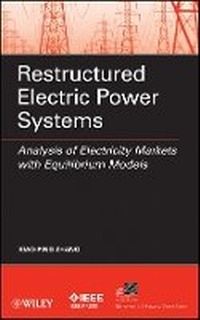
Restructured Electric Power Systems - Analysis of lectricity Markets with Equilibrium Models
Published on 28. September 2010
Software
Other digital
224 pages
978-0-470-60855-5 (ISBN)
Description
Electricity market deregulation is driving power energy production from a monopolistic structure into a competitive market environment. This book reviews the latest developments in analyzing and assessing electricity market behavior and market power, and discusses the application of such models in the practical analysis of electricity markets. It covers the most recent research and developments in the field, as well as future directions. It is an invaluable reference for professionals responsible for the design, engineering, research, and development of competitive electricity markets.
Reviews / Votes
"Restructured Electric Power Systems is an invaluable reference for electrical engineers and power system economists from power utilities and for professors, postgraduate students, and undergraduate students in electrical power engineering, as well as those responsible for the design, engineering, research, and development of competitive electricity markets and electricity market policy." (PR-inside.com, 28 October 2010)More details
Language
English
Place of publication
Hoboken
United Kingdom
Publishing group
John Wiley and Sons Ltd
Target group
Professional and scholarly
ISBN-13
978-0-470-60855-5 (9780470608555)
Copyright in bibliographic data and cover images is held by Nielsen Book Services Limited or by the publishers or by their respective licensors: all rights reserved.
Schweitzer Classification
Other editions
Additional editions
Xiao-Ping Zhang
Restructured Electric Power Systems
Analysis of Electricity Markets with Equilibrium Models
E-Book
10/2010
Wiley-IEEE Press
€104.99
Available for download
Xiao-Ping Zhang
Restructured Electric Power Systems
Analysis of Electricity Markets with Equilibrium Models
E-Book
10/2010
Wiley-IEEE Press
€101.99
Available for download
Person
Xiao-Ping Zhang , PhD, is a reader and director of the Institute for Energy Research and Policy at the University of Birmingham, United Kingdom. He is a senior member of the IEEE, as well as an IEEE PES Distinguished Lecturer.
Content
PREFACE. CONTRIBUTORS. 1 FUNDAMENTALS OF ELECTRIC POWER SYSTEMS ( Xiao-Ping Zhang ). 1.1 Introduction of Electric Power Systems. 1.2 Electric Power Generation. 1.3 Structure of Electric Power Systems. 1.4 Ultra-High Voltage Power Transmission. 1.5 Modeling of Electric Power Systems. 1.6 Power Flow Analysis. 1.7 Optimal Operation of Electric Power Systems. 1.8 Operation and Control of Electric Power Systems-SCADA/EMS. 1.9 Active Power and Frequency Control. 1.10 Voltage Control and Reactive Power Management. 1.11 Applications of Power Electronics to Power System Control. References. 2 RESTRUCTURED ELECTRIC POWER SYSTEMS AND ELECTRICITY MARKETS ( Kwok W. Cheung, Gary W. Rosenwald, Xing Wang, and David I. Sun ). 2.1 History of Electric Power Systems Restructuring. 2.2 Structure of Electricity Markets. 2.3 Design of Electricity Markets. 2.4 Operation of Electricity Markets. 2.5 Computation Tools for Electricity Markets. 2.6 Final Remarks. References. 3 OVERVIEW OF ELECTRICITY MARKET EQUILIBRIUM PROBLEMS AND MARKET POWER ANALYSIS ( Xiao-Ping Zhang ). 3.1 Game Theory and Its Applications. 3.2 Electricity Markets and Market Power. 3.3 Market Power Monitoring, Modeling, and Analysis. 3.4 Application of the Equilibrium Models in the Electricity Markets. 3.5 Computational Tools for Electricity Market Equilibrium Modeling and Market Power Analysis. 3.6 Solution Techniques for MPECs. 3.7 Solution Techniques for EPECs. 3.8 Technical Challenges for Solving MPECs and EPECs. 3.9 Software Resources for Large-Scale Nonlinear Optimization. References. 4 COMPUTING THE ELECTRICITY MARKET EQUILIBRIUM: USES OF MARKET EQUILIBRIUM MODELS ( Ross Baldick ). 4.1 Introduction. 4.2 Model Formulation. 4.3 Market Operation and Price Formation. 4.4 Equilibrium Defi nition. 4.5 Computation. 4.6 Diffi culties with Equilibrium Models. 4.7 Uses of Equilibrium Models. 4.8 Conclusion. Acknowledgment. References. 5 HYBRID BERTRAND-COURNOT MODELS OF ELECTRICITY MARKETS WITH MULTIPLE STRATEGIC SUBNETWORKS AND COMMON KNOWLEDGE CONSTRAINTS ( Jian Yao, Shmuel S. Oren, and Benjamin F. Hobbs ). 5.1 Introduction. 5.2 Role of the ISO. 5.3 The Hybrid Subnetwork Model. 5.4 Numerical Example for the Subnetworks Model. 5.5 Bertrand Model with Common Knowledge Constraints. 5.6 Numerical Example of Equilibrium with Common Knowledge Constraints. 5.7 Concluding Remarks. Acknowledgments. References. 6 ELECTRICITY MARKET EQUILIBRIUM WITH REACTIVE POWER CONTROL ( Xiao-Ping Zhang ). 6.1 Introduction. 6.2 AC Power Flow Model in the Rectangular Coordinates. 6.3 Electricity Market Analysis Using AC Optimal Power Flow in the Rectangular Coordinates. 6.4 Electricity Market Equilibrium Analysis. 6.5 Computing the Electricity Market Equilibrium with AC Network Model. 6.6 Implementation Issues of Electricity Market Equilibrium Analysis with AC Network Model. 6.7 Numerical Examples. 6.8 Conclusions. 6.9 Appendix. Acknowledgments. References. 7 USING MARKET SIMULATIONS FOR ECONOMIC ASSESSMENT OF TRANSMISSION UPGRADES: APPLICATION OF THE CALIFORNIA ISO APPROACH ( Mohamed Labib Awad, Keith E. Casey, Anna S. Geevarghese, Jeffrey C. Miller, A. Farrokh Rahimi, Anjali Y. Sheffrin, Mingxia Zhang, Eric Toolson, Glenn Drayton, Benjamin F. Hobbs, and Frank A. Wolak ). 7.1 Introduction. 7.2 Five Principles. 7.3 Palo Verde-Devers NO. 2 Study. 7.4 Recent Applications of Team to Renewables. 7.5 Conclusion. Acknowledgments. References. INDEX.