

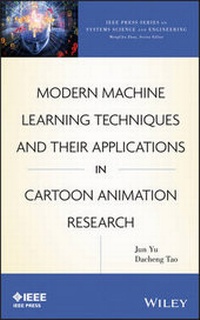
Modern Machine Learning Techniques and their Applications in Cartoon Animation Research
Published on 3. April 2013
Software
Other digital
208 pages
978-1-118-55996-3 (ISBN)
Description
The integration of machine learning techniques and cartoon animation research is fast becoming a hot topic. This book helps readers learn the latest machine learning techniques, including patch alignment framework; spectral clustering, graph cuts, and convex relaxation; ensemble manifold learning; multiple kernel learning; multiview subspace learning; and multiview distance metric learning. It then presents the applications of these modern machine learning techniques in cartoon animation research. With these techniques, users can efficiently utilize the cartoon materials to generate animations in areas such as virtual reality, video games, animation films, and sport simulations.
More details
Language
English
Place of publication
New York
United States
Target group
Professional and scholarly
Dimensions
Height: 250 mm
Width: 150 mm
Thickness: 15 mm
Weight
3436 gr
ISBN-13
978-1-118-55996-3 (9781118559963)
Copyright in bibliographic data and cover images is held by Nielsen Book Services Limited or by the publishers or by their respective licensors: all rights reserved.
Schweitzer Classification
Other editions
Additional editions
Jun Yu | Dacheng Tao
Modern Machine Learning Techniques and Their Applications in Cartoon Animation Research
E-Book
03/2013
Wiley-IEEE Press
€89.99
Available for download
Persons
JUN YU, PhD, is an Associate Professor in the Computer Science Department, School of Information Science and Engineering, Xiamen University, Xiamen, China. His current research interests include computer graphics, computer visions, and machine learning. He has authored or coauthored more than thirty scientific articles in journals including IEEE T-IP, IEEE TSMC-B, and Pattern Recognition. DACHENG TAO, PhD, is Professor of Computer Science with the Centre for Quantum Computation & Intelligent Systems and the Faculty of Engineering & Information Technology, University of Technology, Sydney, Australia. His research applies statistics and mathematics to data analysis problems in computer vision, data mining, machine learning, multimedia, and video surveillance. He has authored more than 100 scientific articles.
Content
1 Introduction 1.1 Perception 1.2 Overview of Machine Learning Techniques 1.2.1 Manifold Learning 1.2.2 Semisupervised Learning 1.2.3 Multiview Learning 1.2.4 Learningbased Optimization 1.3 Recent Developments in Computer Animation 1.3.1 Examplebased Motion Reuse 1.3.2 Physicallybased Computer Animation 1.3.3 Computer Assisted Cartoon Animation 1.3.4 Crowd Animation 1.3.5 Facial Animation 1.4 Chapter Summary 2 Modern Machine Learning Techniques 2.1 A Unified Framework for Manifold Learning 2.1.1 Framework Introduction 2.1.2 Various Manifold Learning Algorithm Unifying 2.1.3 Discriminative Locality Alignment 2.1.4 Discussions 2.2 Spectral Clustering and Graph Cut 2.2.1 Spectral Clustering 2.2.2 Graph Cut Approximation 2.3 Ensemble Manifold Learning 2.3.1 Motivation for EMR 2.3.2 Overview of EMR 2.3.3 Applications of EMR 2.4 Multiple Kernel Learning 2.4.1 A Unified Mulitple Kernel Learning Framework 2.4.2 SVM with Multiple UnweightedSum Kernels 2.4.3 QCQP Multiple Kernel Learning 2.5 Multiview Subspace Learning 2.5.1 Approach Overview 2.5.2 Techinique Details 2.5.3 Alternative Optimization used in PAMSL 2.6 Multiview Distance Metric Learning 2.6.1 Motivation for MDML 2.6.2 Graphbased Semisupervised Learning 2.6.3 Overview of MDML 2.7 Multitask Learning 2.7.1 Introduction of Structural Learning 2.7.2 Hypothesis Space Selection 2.7.3 Algorithm for Multitask Learning 2.7.4 Solution by Alternative Optimization 2.8 Chapter Summary 3 Animation Research: A brief Introduction 3.1 Traditional Animation Production 3.1.1 History of Traditional Animation Production 3.1.2 Procedures of Animation Production 3.1.3 Relationship between Traditional Animation and Computer Animation 3.2 Computer Assisted Systems 3.2.1 Computer Animation Techniques 3.3 Cartoon Reuse Systems for Animation Synthesis 3.3.1 Cartoon Texture for Animation Synthesis 3.3.2 Cartoon Motion Reuse 3.3.3 Motion capture data reuse in cartoon characters 3.4 Graphical Materials Reuse: More Examples 3.4.1 Video Clips Reuse 3.4.2 Motion Captured Data Reuse by Motion Texture 3.4.3 Motion Capture Data Reuse by Motion Graph 3.5 Chapter Summary 4 Animation Research: Modern Techniques 4.1 Automatic Cartoon Generation with Correspondence Construction 4.1.1 Related Work in Correspondence Construction 4.1.2 Introduction of the Semisupervised Correspondence Construction 4.1.3 Stroke Correspondence Construction via Stroke Reconstruction Algorithm 4.1.4 Simulation Results 4.2 Cartoon Characters Represented by Multiple Features 4.2.1 Cartoon Character Extraction 4.2.2 Color Histogram 4.2.3 Motion feature 4.2.4 Skeleton Feature 4.2.5 Complementary Characteristics of Multiview Features 4.3 Graphbased Cartoon Clips Synthesis 4.3.1 Graph Model Construction 4.3.2 Distance Calculation 4.3.3 Simulation Results 4.4 Retrievalbased Cartoon Clips Synthesis 4.4.1 Constrained Spreading Activation Network 4.4.2 Semisupervised Multiview Subspace Learning 4.4.3 Simulation Results 4.5 Chapter Summary References