

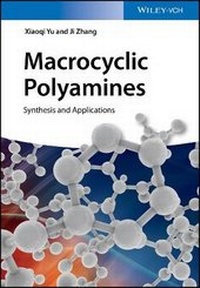
Macrocyclic Polyamines Synthesis and Applications
Published on 24. November 2017
Software
Other digital
232 pages
978-3-527-80410-8 (ISBN)
More details
Language
English
Place of publication
Weinheim
Germany
Target group
Professional and scholarly
Dimensions
Height: 250 mm
Width: 150 mm
Thickness: 15 mm
Weight
666 gr
ISBN-13
978-3-527-80410-8 (9783527804108)
Copyright in bibliographic data and cover images is held by Nielsen Book Services Limited or by the publishers or by their respective licensors: all rights reserved.
Schweitzer Classification
Other editions
Additional editions
E-Book
11/2017
1st Edition
Wiley-VCH
€120.99
Available for download
E-Book
10/2017
1st Edition
Wiley-VCH
€120.99
Available for download
Person
Xiao-Qi Yu is Changjiang Chair professor and Dean of College of Chemistry, Sichuan University. He has received several awards, including Distinguished Young Scholars Awarded (2007, National Science Foundation of China), New Century Excellent Talent Award (2003, Ministry of Education of China). His research interests include biomedical materials chemistry (especially for non-viral gene and drug delivery vectors) and methodology of organic syntheses (green synthetic methodologies). He has published over 300 scientific papers on international journals including JACS, Angew. Chem. Int. Ed., Coord. Chem. Rev., Biomaterials, Chem. Commun., Green Chem., etc. Ji Zhang is now a professor in College of Chemistry, Sichuan University, China. His current research focuses on nano-biomaterials, i.e. design, synthesis and establishment of novel non-viral gene and drug delivery systems and relative structure-activity relationship (SAR) studies. He is also interested in green organic synthetic methodology with high efficiency and selectivity, including microwave-assisted organic synthesis. He has authored over 100 scientific publications and received several awards both in scientific and teaching areas.
Content
1. Introduction 1.1. Classification of macrocyclic polyamines 1.2. Properties of macrocyclic polyamines 1.3. Application of macrocyclic polyamines 2. Synthetic Methods of Macrocyclic Polyamines 2.1. Introduction 2.2. Aliphatic (or saturated) macrocyclic polyamines 2.3. Macrocyclic polyamines containing aromatic rings 2.4. Macrocyclic amides 2.5. Macrocyclic imines 2.6. Cross-linked macrocyclic polyamines 3. Chemical Nucleases Based on Macrocyclic Polyamines 3.1. Introduction 3.2. Hydrolysis of nucleic acid 3.2.1. Metal complexes of macrocyclic ligands 3.2.2. Metal-free macrocyclic polyamines 3.3. Oxidative cleavage of nucleic acid 3.4. Summary 4. The Derivatives of Macrocyclic Polyamines as Nano-vector Materials 4.1. Introduction 4.2. Derivatives of macrocyclic polyamines as non-viral gene vectors 4.2.1. Cationic polymers 4.2.2. Lipids with cationic macrocyclic polyamine headgroups 4.2.3. Other types of vectors 4.3. Multifunctional materials for both drug delivery and bio-imaging 4.3.1. Gd complexes 4.3.2. Cu64 complexes 4.4. Miscellaneous 4.5. Summary 5. Macrocyclic Polyamines Derivatives for Bio-imaging 5.1. Introduction 5.2. Typical macrocyclic polyamines for magnetic resonance imaging (MRI) 5.2.1. DOTA and its derivatives 5.2.2. DO3A and its derivatives 5.2.3. PCTA and its derivatives 5.2.4. TETA and NOTA 5.3. Other derivatives of macrocyclic polyamine for MRI 5.3.1. Phosphonate macrocyclic ligands 5.3.2. Amide macrocyclic ligands 5.3.3. Ligands with hydroxy arms 5.3.4. Other types 5.4. Macrocyclic polyamines for PET imaging 6. Chemical Sensors/Receptors Based on Macrocyclic Polyamines 6.1. Introduction 6.2. Sensors for metal cations 6.2.1. Zn(II) and Cd(II) 6.2.2. Cu(II) and Pb(II) 6.2.3. Hg(II) , Ag(I) and others 6.3. Receptors for anions 6.3.1. Phosphonates 6.3.2. Amino acids 6.3.3. Other anions 6.4. pH indicator 6.5. Sensors for bioactive molecules 6.5.1. Small molecules 6.5.2. Proteins 6.5.3. Others 7. Other Applications of Macrocyclic Polyamines 7.1. Macrocyclic polyamines for exaction and separation of metal ions 7.2. Macrocyclic polyamines for organic catalysis 7.3. Bioactivities of macrocyclic polyamines 7.4. Self-assembly of macrocyclic polymaines 7.5. Others