

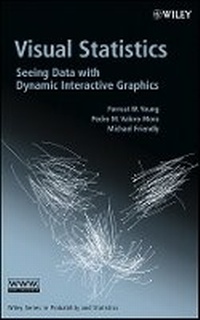
Visual Statistics - Seeing Data with Dynamic ctive Graphics
Published on 19. September 2011
Software
Other digital
400 pages
978-1-118-16540-9 (ISBN)
Description
A visually intuitive approach to statistical data analysis Visual Statistics brings the most complex and advanced statistical methods within reach of those with little statistical training by using animated graphics of the data. Using ViSta: The Visual Statistics System-developed by Forrest Young and Pedro Valero-Mora and available free of charge on the Internet-students can easily create fully interactive visualizations from relevant mathematical statistics, promoting perceptual and cognitive understanding of the data's story. An emphasis is placed on a paradigm for understanding data that is visual, intuitive, geometric, and active, rather than one that relies on convoluted logic, heavy mathematics, systems of algebraic equations, or passive acceptance of results. A companion Web site complements the book by further demonstrating the concept of creating interactive and dynamic graphics. The book provides users with the opportunity to view the graphics in a dynamic way by illustrating how to analyze statistical data and explore the concepts of visual statistics. Visual Statistics addresses and features the following topics: * Why use dynamic graphics?
* A history of statistical graphics * Visual statistics and the graphical user interface * Visual statistics and the scientific method * Character-based statistical interface objects * Graphics-based statistical interfaces * Visualization for exploring univariate data This is an excellent textbook for undergraduate courses in data analysis and regression, for students majoring or minoring in statistics, mathematics, science, engineering, and computer science, as well as for graduate-level courses in mathematics. The book is also ideal as a reference/self-study guide for engineers, scientists, and mathematicians. With contributions by highly regarded professionals in the field, Visual Statistics not only improves a student's understanding of statistics, but also builds confidence to overcome problems that may have previously been intimidating.
* A history of statistical graphics * Visual statistics and the graphical user interface * Visual statistics and the scientific method * Character-based statistical interface objects * Graphics-based statistical interfaces * Visualization for exploring univariate data This is an excellent textbook for undergraduate courses in data analysis and regression, for students majoring or minoring in statistics, mathematics, science, engineering, and computer science, as well as for graduate-level courses in mathematics. The book is also ideal as a reference/self-study guide for engineers, scientists, and mathematicians. With contributions by highly regarded professionals in the field, Visual Statistics not only improves a student's understanding of statistics, but also builds confidence to overcome problems that may have previously been intimidating.
Reviews / Votes
"The people who would benefit most from this book are those who teach courses in statistics." ( AstA Advances in Statistical Analysis , 2008)More details
Language
English
Place of publication
New York
United States
Target group
Professional and scholarly
Dimensions
Height: 250 mm
Width: 150 mm
Thickness: 15 mm
Weight
666 gr
ISBN-13
978-1-118-16540-9 (9781118165409)
Copyright in bibliographic data and cover images is held by Nielsen Book Services Limited or by the publishers or by their respective licensors: all rights reserved.
Schweitzer Classification
Other editions
Additional editions
Forrest W. Young | Pedro M. Valero-Mora | Michael Friendly
Visual Statistics
Seeing Data with Dynamic Interactive Graphics
E-Book
09/2011
Wiley
€128.99
Available for download
Person
The late FORREST W. YOUNG , PhD, was Professor Emeritus of Quantitative Psychology at The University of North Carolina at Chapel Hill. As a result of a ten-year research project, Dr. Young and his students created ViSta: The Visual Statistics System. He acted as a professional consultant for the SAS Institute, Inc., Statistical Sciences, Inc., and Bell Telephone Laboratories. He authored three books and numerous journal articles. He received his PhD in psychometrics from the University of Southern California, Los Angeles. PEDRO M. VALERO-MORA , PhD, is Professor of Data Processing at the University of Valencia in Spain. He is the author of several research papers. He received his PhD in methodology in the behavioral sciences from the University of Valencia in Spain. MICHAEL FRIENDLY , PhD, is Professor in the Department of Psychology at York University in Toronto, Ontario, Canada. He received his PhD in psychometrics and cognitive psychology from Princeton University. He is the author of two books and numerous research papers.
Content
PART I: INTRODUCTION. Chapter 1. Introduction. Chapter 2. Examples. PART II: SEE DATA-THE PROCESS. Chapter 3. Interfaces and Environments. Chapter 4. Tools and Techniques. PART III: SEEING DATA. Chapter 5. Seeing Frequency Data. Chapter 6. Seeing Univariate Data. Chapter 7. Seeing Bivariate Data. Chapter 8. Seeing Multivariate Data. Chapter 9. Seeing Magnitude Data that have Missing Values PART IV: THEORETICAL FOUNDATIONS Chapter 10. Theoretical Foundations. References. Author Index. Subject Index.