

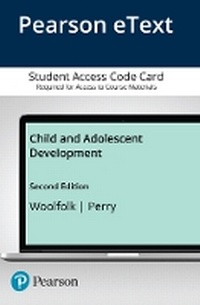
Child and Adolescent Development, Enhanced Pearson eText -- Access Card
2nd Edition
Published on 4. August 2014
Software
Product license key
696 pages
978-0-13-355148-8 (ISBN)
Description
Child and Adolescent Development provides reliable and practical guidelines to help you recognize typical and atypical development and to support the development of children and adolescents in positive ways.
Pearson eText is an easy-to-use digital textbook that you can purchase on your own or instructors can assign for their course. The mobile app lets you keep on learning, no matter where your day takes you -- even offline. You can also add highlights, bookmarks, and notes in your Pearson eText to study how you like.
NOTE: This ISBN is for the Pearson eText access card. Pearson eText is a fully digital delivery of Pearson content. Before purchasing, check that you have the correct ISBN. To register for and use Pearson eText, you may also need a course invite link, which your instructor will provide. Follow the instructions provided on the access card to learn more.
Pearson eText is an easy-to-use digital textbook that you can purchase on your own or instructors can assign for their course. The mobile app lets you keep on learning, no matter where your day takes you -- even offline. You can also add highlights, bookmarks, and notes in your Pearson eText to study how you like.
NOTE: This ISBN is for the Pearson eText access card. Pearson eText is a fully digital delivery of Pearson content. Before purchasing, check that you have the correct ISBN. To register for and use Pearson eText, you may also need a course invite link, which your instructor will provide. Follow the instructions provided on the access card to learn more.
Reviews / Votes
"[This text is] well written with a clear focus on the undergraduate audience, it covers a wide range of relevant topics that undergraduates are interested in, it makes human development theories accessible to undergraduates, and it integrates multiple cultural lenses ... I absolutely love it compared to the other options on the market in this field ... this book does a great job at allowing for adequate depth and breadth across many topics and theories." -- Michelle Tichy, University of Northern Iowa"The writing style is excellent! ...The Introductory "What would you do" scenarios are great for stimulating critical thinking at the beginning of the class discussions even for students who might have not had a chance to read the material in advance. These scenarios jump start the thinking process. Connecting with Children" sections provide helpful guidelines for teachers, families and other professionals. ...[The text includes] comprehensive coverage of up-to-date topics [and makes an] intentional effort to cover diversity and culture." -- Winnie Mucherah, Ball State University
"One of the reasons I changed to this text was the very clear and interesting writing style. I found myself absorbed in the information even though I have been using these types of texts for decades. The level is appropriate for the students. In addition, if a topic is introduced, it is presented in some depth ... there is a great deal of material on practical considerations related to parenting and teaching as well as to cross-cultural issues and diversity. Topics are covered thoroughly and related to one another. I also like the layout of the material in terms of how it appears on the page, ease of reading the print, etc." -- Sandra Twardosz, University of Tennessee, Knoxville
More details
Edition
2nd edition
Language
English
Place of publication
United States
Publishing group
Pearson Education (US)
Target group
College/higher education
Dimensions
Height: 100 mm
Width: 100 mm
Thickness: 100 mm
Weight
100 gr
ISBN-13
978-0-13-355148-8 (9780133551488)
Copyright in bibliographic data and cover images is held by Nielsen Book Services Limited or by the publishers or by their respective licensors: all rights reserved.
Schweitzer Classification
Persons
Anita Woolfolk Hoy is a Texas Longhorn -- all her degrees are from the University of Texas, Austin, the last one a Ph.D. After working as a psychologist in elementary and secondary schools in central Texas, she joined the faculty at Rutgers University as a professor of educational psychology at Rutgers University, and then moved to The Ohio State University in 1994. Today she is an Emeritus Professor of Educational Psychology and Philosophy at Ohio State. Anita's research focuses on students' and teachers' sense of efficacy. With students and colleagues, she has published over 80 books, chapters, and research articles. Anita has been the editor of Theory Into Practice, a journal that brings the best ideas from research to practicing educators and has served as Vice-President for Division K (Teaching & Teacher Education) of the American Educational Research Association and President of Division 15 (Educational Psychology) of the American Psychological Association.
Nancy Perry worked as a classroom and resource teacher in school districts in British Columbia, Canada, before obtaining her Ph.D. from the University of Michigan in 1996. Today she is Professor in the Department of Educational and Counseling Psychology, and Special Education at the University of British Columbia (UBC), where she teaches courses in the Human Development, Learning, and Culture and in the Special Education program. She is a recipient of UBC's Killam Teaching Prize and holds a UBC endowed Professorship for the Faculty of Education's Struggling Youth Initiative. Currently, she is a section editor for the Journal of Learning and Instruction and serves on the editorial boards of several additional journals She is a Past President of the Canadian Association for Educational Psychology and has served on the Executive Boards of the Canadian Association for Studies in Education and Division 15 (Educational Psychology) of the American Psychological Association.
Nancy Perry worked as a classroom and resource teacher in school districts in British Columbia, Canada, before obtaining her Ph.D. from the University of Michigan in 1996. Today she is Professor in the Department of Educational and Counseling Psychology, and Special Education at the University of British Columbia (UBC), where she teaches courses in the Human Development, Learning, and Culture and in the Special Education program. She is a recipient of UBC's Killam Teaching Prize and holds a UBC endowed Professorship for the Faculty of Education's Struggling Youth Initiative. Currently, she is a section editor for the Journal of Learning and Instruction and serves on the editorial boards of several additional journals She is a Past President of the Canadian Association for Educational Psychology and has served on the Executive Boards of the Canadian Association for Studies in Education and Division 15 (Educational Psychology) of the American Psychological Association.
Content
1. Introduction. Dimensions of Development
2. Theory and Research in Child Development
3. Genetics, Prenatal Development, and Birth
4. Infancy and Toddlerhood
5. Physical Development in Early Childhood
6. Cognitive Development in Early Childhood
7. Social Emotional Development in Early Childhood
8. Physical Development in Middle Childhood
9. Cognitive Development in Middle Childhood
10. Social Emotional Development in Middle Childhood
11. Physical Development in Adolescence
12. Cognitive Development in Adolescence
13. Social Emotional Development in Adolescence
2. Theory and Research in Child Development
3. Genetics, Prenatal Development, and Birth
4. Infancy and Toddlerhood
5. Physical Development in Early Childhood
6. Cognitive Development in Early Childhood
7. Social Emotional Development in Early Childhood
8. Physical Development in Middle Childhood
9. Cognitive Development in Middle Childhood
10. Social Emotional Development in Middle Childhood
11. Physical Development in Adolescence
12. Cognitive Development in Adolescence
13. Social Emotional Development in Adolescence