

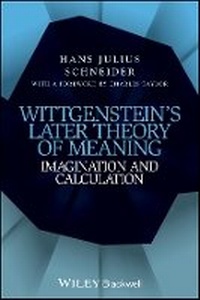
Wittgenstein's Later Theory of Meaning - Imagination and Calculation
Published on 21. January 2014
Software
Other digital
200 pages
978-1-118-64237-5 (ISBN)
Description
By exploring the significance of Wittgenstein's later texts relating to the philosophy of language, Wittgenstein's Later Theory of Meaning offers insights that will transform our understanding of the influential 20th-century philosopher. Explores the significance of Wittgenstein's later texts relating to the philosophy of language, and offers new insights that transform our understanding of the influential 20th-century philosopher Provides original interpretations of the systematic points about language in Wittgenstein's later writings that reveal his theory of meaning Engages in close readings of a variety of Wittgenstein's later texts to explore what the philosopher really had to say about 'kinds of words' and 'parts of speech' Frees Wittgenstein from his reputation as an unsystematic thinker with nothing to offer but 'therapy' for individual cases of philosophical confusion
More details
Language
English
Place of publication
New York
United States
Target group
College/higher education
Dimensions
Height: 254 mm
Width: 183 mm
Thickness: 58 mm
Weight
1643 gr
ISBN-13
978-1-118-64237-5 (9781118642375)
Copyright in bibliographic data and cover images is held by Nielsen Book Services Limited or by the publishers or by their respective licensors: all rights reserved.
Schweitzer Classification
Other editions
Additional editions
E-Book
01/2014
Wiley-Blackwell
€58.99
Available for download
E-Book
01/2014
Wiley-Blackwell
€58.99
Available for download
Person
Hans Julius Schneider is Professor Emeritus of Philosophy at the University of Potsdam. His publications include Phantasie und Kalkul (1992) and Religion (2008). He also served as a co-editor of the journal Deutsche Zeitschrift fur Philosophie for a number of years and has made several contributions to this publication as well as numerous other philosophical essay collections.
Content
Acknowledgments vii Foreword by Charles Taylor viii Introduction 1 1 The Fregean Perspective and Concomitant Expectations One Brings to Wittgenstein 7 2 How a Language Game Becomes Extended 21 3 Kinds of Expression 35 4 "Function" in Language Games and in Sentential Contexts 47 5 The Sound of a Sentence I: Singing from the Score 67 6 Projection: No Mere Mapping but a Creative Activity 83 7 The Sound of a Sentence II: Surface Grammar 98 8 Complexity 104 9 An Integration of Wittgenstein and Frege? 115 10 Dummett's Doubts and Frege's Concept of "Sense" 128 11 Wittgenstein on "Communicating Something" 137 12 "Grammatical Sense" and "Syntactic Metaphor": A Wittgensteinian Solution 152 13 A "Theory of Meaning" -- In What Sense? 166 Index 180