

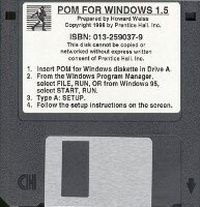
POM for Windows
Published on 8. December 1996
Software
CD-ROM
300 pages
978-0-13-259037-2 (ISBN)
Description
POM for Windows is a user friendly software package available for production and operations management (POM). It is a package which has been designed to help students to better learn and understand production/operations management. The software can be used to either solve problems or to check answers which have been derived by hand. POM for Windows contains a large number of models and most of the homework problems in most POM books can be solved or approached using POM for Windows.
More details
Language
English
Place of publication
United States
Publishing group
Pearson Education (US)
Target group
Professional and scholarly
Dimensions
Height: 160 mm
Width: 150 mm
Thickness: 1 mm
Weight
1000 gr
ISBN-13
978-0-13-259037-2 (9780132590372)
Copyright in bibliographic data and cover images is held by Nielsen Book Services Limited or by the publishers or by their respective licensors: all rights reserved.
Schweitzer Classification
Other editions
New editions
Howard J. Weiss
POM for Windows, Version 2
Software
11/1999
Pearson
€21.08
Article is exhausted; no reprint
Content
1. Break-even/Cost-Volume Analysis. Break-even Analysis. Cost/Volume Analysis. 2. Decision Analysis. Decision Tables. Decision Trees. 3. Forecasting. Time Series Analysis. Simple and Multiple Regression. 4. Location. Qualitative Location (Factor Weighting) 1 Dimensional Location. 2 Dimensional Location (Center of Gravity). 5. Transportation. 6. Assembly Line Balancing. 7. Operations Layout. 8. Waiting Lines. M/M/1. M/d/1. M/Ek/1. M/G/1. M/M/s. M/M/1 with Finite Waiting Line. M/M/s with Finite Waiting Line. M/M/1 with Finite Population. M/M/s with Finite Population. 9. Reliability. Learning Curves. Find Time Given Learning Coefficient. Find Coefficient Given Times. 10. Aggregate Planning. 11. Inventory EOQ. POQ. EOQ with Shortages. POQ with Shortages. Quantity Discount. ABC Analysis. 12. Materials Requirements Planning. 13. Lot Sizing. 14. Job Shop Scheduling. One Machine Scheduling. Two Machine Scheduling. 15. Linear Programming. 16. Project Management. 1 Time Estimate. 3 Time Estimates. Crashing. Budgeting. 17. Assignment. 18. Quality Control. Acceptance Sampling. Attributes Sampling. OC Curves. P Bar Charts. X Bar and Range Charts. C Charts. Simulation.