

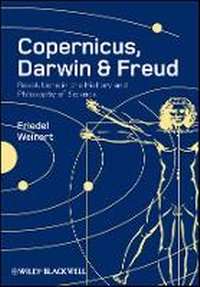
Copernicus, Darwin, Freud - Revolutions in the History and Philosophy of Science
Published on 10. March 2009
Software
Other digital
296 pages
978-1-4443-0493-0 (ISBN)
Description
Using Copernicanism, Darwinism, and Freudianism as examples of scientific traditions, Copernicus, Darwin and Freud takes a philosophical look at these three revolutions in thought to illustrate the connections between science and philosophy. Shows how these revolutions in thought lead to philosophical consequences Provides extended case studies of Copernicanism, Darwinism, and Freudianism Integrates the history of science and the philosophy of science like no other text Covers both the philosophy of natural and social science in one volume
Reviews / Votes
"Whether used as a textbook or as a review of issues concerning scientific revolutions and theory change in their historical context, Copernicus, Darwin, and Freud may be strongly recommended." (The Journal of the International Society for the History of Philosophy of Science, 2011) "Those seeking a more conventional approach to the history and philosophy of science may well find Weinert's book informative...there is much to be learned from Weinert's comparison of Copernicus, Darwin, and Freud." ( Science & Education , January 2011)"Weinert has provided an informative textbook that is written in a very accessible style. His examples invite the student to apply the philosophical concepts that are discussed." ( Metapsychology , May 2009)More details
Language
English
Place of publication
Chicester
United Kingdom
Publishing group
John Wiley and Sons Ltd
Target group
Professional and scholarly
Dimensions
Height: 258 mm
Width: 184 mm
Thickness: 22 mm
Weight
704 gr
ISBN-13
978-1-4443-0493-0 (9781444304930)
Copyright in bibliographic data and cover images is held by Nielsen Book Services Limited or by the publishers or by their respective licensors: all rights reserved.
Schweitzer Classification
Other editions
Additional editions
E-Book
03/2009
Wiley-Blackwell
€29.99
Available for download
Person
Friedel Weinert is Professor of Philosophy at Bradford University and a former Visiting Research Fellow at Harvard University and Visiting Fellow at the Centre for the Philosophy of Natural and Social Science at the LSE in London. He holds a PhD in Philosophy, a BA in Sociology, and a BSc in Physics. Dr. Weinert is the editor of Laws of Nature (1995), the author of The Scientist as Philosopher (2004) and chief editor of the forthcoming Compendium of Quantum Physics: Concepts, Experiments, History and Philosophy .
Content
Preface. Acknowledgments. Introduction. I. Nicolaus Copernicus: The Loss of Centrality. 1. Ptolemy and Copernicus. 2. A Clash of Two Worldviews. 3. The Heliocentric Worldview. 4. Copernicus was not a Scientific Revolutionary. 5. The Transition to Newton. 6. Some Philosophical Lessons. 7. Copernicus and Scientific Revolutions. 8. The Anthropic Principle: A Reversal of the Copernican Turn?. Reading List. Essay Questions. II. Charles Darwin: The Loss of Rational Design . 1. Darwin and Copernicus. 2. Views of Organic Life. 3. Fossil Discoveries. 4. Darwin's Revolution. 5. Philosophical Matters. 6. A Question of Method. Reading List. Essay Questions. III. Sigmund Freud: The Loss of Transparency . 1. Copernicus, Darwin and Freud. 2. Some Views of Humankind. 3. Scientism and the Freudian Model of Personality. 4. The Social Sciences beyond Freud. 5. Evolution and the Social Sciences. 6. Freud and Revolutions in Thought. Reading List. Essay Questions. Name Index. Subject Index